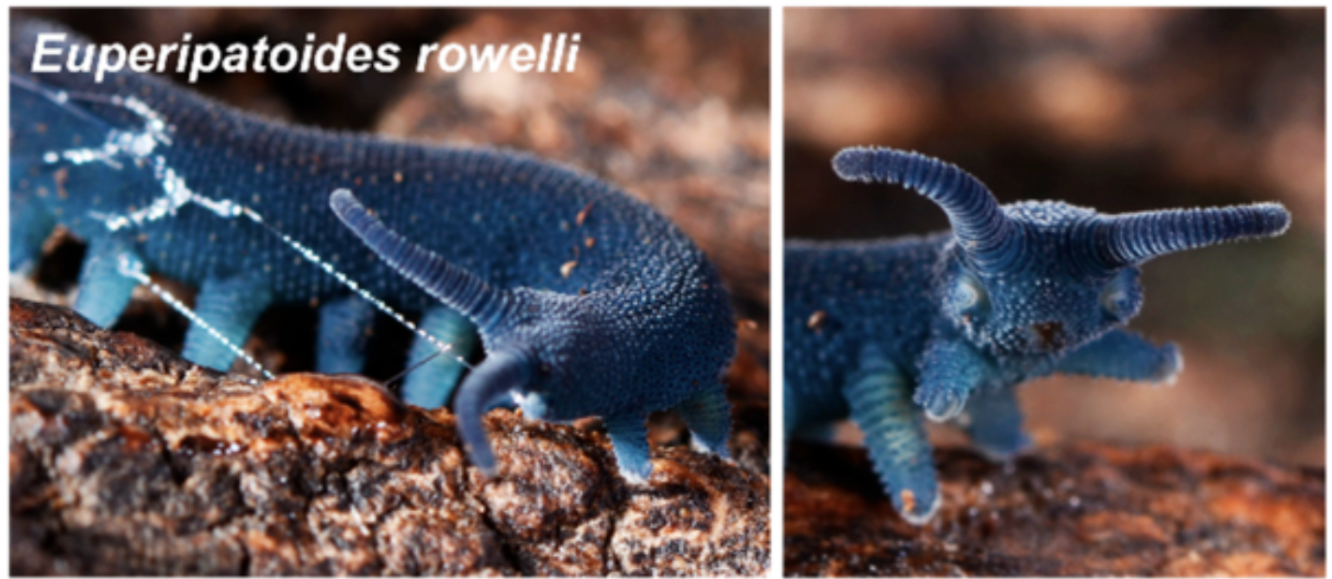
Onychophora (velvet worms) are carnivorous invertebrates that possess a unique weapon. Through their specialized appendages, they excrete a sticky, hardening slime to prey on other invertebrates and to defend themselves from predators (Baer and Mayer, 2012). Due to its remarkable properties, the slime has great potential in designing sustainable plastics and glues (Poulhazan, et al., 2023).
These fascinating creatures make use of their distinct feeding and hunting behaviours on invertebrates such as crickets, spiders, and woodlice (Baer and Mayer, 2012). Velvet worms have specialized cephalic (head) appendages including antennae, jaws, and oral papillae, which they utilize for these behaviours (Figure 1) (Mayer, et al., 2015). Typically, potential prey or predators are first located using sensory antennae (Figure 1c). The oral papillae (Figure 1a,b) then extend from their folded shape to their full-length, in order to excrete the slime (Concha, et al., 2015). The slime itself is produced and stored in large glands with narrow ducts that lead to the oral papillae (Figure 1a). Slime projectiles then act by hardening to entangle and immobilize the prey (Mayer, et al., 2015). Once immobilized, velvet worms puncture the cuticle of their prey using internalized jaws (Figure 1c) and inject it with digestive saliva.

The velvet worm slime is unique due to its property of hardening once expelled, exposed to air, and agitated (Baer, et al., 2019). A mechanical stimulus, such as the movement of trapped prey, causes the slime to self-assemble from globules into fibres (Corrales-Ureña et al., 2022). This transition occurs within ten seconds to one minute of mechanical stimulus. The stiffness of the produced fibres is similar to thermoplastics, such as nylon (Baer, et al., 2019).

It was hypothesized that the ability of the slime to undergo liquid-solid transition comes from its phosphate content (Baer, et al., 2019). Recently, the chemical composition of velvet worm slime has been elucidated through spectroscopic techniques (Poulhazan, et al., 2023); specifically, solution and solid-state 31P nuclear magnetic resonance (NMR) were used. It was shown that slime proteins consist of phosphonated glycans, which are a rare post-translational modification.

The results from Poulhazan et al. (2023) provide a key insight into the molecular composition of velvet worm slime, which may be further investigated to help design sustainable materials. Based on inspiration from velvet worms, the role and properties of phosphonate-rich molecules can open doors to drastically improve polymers and adhesives.
References
Baer, A. and Mayer, G., 2012. Comparative anatomy of slime glands in onychophora (velvet worms). Journal of Morphology, 273(10), pp.1079–1088. https://doi.org/10.1002/jmor.20044.
Baer, A., Schmidt, S., Mayer, G. and Harrington, M.J., 2019. Fibers on the fly: Multiscale mechanisms of fiber formation in the capture slime of velvet worms. Integrative and Comparative Biology, 59(6), pp.1690–1699. https://doi.org/10.1093/icb/icz048.
Concha, A., Mellado, P., Morera-Brenes, B., Sampaio Costa, C., Mahadevan, L. and Monge-Nájera, J., 2015. Oscillation of the velvet worm slime jet by passive hydrodynamic instability. Nature Communications, 6(1), p.6292. https://doi.org/10.1038/ncomms7292.
Corrales-Ureña, Y.R., Schwab, F., Ochoa-Martínez, E., Benavides-Acevedo, M., Vega-Baudrit, J., Pereira, R., Rischka, K., Noeske, P.-L.M., Gogos, A., Vanhecke, D., Rothen-Rutishauser, B. and Petri-Fink, A., 2022. Encapsulated salts in velvet worm slime drive its hardening. Scientific Reports, 12(1), p.19261. https://doi.org/10.1038/s41598-022-23523-z.
Poulhazan, A., Baer, A., Daliaho, G., Mentink-Vigier, F., Arnold, A.A., Browne, D.C., Hering, L., Archer-Hartmann, S., Pepi, L.E., Azadi, P., Schmidt, S., Mayer, G., Marcotte, I. and Harrington, M.J., 2023. Peculiar phosphonate modifications of velvet worm slime revealed by advanced nuclear magnetic resonance and mass spectrometry. Journal of the American Chemical Society, 145(38), pp.20749–20754. https://doi.org/10.1021/jacs.3c06798.