Can you imagine the development of a tiny particle that can be an aspect of furthering research and knowledge in a magnitude of different scientific disciplines? As crazy as this seems, this phenomenon is made true through the development of quantum dots (QDs). These are semiconductor particles that range in size from just a few to tens of nanometres across, and their extremely small nature means they must be described using quantum physics (Agarwal, Rai and Mondal, 2023).
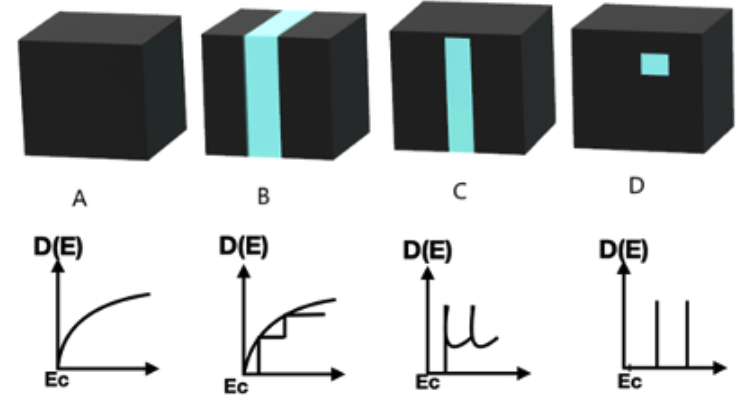
Mathematically, a function is confined by the variables we give it. This means that if variables are limited, the dimensions the function can move in are limited. By confining the electron movement in all spatial directions, they are confined in a space of zero dimensions and considered to have quantum confinement (Agarwal, Rai and Mondal, 2023). This quantum confinement affects the electronic density of states (DOS), which is the number of different states that an electron can occupy at a given energy level (Marchiori, 2017). As the DOS becomes discrete in confined electron regions, the energy states become quantized (Figure 1).

The importance of quantum confinement is that the quantized energy levels mean we can adjust the band gap, which is the difference in energy between the valence electrons band, and the lowest level of the conduction band – electrons which escape beyond the outer valence (Perdew et al., 2017). As you increase this gap, the QD size decreases, which is an extremely useful tool for manipulating optical and electronic properties precisely (Agarwal, Rai and Mondal, 2023). The wavelength of the light emitted is proportional to the size of the QD, meaning that by changing the size of the QD during synthesis, you will get different colours (Abdellatif et al., 2022).
The coloured fluorescent light that QDs emit has a long lifetime, broad absorption spectrum, and narrow emission spectrum, allowing for great efficiency and accuracy (Keane, Ruiz-Garcia and Sadda, 2013). By designing a QD to bind to a specific molecule, they can become labellers for targeted imaging (Medscience, 2023). Their sharp absorption and emission spectrum can improve the current accuracy of diagnostics and allow for early detection of diseases such as neurodegenerative disorders and cancer tumours (Figure 2).

The magnetic properties of QDs can also be harnessed for easy and predictable manipulation, making them a great option for MRIs (Medscience, 2023). By administering a patient QDs before an MRI scan, the images will have higher contrast, allowing for easier reading. Because of their high accuracy, smaller concentrations need to be given to patients, making them a better option than other agents because it lowers the risk of side effects. Although there are many benefits, the metal-based composition means they are toxic to organisms. They also tend to bioaccumulate because of their small size and high surface area-to-volume ratio, which allows for them to easily react with other molecules in the body (Agarwal, Rai and Mondal, 2023).
It is hard to understand something so small, but this has not stopped curiosity for QDs. As we continue to learn more about QDs and their unique optical and magnetic properties, we can further apply this useful technology to every aspect of science. Although their applications are vast, they do not come without the challenges such as toxicity and bioaccumulation, signifying the need for further research in an emerging field.
References
Abdellatif, A.A.H., Younis, M.A., Alsharidah, M., Al Rugaie, O. and Tawfeek, H.M., 2022. Biomedical Applications of Quantum Dots: Overview, Challenges, and Clinical Potential. International Journal of Nanomedicine, 17, pp.1951–1970. https://doi.org/10.2147/IJN.S357980.
Agarwal, K., Rai, H. and Mondal, S., 2023. Quantum dots: an overview of synthesis, properties, and applications. Materials Research Express, 10(6), p.062001. https://doi.org/10.1088/2053-1591/acda17.
Gao, X., Cui, Y., Levenson, R.M., Chung, L.W.K. and Nie, S., 2004. In vivo cancer targeting and imaging with semiconductor quantum dots. Nature Biotechnology, 22(8), pp.969–976. https://doi.org/10.1038/nbt994.
Keane, P.A., Ruiz-Garcia, H. and Sadda, S.R., 2013. Chapter 5 – Advanced Imaging Technologies. In: S.J. Ryan, S.R. Sadda, D.R. Hinton, A.P. Schachat, S.R. Sadda, C.P. Wilkinson, P. Wiedemann and A.P. Schachat, eds. Retina (Fifth Edition). [online] London: W.B. Saunders. pp.133–150. https://doi.org/10.1016/B978-1-4557-0737-9.00005-9.
Marchiori, R., 2017. 8 – Mathematical Fundamentals of Nanotechnology. In: A.L. Da Róz, M. Ferreira, F. de Lima Leite and O.N. Oliveira, eds. Nanostructures. [online] William Andrew Publishing. pp.209–232. https://doi.org/10.1016/B978-0-323-49782-4.00008-5.
Medscience, O., 2023. Nobel Prize Quantum Dots and their Applications in Medical Imaging. Open Medscience. Available at: <https://openmedscience.com/nobel-prize-quantum-dots-and-their-applications-in-medical-imaging/> [Accessed 6 March 2024].
Perdew, J.P., Yang, W., Burke, K., Yang, Z., Gross, E.K.U., Scheffler, M., Scuseria, G.E., Henderson, T.M., Zhang, I.Y., Ruzsinszky, A., Peng, H., Sun, J., Trushin, E. and Görling, A., 2017. Understanding band gaps of solids in generalized Kohn-Sham theory. Proceedings of the National Academy of Sciences of the United States of America, 114(11), pp.2801–2806. https://doi.org/10.1073/pnas.1621352114.