Many social interactions today occur at entertainment events like concerts, clubs, and festivals, where amplified music and speech are common. These events may be fun and easily accessible; however, they may be linked to sound-induced hearing loss. Noise-induced hearing loss (NIHL) is the most common workplace disorder and the second most frequently reported occupational injury (Taneja 2014). However, it also affects people attending loud recreational events. If you’ve ever gone to a concert or club and noticed ringing in your ears afterward, the same mechanism causing it can lead to permanent hearing damage.
The ear is a complex organ composed of an outer, middle, and inner ear (Figure 1). The outer ear collects sound waves and passes them to the middle ear, which transforms them into mechanical motion that is then received by the inner ear, converting vibrations into neural signals. Within the fluid-filled inner ear, the snail-shaped structure called the cochlea is responsible for the conversion of vibrations to neural signals to the brain through structures called hair cells (Dougherty et al 2023).
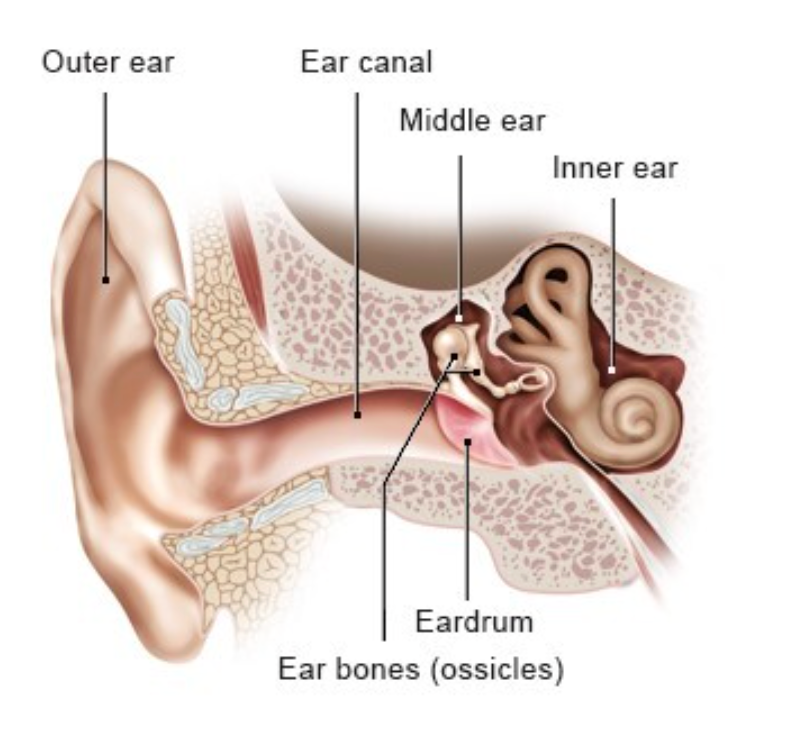
Figure 1. A simple diagram of the anatomy of the ear. The outer ear, the most visible component, shows its funnelling shape towards the eardrum/tympanic membrane. The small bones that create the vibrations are seen attached to the eardrum and the inner ear, showing directly how sound waves are converted to vibrations and then neural signals. The production of the neural signals has an intricate cellular mechanism for ideal function (Dougherty et al 2023).
Temporary hearing loss, also known as temporary threshold shift, occurs when sounds above ~85 decibels, meaning the threshold required action potentials to occur within the haircells shifts, and a larger stimulus is required for an equivalent response (Taneja 2014). When this exposure is consistent, or eight hours a day for a week, the resulting impacts can become permanent, where a larger stimulus is always required. As one can imagine, the loss of hearing can greatly impact someone’s way of living as it changes daily routines and communication efficiency, along with casual enjoyment of music. Understanding the potential life-long effects of high-decibel noises is important to encourage the prevention of potential damage through ear protection.
In recent years, social media has helped increase awareness of hearing protection, encouraging casual use of devices like earplugs at concerts, clubs, and festivals. Sound levels at these events can typically be around 100-110 decibels, posing a risk to long-term hearing. This rise in awareness is notable as previously, the general willingness to use ear protection by attendees at these social events was low (Ramakers et al. 2016), and this new encouragement could be significant in the reduction of NIHL. From Ramakers et al 2016, it has been found that the use of earplugs at recreational events resulted in lower threshold differences and fewer temporary threshold shifts.
Among some of the most popular ear protection, loop earplugs are commonly spread across not only social media, but they are also frequently worn by young adults. The typical criteria determining the likelihood of ear protection being worn are comfort, usability, and social acceptance. If the earplugs themselves are socially stigmatized or uncomfortable, those who would benefit from ear protection are less likely to wear them (Fauzan et al. 2013). Understanding these criteria, the visual design of the loop earplugs makes them more likely to be worn by younger adults due to their jewelry-like appearance (Figure 2).
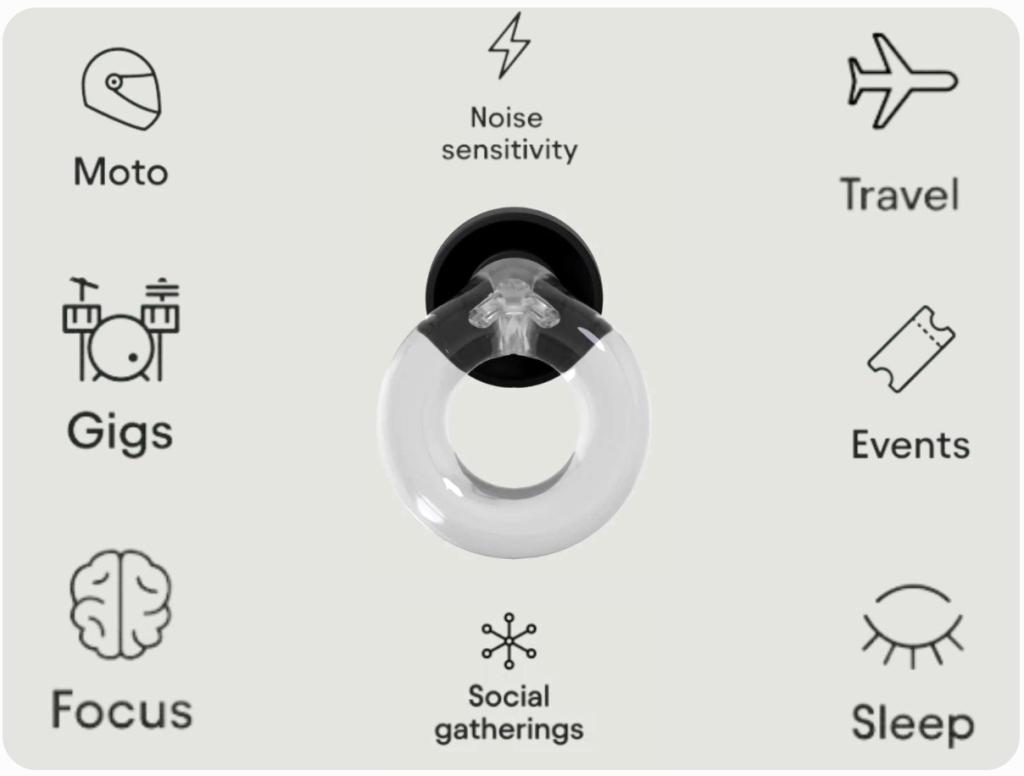
Figure 2. The visual design of the loop earplugs, along with the common events they are used in. The clear acoustic channel comes in several colours, allowing customers to purchase the style they desire the most, encouraging the total use of the product. The simplified and subtle style decreases the stigmatized visual appearance of hearing protection throughout recreational events, decreasing temporary threshold shifts (Sarow 2026).
Overall, the modern and simplistic styles of earplugs today encourage the use of regular ear protection during frequent entertainment events with auditory risks. The increase in products that are designed to work with common sociological concepts can decrease the population’s frequency of impacted hearing.
References
Dougherty, Joseph M., Michael Carney, Marc H. Hohman, and Prabhu D. Emmady. “In Brief: How Does the Ear Work?” In InformedHealth.Org [Internet]. Institute for Quality and Efficiency in Health Care (IQWiG), 2023. https://www.ncbi.nlm.nih.gov/books/NBK279191/.
Fauzan, Nur Syafiqah, Ezrin Hani Sukadarin, Mirta Widia, Irianto Irianto, and Ihwan Ghazali. “A Systematic Literature Review of the Factors Influencing Hearing Protection Device Usage among Industrial Workers.” International Journal of Environmental Research and Public Health 20, no. 4 (2023): 2934. https://doi.org/10.3390/ijerph20042934.
Ramakers, Geerte G. J., Véronique J. C. Kraaijenga, Guido Cattani, Gijsbert A. van Zanten, and Wilko Grolman. “Effectiveness of Earplugs in Preventing Recreational Noise–Induced Hearing Loss: A Randomized Clinical Trial.” JAMA Otolaryngology–Head & Neck Surgery 142, no. 6 (2016): 551–58. https://doi.org/10.1001/jamaoto.2016.0225.
Sarow, Amy. “Loop Earplugs Review 2026: An Audiologist’s Verdict.” January 28, 2026. https://www.soundly.com/blog/loop-earplugs-audiologist-review.
Taneja, Mahendra K. “Noise-Induced Hearing Loss.” Indian Journal of Otology 20, no. 4 (2014): 151. https://doi.org/10.4103/0971-7749.146928.


Leave a Reply
You must be logged in to post a comment.