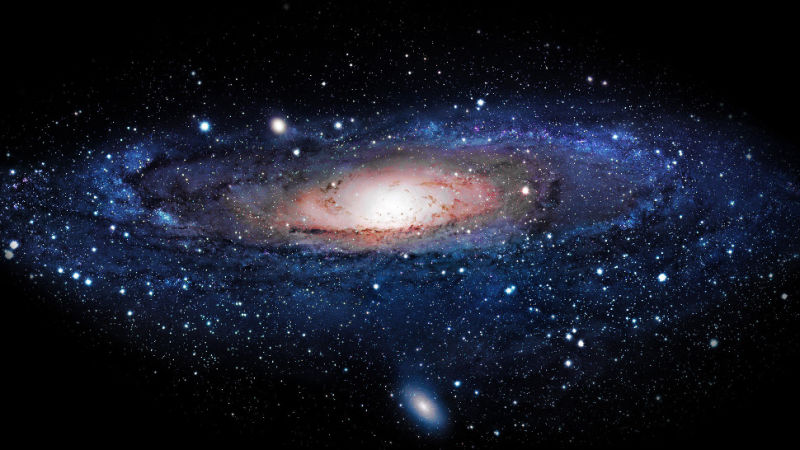
For thousands of years, mankind has pointed their heads heavenward and has pondered the daunting question – “Are we alone?”
One afternoon in the 1950s, amid a lunchtime meet with colleagues, Enrico Fermi (Fig. 1) posed a question that would baffle scientists and pique the interest of the general public for years to come. It suddenly dawned on him how young our planet really was in comparison to the age of the Galaxy, which is roughly 13 billion light years old. Given this fact, there should have been more than enough time in Earth’s past for the planet to have been visited by extra-terrestrial beings, or to at least have been contacted by them.

In November 2013, a study based on data collected from the Kepler Space Telescope suggested that one in five sun-like stars are host to an orbiting Earth-sized planet that is an adequate distance away for the presence of water to be possible (Howell, 2014). However, up until today, there still has been no concrete evidence to support the presence of alien life forms or contact. Thus, the question at the heart of the Fermi Paradox stands: “Where is everybody?”
“This, then, is the paradox: all our logic, all our anti-isocentrism, assures us that we are not unique—that they must be there. And yet we do not see them!” – David Viewing, English engineer (1975)
In the years following Fermi’s puzzling query, countless propositions from scientists all over the world have emerged – some to address the matter, some to propose new solutions to the paradox, and some to completely refute the idea of intelligent life elsewhere.
In his book If the Universe is Teeming with Aliens, Where is Everybody? (Copernicus, 2002), Stephen Webb divides all solutions ever brought forth in regards to the Fermi Paradox into three sections – “They are here”, “They exist, but have not yet communicated”, and “They do not exist”.
Some researchers suggest that extraterrestrial powers may already be present, and that the reason for their apparent absence in communications is because we, and our devices of detection, are comparatively too primitive to pick up on them. Perhaps any evidence of alien presence is so beyond human understanding that we simply do not recognize it – much like how an ant colony being researched would not be able to understand that it is being studied and analyzed by human beings (Watson, 2007). Another thought is that these extraterrestrial beings are on such a level of intelligence that they may observe us without being observable themselves. This idea that the human race is constantly being watched by beings of higher understanding is called the “Zoo Hypothesis” (SETI, 2016).
Another solution created in response to the Fermi Paradox includes Robin Hanson’s “Great Filter” theory (Fig. 2), which suggests the existence of a hypothetical barrier. All or nearly all attempts at life reach this barrier, but it is extremely unlikely or impossible for them to surpass it (Foley, 2016). It is in our hopes, therefore, that we are one of the extremely lucky few planets to have been able to get beyond this barrier (and hopefully to not have it be ahead of us!). After all, it took at least 3.5 billion years for intelligent life to evolve. According to Princeton University researchers David Spiegel and Edwin Turner, this interval indicates to us that it requires an incredible amount of time and luck for multi-cellular organisms to develop and to evolve to the level of intelligence that we have today.

And still, there are those who look at mankind’s utter lack of concrete evidence, and deduce that we may quite possibly be alone in this galaxy. Though it may seem like a lonely and harrowing thought, we must also keep in mind that nobody really knows the truth behind Fermi’s Paradox. Until we find out, however, humankind will continue to imagine the likes of our extraterrestrial neighbours, to search a seemingly endless cosmos with awe and wonder, and to await the day when our calls will finally be answered.
References
Foley, J., 2016. Examining the Fermi Paradox. [online] Available at <https://omni.media/examining-the-fermi-paradox> [Accessed 20 September 2016]
Howell, E., 2014. What is the Fermi Paradox? [online] Available at < http://www.space.com/25325-fermi-paradox.html> [Accessed 17 September 2016]
Maunder, M., 2007. Lights in the Sky. London: Springer.
SETI Institute, 2016. Fermi Paradox. [online] Available at: < http://www.seti.org/seti-institute/project/details/fermi-paradox. [Accessed 17 September 2016]
Shuch, P. H., ed., 2011. Searching for Extraterrestrial Intelligence. Berlin: Springer.
Webb, S., 2015. If the Universe is Teeming with Aliens…Where are they?. 2nd ed. Cham: Springer.