Over 70,000 tree species exist worldwide, yet each species exhibits distinct traits and fulfils a unique ecological niche (Gatti, et al., 2022). Trees are highly sophisticated and receptive to environmental stimuli, altering their growth patterns in response to the presence of sunlight, water, and other organisms (Freschet, et al., 2013). Trees grow branches out from their trunk at an angle that maximizes sunlight interception and minimizes competition with neighbouring trees. In most tree species, the tip of a branch grows upward at a steeper angle than the rest of the branch (Hollender and Dardick, 2015). This growth pattern provides the leaves at the end of a branch with maximum access to sunlight and does not require a significant resource investment into structural supports, as the tip is the lightest part of the branch. However, in trees with a weeping growth habit, branches initially begin growing upward, but as growth continues, the branches bend downwards (Figure 1).

Figure 1: Upright (a) and weeping (b) branch diagrams. Most trees follow an upright growth pattern, while the branches of weeping trees grow downwards as they elongate (Sugano, et al., 2004).
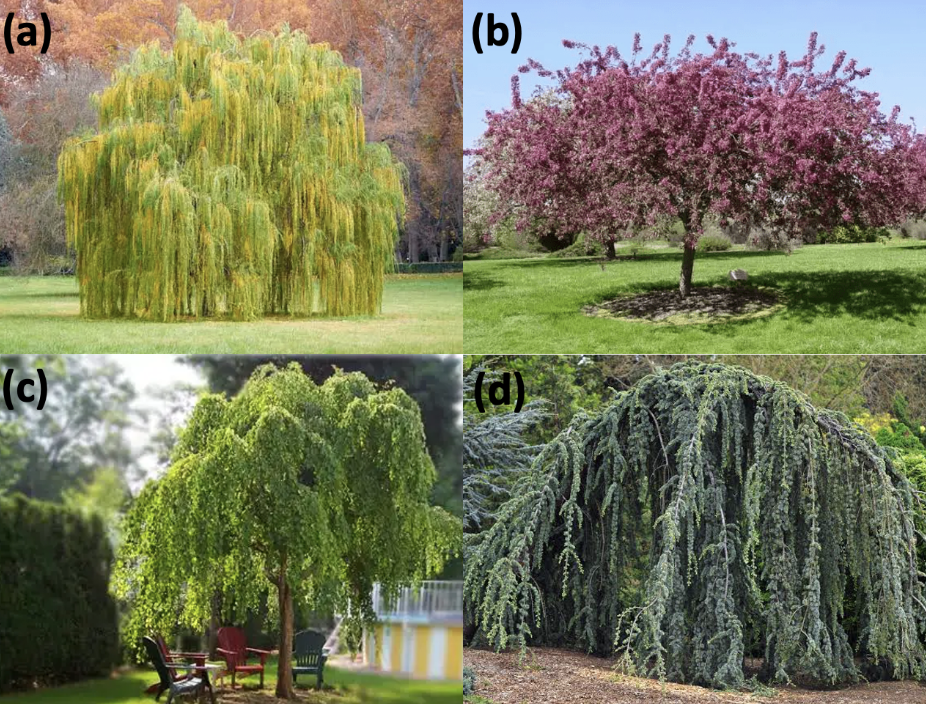
Hormones, such as auxin and gibberellin, are responsible for directing a newly germinated seed upward, determining the angle at which a tree’s branches should emerge off the main trunk, and regulating the thickness of each part of a tree’s branch (Liu et al., 2017; Sugano et al., 2004). Mutations in the genes that encode growth-regulating hormones result in trees exhibiting a weeping phenotype (Hollender and Dardick, 2015; Li, et al., 2021). Over 500 weeping tree cultivars have been documented, including varieties of willow, peach, apple, cherry, hemlock, and maple (Hollender and Dardick, 2015; Figure 2).

Figure 2: Weeping willow (a), weeping crabapple (b), weeping katsura (c), and weeping cedar (d) are just some of the over 500 documented weeping tree varieties (American Gardener, 2022).
As trees and other organisms reproduce, genetic mutations often occur. Organisms with deleterious mutations are less likely to survive long enough to reproduce. If these individuals do not reproduce, their deleterious genes will not be passed on to the next generation (Pausch, et al., 2015). In contrast, if a random mutation results in a favourable phenotype, the mutated individual will be more likely to survive and reproduce, passing their advantageous genes to the next generation (Behrman and Kirkpatrick, 2011). Weeping did not give trees a competitive advantage over their non-weeping counterparts until humans began to have an outsized impact on the survival of other organisms.
Weeping growth patterns result in a tree having less access to sunlight, meaning weeping trees photosynthesize slower than their non-weeping counterparts (Hollender and Dardick, 2015). In a human-free world, this would result in weeping trees being outcompeted by conventional trees and the genetic mutations that code for a weeping phenotype would be eliminated. However, weeping growth does provide trees with one significant advantage in the eyes of humans: beauty. Weeping willows are native to China but were traded throughout Asia and Europe on the Silk Road for their ornamental value (Barnes, 2004). Weeping trees are highly valued by gardeners and landscapers for their unique phenotype, making cultivation by humans the primary mechanism of weeping tree reproduction (Li, et al., 2002).
Trees are some of Earth’s most unique organisms. Weeping growth provides another example of the diverse array of traits exhibited by trees. However, no organism lives in isolation. Humans impact the living things around us in myriad ways, yet human impacts on the natural world do not have to be negative. Weeping trees provide a case study on how humans can form a mutually beneficial relationship with another organism.
References:
American Gardener, 2022. 24 Types of Weeping Trees. American Gardener. [image online] Available at: <https://americangardener.net/types-of-weeping-trees/> [Accessed 21 September 2023].
Barnes, B.V., 2004. Michigan trees : a guide to the trees of the Great Lakes Region. [online] Ann Arbor : University of Michigan Press. Available at: <http://archive.org/details/michigantreesgui0000barn> [Accessed 21 September 2023].
Behrman, K.D. and Kirkpatrick, M., 2011. Species range expansion by beneficial mutations. Journal of Evolutionary Biology, [online] 24(3), pp.665–675. https://doi.org/10.1111/j.1420-9101.2010.02195.x.
Freschet, G.T., Bellingham, P.J., Lyver, P.O., Bonner, K.I. and Wardle, D.A., 2013. Plasticity in above- and belowground resource acquisition traits in response to single and multiple environmental factors in three tree species. Ecology and Evolution, [online] 3(4), pp.1065–1078. https://doi.org/10.1002/ece3.520.
Gatti, R., Reich, P.B., Gamarra, J.G.P., Crowther, T., Hui, C., Morera, A., Bastin, J.-F., de-Miguel, S., Nabuurs, G.-J., Svenning, J.-C., Serra-Diaz, J.M., Merow, C., Enquist, B., Kamenetsky, M., Lee, J., Zhu, J., Fang, J., Jacobs, D.F., Pijanowski, B., Banerjee, A., Giaquinto, R.A., Alberti, G., Almeyda Zambrano, A.M., Alvarez-Davila, E., Araujo-Murakami, A., Avitabile, V., Aymard, G.A., Balazy, R., Baraloto, C., Barroso, J.G., Bastian, M.L., Birnbaum, P., Bitariho, R., Bogaert, J., Bongers, F., Bouriaud, O., Brancalion, P.H.S., Brearley, F.Q., Broadbent, E.N., Bussotti, F., Castro da Silva, W., César, R.G., Češljar, G., Chama Moscoso, V., Chen, H.Y.H., Cienciala, E., Clark, C.J., Coomes, D.A., Dayanandan, S., Decuyper, M., Dee, L.E., Del Aguila Pasquel, J., Derroire, G., Djuikouo, M.N.K., Van Do, T., Dolezal, J., Đorđević, I.Đ., Engel, J., Fayle, T.M., Feldpausch, T.R., Fridman, J.K., Harris, D.J., Hemp, A., Hengeveld, G., Herault, B., Herold, M., Ibanez, T., Jagodzinski, A.M., Jaroszewicz, B., Jeffery, K.J., Johannsen, V.K., Jucker, T., Kangur, A., Karminov, V.N., Kartawinata, K., Kennard, D.K., Kepfer-Rojas, S., Keppel, G., Khan, M.L., Khare, P.K., Kileen, T.J., Kim, H.S., Korjus, H., Kumar, A., Kumar, A., Laarmann, D., Labrière, N., Lang, M., Lewis, S.L., Lukina, N., Maitner, B.S., Malhi, Y., Marshall, A.R., Martynenko, O.V., Monteagudo Mendoza, A.L., Ontikov, P.V., Ortiz-Malavasi, E., Pallqui Camacho, N.C., Paquette, A., Park, M., Parthasarathy, N., Peri, P.L., Petronelli, P., Pfautsch, S., Phillips, O.L., Picard, N., Piotto, D., Poorter, L., Poulsen, J.R., Pretzsch, H., Ramírez-Angulo, H., Restrepo Correa, Z., Rodeghiero, M., Rojas Gonzáles, R.D.P., Rolim, S.G., Rovero, F., Rutishauser, E., Saikia, P., Salas-Eljatib, C., Schepaschenko, D., Scherer-Lorenzen, M., Šebeň, V., Silveira, M., Slik, F., Sonké, B., Souza, A.F., Stereńczak, K.J., Svoboda, M., Taedoumg, H., Tchebakova, N., Terborgh, J., Tikhonova, E., Torres-Lezama, A., van der Plas, F., Vásquez, R., Viana, H., Vibrans, A.C., Vilanova, E., Vos, V.A., Wang, H.-F., Westerlund, B., White, L.J.T., Wiser, S.K., Zawiła-Niedźwiecki, T., Zemagho, L., Zhu, Z.-X., Zo-Bi, I.C. and Liang, J., 2022. The number of tree species on Earth. Proceedings of the National Academy of Sciences, [online] 119(6), p.e2115329119. https://doi.org/10.1073/pnas.2115329119.
Hollender, C.A. and Dardick, C., 2015. Molecular basis of angiosperm tree architecture. New Phytologist, [online] 206(2), pp.541–556. https://doi.org/10.1111/nph.13204.
Li, J., Dosmann, M.S., Tredici, P.D. and Andrews, S., 2002. Systematic relationship of weeping katsura based on nuclear ribosomal DNA sequences. HortScience, [online] 37(3), pp.595–598. https://doi.org/10.21273/HORTSCI.37.3.595.
Li, L., Zhang, Y., Zheng, T., Zhuo, X., Li, P., Qiu, L., Liu, W., Wang, J., Cheng, T. and Zhang, Q., 2021. Comparative gene expression analysis reveals that multiple mechanisms regulate the weeping trait in Prunus mume. Scientific Reports, [online] 11(1), p.2675. https://doi.org/10.1038/s41598-021-81892-3.
Liu, J., Zeng, Y., Yan, P., He, C. and Zhang, J., 2017. Transcriptional and hormonal regulation of weeping trait in Salix matsudana. Genes, [online] 8(12), p.359. https://doi.org/10.3390/genes8120359.
Pausch, H., Schwarzenbacher, H., Burgstaller, J., Flisikowski, K., Wurmser, C., Jansen, S., Jung, S., Schnieke, A., Wittek, T. and Fries, R., 2015. Homozygous haplotype deficiency reveals deleterious mutations compromising reproductive and rearing success in cattle. BMC Genomics, [online] 16(1), p.312. https://doi.org/10.1186/s12864-015-1483-7.
Sugano, M., Nakagawa, Y., Nyunoya, H. and Nakamura, T., 2004. Expression of gibberellin 3β-hydroxylase gene in a gravi-response mutant, weeping Japanese flowering cherry. Biological Sciences in Space, 18(4), pp.261–266. https://doi.org/10.2187/bss.18.261.