Transport networks are vital to the infrastructure of our current industrial society, enabling the efficient travel of resources, people, and data. In spite of their significance, the conception of these networks lacks a guiding methodology, with a majority being limited by the most pressing concerns at the time of their construction. Previously, the notion of creating a system of low cost with high transportation efficiency has taken precedence. As a result, less priority has been placed on generating systems resilient to disruption and failure. Ensuring a robust network necessitates incorporating an excess of routes, which are not immediately cost-effective (Tero, et al., 2010). The current failures of key infrastructure including railways, financial systems, and power grids have only emphasized the importance of designing adaptive and robust transport networks. A group of researchers led by Toshiyuki Nakagaki from Hokkaido University believe the solution lies in slime moulds.
A variety of animals and plants develop as interconnected networks to forage and exploit new niches. In contrast to human infrastructure systems, such biological networks have continuously undergone generations of evolutionary selection, which has enabled them to optimize their adaptability, efficiency, and cost (Bebber, et al., 2007). These organisms balance the costs of growing efficient biological networks against failure in highly competitive ecosystems, and thus, are constantly adapting to their surroundings.
Nakagaki, et al. (2010) exploited the slime mould Physarum polycephalum to create a model for developing adaptive networks and applied this to the Japanese rail network. P. polycephalum is a giant unicellular amoeba containing a tubular network that directly links to discovered nutrient sources through which nutrients and chemical signals circulate (Nakagaki, 2004). This network also includes interposed junctions, known as Steiner points, between connecting tubules to minimize the overall distance and total length of the network and between food sources. Further, Steiner points form cross-links that maximize the overall adaptability, nutrient uptake and efficiency of transportation (Nakagaki, 2004). As a result, P. polycephalum have a very high fault tolerance, meaning they are able to continue operating optimally when there are faults, failures, and disconnections in some components of their network. It is this high fault tolerance and balance between efficiency and transport that make the systems generated by P. polycephalum an ideal model for generating decentralized networks in other contexts (Tero, et al., 2010).
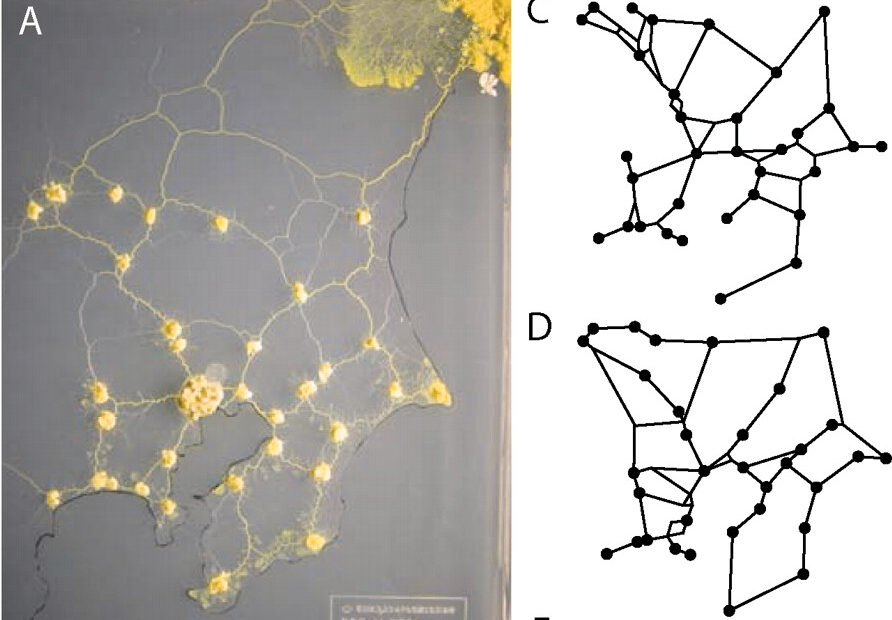
Thirty six food sources were placed on a 17×17 cm template of the Tokyo region to coincide with the geographical locations of major cities and hubs. Twenty two P. polycephalum networks were then grown. As shown in Figure 1, the network formed by P. polycephalum was then compared to the actual railway network in Japan.

All networks seen in Figure 1 were compared to each other and the MST (1E), which is the shortest possible network connecting all cities positioned on the map, and its derivative which had more cross-links (i.e. Steiner points) were added (1F). To assess the performance, overall cost and efficiency were compared using the total length and average minimum distance respectively (Tero, et al., 2010). Compared to the MST, the cost of the Tokyo railway was larger by a factor of roughly 1.8 whereas the P. polycephalum produced a cheaper model, which was 1.45 to 1.75 times the cost of the MST. The efficiency of the railway and P. polycephalum network were found to be 0.85 and 0.81 to 0.85 times less efficient than the MST respectively (Tero, et al., 2010).
The findings of this experiment were highly influential in the scientific community and have begun ushering in the usage of biological models in developing adaptive networks and solving problems. For example, generating sustainable urban infrastructure; using ant foraging patterns to optimize and model neural networks; using biomimicry of bacterial and fungal metabolism to optimize and control industrial processes; and using systems of insect navigation for automation and adaptability in automated systems and robotics (Colorni, et al., 1996). However, the implementation of adaptive biological networks on larger scales will require broader collaboration from a range of interdisciplinary experts to create truly effective and innovative designs; including biologists, engineers, urban planners, and architects.
When developing infrastructure, we often see ourselves as species with the most advanced capabilities for optimizing the systems we rely on most. Nakagaki and his team were able to prove the contrary. As we continue expanding our infrastructure or are faced with complex problems, before looking forward to the future, we should look to our surroundings and take notes from our amoeboid friends.
Works Cited
Bebber, D.P., Hynes, J., Darrah, P.R., Boddy, L. and Fricker, M.D., 2007. Biological solutions to transport network design. Proceedings of the Royal Society B: Biological Sciences, 274(1623), pp.2307–2315. https://doi.org/10.1098/rspb.2007.0459.
Colorni, A., Dorigo, M., Maffioli, F., Maniezzo, V., Righini, G. and Trubian, M., 1996. Heuristics from nature for hard combinatorial optimization problems. International Transactions in Operational Research, 3(1), pp.1–21. https://doi.org/10.1111/j.1475-3995.1996.tb00032.x.
Nakagaki, T., 2004. Smart network solutions in an amoeboid organism. Biophysical Chemistry, 107(1), pp.1–5. https://doi.org/10.1016/S0301-4622(03)00189-3.
Tero, A., Takagi, S., Saigusa, T., Ito, K., Bebber, D.P., Fricker, M.D., Yumiki, K., Kobayashi, R. and Nakagaki, T., 2010. Rules for biologically inspired adaptive network design. Science, 327(5964), pp.439–442. https://doi.org/10.1126/science.1177894.