Since the Food and Drug Administration approved over-the-counter and prescribed Benzoyl Peroxide (BPO), many people suffering from acne vulgaris have found a treatment for this very common problem (Matin and Goodman, 2024). Acne vulgaris is an inflammatory disorder, that causes pimples primarily on the face, but can occur on the back, abdomen, and upper arms (Sutaria, et al., 2024). Affecting 80% of adolescents, this disease is not physically debilitating nor life-threatening but it can lower self-esteem (Tasoula, et al., 2012).
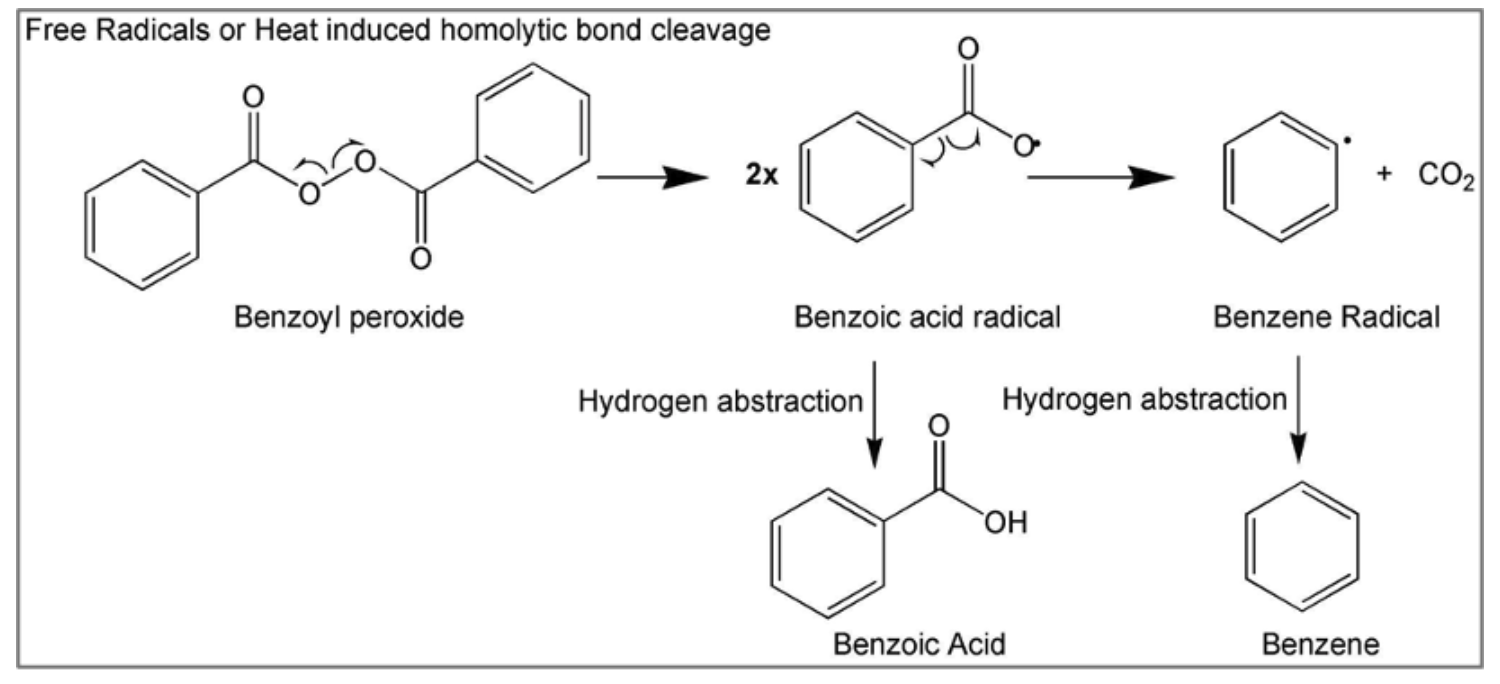
Due to BPO’s bacteria-killing effects against the key component of acne vulgaris, Cutibacterium acnes, many people have been able to either completely alleviate this disease from their skin or minimize the effects (Matin and Goodman, 2024). Once applied, BPO is converted to benzoic acid. Only 5% of the benzoic acid is absorbed and secreted via the renal system while the remaining 95% is metabolized by cysteine, an amino acid which is a building block of proteins, in the skin. This process allows for the release of free-radical oxygen species, causing the oxidation of bacterial proteins. According to patient testimony and analysis of the mechanism of action, there are no concerning adverse effects of BPO. The worst case that has been recorded is the potential for contact dermatitis, only recorded in a small percentage of users (Matin and Goodman, 2024). However, a recent study conducted by Valisure has stated that BPO should be pulled from drug stores due to the “instability” of the product and the potential for BPO to convert to benzene, a cancer-causing organic chemical compound (Figure 1; CDC, 2019; Kucera, et al., 2024).

Figure 1: Representation of BPO degrading into benzene. BPO is known for its thermal decomposition into two molecules of benzoyloxy radicals. These could further decompose to benzoic acid or phenyl radicals with the release of carbon dioxide. Then depending on the surrounding chemical environment, the phenyl radicals produce end products. One of these end products is benzene (Kucera, et al., 2024).
Although Valisure’s article has posed such an allegation, BPO was placed in conditions that do not realistically simulate daily use. It was noted that benzene levels are elevated when BPO is placed at 37°C, 50°C (Figure 2), and 70°C. The 37°C is to be representative of the standard human body temperature, 50°C is to represent shelf-life performance, and 70°C for potential transportation conditions (Kucera, et al., 2024).

Figure 2: Graphical representation of benzene concentrations, represented in parts per million (ppm), for five products at prolonged periods of incubation. The products were incubated at (A) 37 °C for 28 days and (B) 50°C for 21 days. Each product line—Equate Beauty, Neutrogena, Clean & Clear, CVS Health, and Walgreens—is represented by different markers and is accompanied by its respective trend lines, indicating the strength of the relationship between days of incubation and benzene concentration. An exponential or linear fit was applied depending on the pattern of benzene formation. The R-squared values are all close to 1, indicating a strong relationship between the dependent and independent variables (Kucera, et al., 2024).
Contrary to these claims, the study fails to take into account one vital factor: the time BPO was incubated at the set temperatures. Many of these products are not going to be placed at the temperatures indicated for prolonged periods. The average home temperature in Ontario is kept at around 16°C to 18°C, which is much lower than the minimum temperature BPO was kept in (Statistics Canada, 2008). Thus, the possibility of harmful levels of benzene being produced in and around the product is very low. As seen in Figure 2, from day 0 to day 1, very little amounts of benzene are detected. Not only that, but the study highlights that the test was halted for BPO put under 70°C conditions due to the rupturing of the product, making it improbable this would happen in a non-laboratory setting (Kucera, et al., 2024). This further showcases that such conditions are not representative of real-life scenarios. Furthermore, there has been no correlation found between the use of BPO and the incidence of cancer ever since the approval of the medication in 1984 (Kraus, et al., 1995).
Overall, several questions remain unanswered about the dangers of BPO use. The removal of every product containing BPO may not be necessary with further investigation into the existing literature and lab-based experimental studies still required for one to come to a conclusion. Instead, a label warning of the potential risks of placing the product at certain temperatures would be a feasible solution.
Works Cited
CDC, 2019. CDC | Facts About Benzene. Available at: <https://emergency.cdc.gov/agent/benzene/basics/facts.asp>.
Kraus, A.L., Munro, I.C., Orr, J.C., Binder, R.L., LeBoeuf, R.A. and Williams, G.M., 1995. Benzoyl peroxide: an integrated human safety assessment for carcinogenicity. Regulatory toxicology and pharmacology: RTP, 21(1), pp.87–107. https://doi.org/10.1006/rtph.1995.1014.
Kucera, K., Zenzola, N., Hudspeth, A., Dubnicka, M., Hinz, W., Bunick, C.G., Dabestani, A. and Light, D.Y., 2024. Benzoyl Peroxide Drug Products Form Benzene. Environmental Health Perspectives, 132(3), p.037702. https://doi.org/10.1289/EHP13984.
Matin, T. and Goodman, M.B., 2024. Benzoyl Peroxide. In: StatPearls. Treasure Island (FL): StatPearls Publishing. Available at: <http://www.ncbi.nlm.nih.gov/books/NBK537220/>.
Statistics Canada, 2008. Controlling the Temperature in Canadian Homes: Main article. Available at: <https://www150.statcan.gc.ca/n1/pub/16-001-m/2008006/5212652-eng.htm>.
Sutaria, A.H., Masood, S., Saleh, H.M. and Schlessinger, J., 2024. Acne Vulgaris. In: StatPearls. Treasure Island (FL): StatPearls Publishing. Available at: <http://www.ncbi.nlm.nih.gov/books/NBK459173/>.
Tasoula, E., Gregoriou, S., Chalikias, J., Lazarou, D., Danopoulou, I., Katsambas, A. and Rigopoulos, D., 2012. The impact of acne vulgaris on quality of life and psychic health in young adolescents in Greece. Results of a population survey. Anais brasileiros de dermatologia, 87(6), pp.862–869. https://doi.org/10.1590/S0365-05962012000600007.