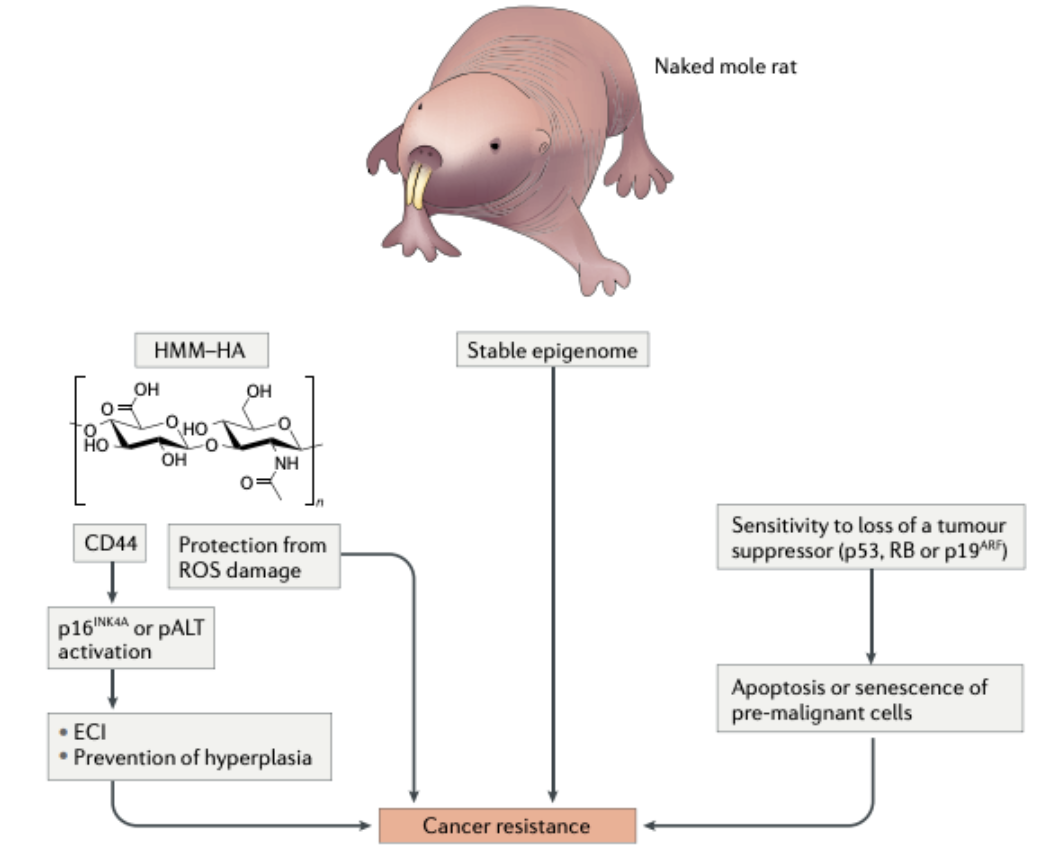
Whether it be dogs, humans or hamsters, cancer appears to affect all organisms. However, it does not affect all organisms equally. The naked mole-rat, Heterocephalus glaber, lives in underground burrows where they have no need for hair to protect them from the sun (San Diego Zoo, 2022). They are eusocial, meaning that they have a complex social organization with one reproductive female and other non-reproducing workers (Wilson and Hölldobler, 2005). They can live for 30 years, which is extraordinarily long as other rodents, such as rats, live for around two (Seluanov, et al., 2018). The most incredible thing about them is their resistance to cancer, as they are among a few mammals which have a high tolerance to tumour formation. Examining the mechanisms by which they stunt tumour growth can help us understand cancer prevention.
Some tumour suppressing mechanisms include slower cell proliferation. The fibroblasts in naked mole rats double every 7 days, whereas, in humans, this process only takes 2 (Seluanov, et al., 2018). This slower rate is due to early contact inhibition (ECI), which is when cells stop growing when in close proximity to each other. Cancer cells do not follow this and will grow on top of each other, however, due to the mole rat’s inhibition of cell growth, there is a lower chance their cells will grow out of control (Seluanov, et al., 2018). Mole rats also have an additional cyclin-dependent kinase (CDK) inhibitor called pALT, which makes their cell cycle more regulated than a human’s.
Another way naked mole rats can prevent cancer is by controlling the transcription of proteins related to the cell cycle. The naked mole-rat lives in subterranean tunnels which can be deprived of oxygen. They have a high tolerance for hypoxia and can live with oxygen concentrations as low as 8% for weeks (Maldonado and Hernández, 2021). This lack of oxygen slows down translation through the inhibition of a signalling cascade. This means that proteins involved in cell replication are produced less frequently, preventing rapid cell proliferation. Furthermore, the mole rat upregulates p53, a protein which regulates the cell cyle (Maldonado and Hernández, 2021). In humans, over 50% of cancers are a result of a p53 mutation, but due to its tight regulation in mole rats, they are at a lower risk of developing cancer. This among similar control mechanisms prevents mutations in the mole rat’s genes. Finally, mole rats produce a high-molecular-weight hyaluronan molecule, which appears to prevent the formation of tumours. This hyaluronan molecule is unique to the naked mole-rat and removing it from their system promotes tumour growth (Zhao, et al., 2020).

The naked mole-rat could replace the rat as a model for studying cancer prevention, as rats’ short lifespan deems them unideal models. Their fast metabolic rate makes them much more prone to develop cancer as 50-90% of old aged mice die from cancer, while only 23% of old aged humans do (Seluanov, et al., 2018). Furthermore, it takes fewer mutations to induce cancer in rats than it does in humans and naked mole rats (Zhao, et al., 2020), meaning that using them to model cancer prevention can lead to inaccuracies. As mole-rats are more similar humans, studying them may allow us to live longer, more prosperous, and cancer-free lives.
Works Cited
Maldonado, G. and Hernández, G., 2021. Translational control in the naked mole-rat as a model highly resistant to cancer. Biochimica et Biophysica Acta (BBA) – Reviews on Cancer, 1875(1), p.188455. https://doi.org/10.1016/j.bbcan.2020.188455.
San Diego Zoo, 2022. Naked Mole-rat | San Diego Zoo Animals & Plants. [online] Available at: <https://animals.sandiegozoo.org/animals/naked-mole-rat>
nova, V., 2018. Mechanisms of cancer resistance in long-lived mammals. Nature Reviews Cancer, 18(7), pp.433–441. https://doi.org/10.1038/s41568-018-0004-9.
Wilson, E.O. and Hölldobler, B.,2005. Eusociality: Origin and consequences. Proceedings of the National Academy of Sciences, 102(38), pp.13367–13371. https://doi.org/10.1073/pnas.0505858102.
Zhao, J., Tian, X., Zhu, Y., Zhang, Z., Rydkina, E., Yuan, Y., Zhang, H., Roy, B., Cornwell, A., Nevo, E., Shang, X., Huang, R., Kristiansen, K., Seluanov, A., Fang, X. and Gorbunova, V., 2020. Dampened PI3K/AKT signaling contributes to cancer resistance of the naked mole rat. https://doi.org/10.1101/2020.02.27.967729.