Substance use disorder (SUD) claims an estimated 67,000 lives annually in Canada, highlighting the devastating impact of the drug epidemic (CAMH 2025). SUD is a chronic illness that causes symptoms of impaired judgement, impulsiveness, drowsiness, nausea and vomiting, and mood changes. These symptoms can lead to significant impairments in health, social function, and voluntary substance control (Administration (US) and General (US) 2016a). SUD is prone to relapse and is influenced by genetic, developmental, behavioural, social, and environmental factors. Historically, SUD was highly stigmatized and not widely recognized as a mental disorder, limiting treatment accessibility and efficacy (Administration (US) and General (US) 2016b). Traditional treatments, such as methadone and amphetamines, were administered episodically in response to crises or relapses but proved ineffective for a chronic condition that requires continuous care. This gap in effective treatment created a demand for new approaches, leading to the emergence of innovative treatments like neuromodulation, which offers a promising alternative for managing SUD symptoms and preventing relapse (Soleimani et al. 2025).
Neuromodulation directly alters nerve activity through electrical or pharmacological stimulation (Soleimani et al., 2025). In psychiatric treatment, non-invasive brain stimulation (NIBS) techniques such as transcranial magnetic stimulation (TMS) and transcranial electrical stimulation (tES) are commonly used to deliver electrical stimulation (Figure 1). TMS stimulates specific brain regions through brief, focal electromagnetic pulses that penetrate the skull (Ekhtiari et al. 2019). The magnetic field is strong enough to induce neuronal firing, depending on the parameters set for stimulation, such as frequency, pattern, and intensity. In contrast, tES delivers low-intensity electrical currents through electrodes placed on the scalp or upper body. Unlike TMS, tES does not directly induce neuronal firing but modulates cortical excitability by shifting the membrane potential of neurons (Ekhtiari et al. 2019).
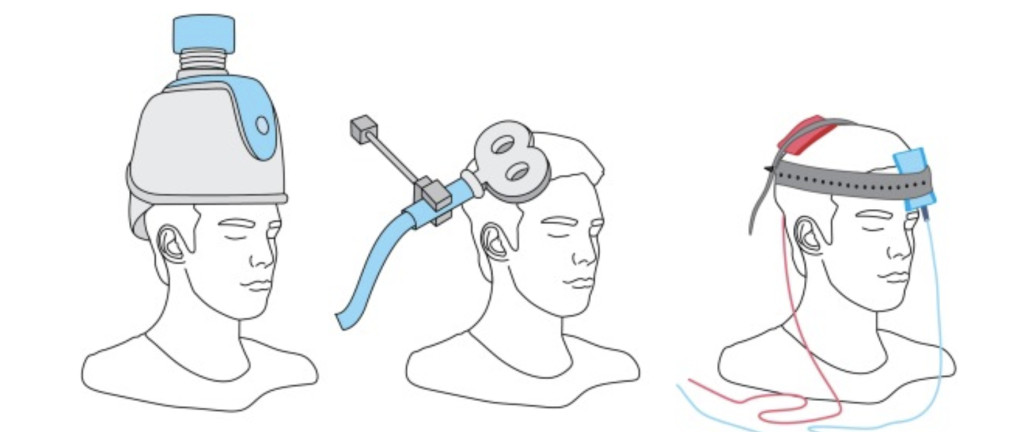
Figure 1: Different types of NIBS neuromodulation techniques, including deep TMS (depicted on the left), conventional TMS (depicted in the middle) and tES (depicted on the right). For both deep TMS and conventional TMS, a coil is used to deliver magnetic pulses. The coils for deep TMS are larger and positioned all around the scalp to deliver stimulation to deep brain regions, whereas with traditional TMS, smaller coils are used to directly target certain brain regions. In tES, electrodes are placed on the scalp (depicted in blue and red) to deliver electrical currents to different brain regions (Ekhtiari et al. 2019).
Neuromodulation is effective in treating SUDs by targeting neural circuits involved in drug-seeking behaviour, which are disrupted by prolonged substance use (NIDA, 2020) (Figure 2). A review by Antonelli et al. (2021) suggests that repetitive transcranial magnetic stimulation (rTMS) can reduce cravings and drug consumption by stimulating dopamine release in areas projecting to the prefrontal cortex, restoring neural function. Both rTMS and tES enhance neural excitability, potentially reversing substance-related brain damage, lowering drug consumption, and increasing brain-derived neurotrophic factor, which supports neuroplasticity and recovery (Antonelli et al. 2021).

Figure 2: The key brain regions affected by SUDs, including the extended amygdala, which drives withdrawal symptoms and relapse; the basal ganglia, which become overactivated and reduce sensitivity to healthy rewards; and the prefrontal cortex, which weakens and impairs decision-making and impulse control (Zein and Danovitch 2023).
The devastating impact of SUDs, including high mortality rates, incarceration, and social consequences, demonstrates the urgent need for effective, long-term treatment strategies (CAMH 2025). Traditional treatments, while useful in managing acute symptoms, often fail to address the chronic nature of addiction, leaving individuals vulnerable to relapse. Neuromodulation techniques, such as TMS and tES, offer a promising alternative by directly targeting the disrupted neural circuits involved in addiction. While further research is needed to determine clinical safety and efficacy, neuromodulation presents itself as a promising new addiction treatment.
References
Administration (US), Substance Abuse and Mental Health Services, and Office of the Surgeon General (US). 2016a. “THE NEUROBIOLOGY OF SUBSTANCE USE, MISUSE, AND ADDICTION.” In Facing Addiction in America: The Surgeon General’s Report on Alcohol, Drugs, and Health [Internet]. US Department of Health and Human Services. https://www.ncbi.nlm.nih.gov/books/NBK424849/.
Administration (US), Substance Abuse and Mental Health Services, and Office of the Surgeon General (US). 2016b. “HEALTH CARE SYSTEMS AND SUBSTANCE USE DISORDERS.” In Facing Addiction in America: The Surgeon General’s Report on Alcohol, Drugs, and Health [Internet]. US Department of Health and Human Services. https://www.ncbi.nlm.nih.gov/books/NBK424848/.
Antonelli, Mariangela, Liana Fattore, Luisa Sestito, Daniela Di Giuda, Marco Diana, and Giovanni Addolorato. 2021. “Transcranial Magnetic Stimulation: A Review about Its Efficacy in the Treatment of Alcohol, Tobacco and Cocaine Addiction.” Addictive Behaviors 114 (March):106760. https://doi.org/10.1016/j.addbeh.2020.106760.
CAMH. 2025. “Mental Illness and Addiction: Facts and Statistics.” CAMH. 2025. https://www.camh.ca/en/driving-change/the-crisis-is-real/mental-health-statistics.
Ekhtiari, Hamed, Hosna Tavakoli, Giovanni Addolorato, Chris Baeken, Antonello Bonci, Salvatore Campanella, Luis Castelo-Branco, et al. 2019. “Transcranial Electrical and Magnetic Stimulation (tES and TMS) for Addiction Medicine: A Consensus Paper on the Present State of the Science and the Road Ahead.” Neuroscience and Biobehavioral Reviews 104 (September):118–40. https://doi.org/10.1016/j.neubiorev.2019.06.007.
Roebuck, Ben. 2008. “Homelessness, Victimization and Crime: Knowledge and Actionable Recommendations.” University of Ottawa, Institute for the Prevention of Crime. https://doi.org/10.13140/RG.2.2.20100.32648.
Soleimani, Ghazaleh, Afra Souki, Sara Honari, Mohsen Ebrahimi, Hosna Tavakoli, Alireza Valyan, and Hamed Ekhtiari. 2025. “Noninvasive Neuromodulation for Addiction Treatment: A Systematic Review and Meta-Analysis.” Brain Stimulation: Basic, Translational, and Clinical Research in Neuromodulation 18 (1): 528. https://doi.org/10.1016/j.brs.2024.12.914.
Zein, Mira, and Itai Danovitch. 2023. “Substance-Related and Addictive Disorders.” In Atlas of Psychiatry, edited by Waguih William IsHak, 437–67. Cham: Springer International Publishing. https://doi.org/10.1007/978-3-031-15401-0_14.
Comments
One response to “From Relapse to Recovery: How Neuromodulation Techniques Could Revolutionize Addiction Treatment”
Hi Mia,
I really enjoyed reading your blog post, as it was very direct and informative. I certainly think it is important to increase awareness for those impacted by substance use disorders, especially in the destigmatization of addiction.
I have a few suggestions:
1) Your may want to strengthen your hook. The stat you have now is impactful, however I think saying something along the lines of “Every day, more than 180 people in Canada lose their lives to substance use disorders, leading to more than 67 000 deaths in 2025 alone.” will grab readers’ attention.
2) In P3 you reference the source (NIDA, 2020) however I do not see that in your works cited. The in-text citation also should not have a comma between the name and date.
3) In P4 you use the word “promising” twice. Try switching the last sentence to “…neuromodulation shows great potential as a new addiction treatment.”
Overall very well written and concise blog!
I hope this helps,
Sydney