In May of 1543, Nicolaus Copernicus passed away and was buried in Frombork Cathedral, but his grave was soon forgotten. Countless attempts to locate his resting place were made, including a search ordered by the French emperor Napoleon Bonaparte in 1807. However, it took until 2005 for archaeologists to exhume remains near the altar he had tended, which were later matched by DNA to hairs left in a book he owned (Bogdanowicz et al. 2009). His revolutionary idea, that the Earth moves around the sun, also took time to find its place. Roughly 150 years passed before the sun-centred model was widely accepted. Several obstacles stood in the way, starting with how well the old model seemed to work.
The model Copernicus challenged came from Ptolemy, a second-century astronomer whose Earth-centred system was built on careful observation. Planets such as Mars sometimes seem to drift backwards across the sky. To explain this, Ptolemy had each planet ride a small circle (an epicycle) that was carried around a larger one, with the motion timed from a slightly off-centre point called the equant (Boccaletti 2001).
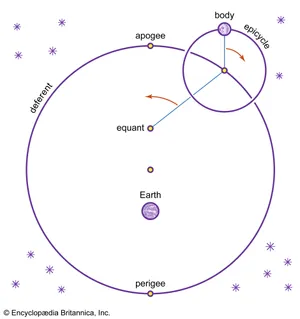
The geocentric model also matched experience, since we don’t feel the Earth move. Most importantly, it seemed to pass a key test. If the Earth really circled the sun, nearby stars should shift slightly against more distant ones over a year, just as a close tree seems to slide past far-off hills when you walk by. Astronomers called this stellar parallax, but no one could see it (Graney 2006).
Copernicus was a careful scholar and a member of the clergy at Frombork Cathedral. He owed his education to his uncle, Bishop Lucas Watzenrode (Bogdanowicz et al. 2009). Around 1510 he privately distributed a short sketch of his idea, the Commentariolus (Little Commentary), but published his full theory once the young Wittenberg mathematician Georg Rheticus came to study with him in 1539 (Westman, n.d.).
The reason he put the sun at the centre is still debated by historians. One view is that he disliked Ptolemy’s equant. Since Aristotle, astronomers had maintained that heavenly bodies move around the centre of a circle at a constant speed. The equant bent that rule. A planet moved steadily only when viewed from the off-centre equant point, so measured from the centre of its own circle, it sped up and slowed down (Encyclopedia Britannica 2025; Boccaletti 2001). Another is that he liked how a sun-centred system put the planets in a natural order, with the more distant planets taking longer to complete an orbit (Westman, n.d.). He also built on mathematical tools developed centuries earlier by Persian astronomers, such as Nasir al-Din Tusi, who worked at the Maragheh observatory in the 1200s (Ragep 2022). What no one before him had done was combine such tools with a moving Earth.
Copernicus’s model explained the planets’ backward loops naturally, as the Earth overtaking them in its orbit. But because he kept uniform circular motion, he still needed epicycles, so his predictions were not yet much better than Ptolemy’s (Encyclopedia Britannica 2025). Another setback for accepting heliocentrism occurred when the theologian Andreas Osiander added an unsigned preface to Copernicus’s book, telling readers the theory was simply a handy way to calculate planetary positions rather than a true picture of the heavens (Westman, n.d.). Many astronomers, especially at the University of Wittenberg, were happy to read it that way. They used Copernicus’s mathematics while ignoring his central claim that the Earth moves (Rabin 2023). And until someone could detect stellar parallax, the evidence still seemed to favour a stationary Earth.
What changed was data. In 1609, Johannes Kepler built on Copernicus’s sun-centred system, replacing his circles with elliptical orbits and making the model far more accurate (Boccaletti 2001). In 1610, Galileo turned his new telescope on Venus and saw it change shape like the Moon, from a thin crescent to a full, round disc. In Ptolemy’s model, Venus always stayed between the Earth and the sun, so it could never appear full. Seeing a full Venus meant it had to pass behind the sun, which only made sense if it orbited the sun (Blåsjö 2021).
Parallax had gone undetected for a simple reason. The stars are so far away that the shift is incredibly small, just as a tree on a distant mountain barely seems to move as you walk past. Using a precision telescope, Friedrich Bessel finally measured it for the star 61 Cygni in 1838. The shift was about 0.3 arcseconds, roughly the width of a quarter seen from 16 kilometres away (Reid and Menten 2020). Knowing that angle and the size of Earth’s orbit, he could also work out how far away the star was. It’s the same baseline-and-angle geometry we still use to estimate distances to nearby stars.
Copernicus was right about the sun long before anyone could prove it. The evidence caught up with him over the following centuries, nearly three hundred years later in the case of parallax. His story is a reminder that a good idea can be right long before the evidence arrives, and that science moves forward when bold theories and careful observations combine.
References
Blåsjö, Viktor. 2021. “Galileo, Ignoramus: Mathematics versus Philosophy in the Scientific Revolution.” arXiv. https://doi.org/10.48550/arXiv.2102.06595.
Boccaletti, Dino. 2001. “From the Epicycles of the Greeks to Kepler’s Ellipse: The Breakdown of the Circle Paradigm.” arXiv. https://doi.org/10.48550/arXiv.physics/0107009.
Bogdanowicz, Wiesław, Marie Allen, Wojciech Branicki, Maria Lembring, Marta Gajewska, and Tomasz Kupiec. 2009. “Genetic Identification of Putative Remains of the Famous Astronomer Nicolaus Copernicus.” Proceedings of the National Academy of Sciences 106 (30): 12279–82. https://doi.org/10.1073/pnas.0901848106.
Encyclopedia Britannica. 2025. “Scientific Revolution.” Encyclopedia Britannica. Last modified February 13, 2025. https://www.britannica.com/science/Scientific-Revolution.
Encyclopedia Britannica. 2026. “Ptolemaic System.” Image. Encyclopedia Britannica. Last modified September 28, 2026. https://www.britannica.com/science/Ptolemaic-system#/media/1/482079/60364.
Graney, Christopher M. 2006. “The Accuracy of Galileo’s Observations and the Early Search for Stellar Parallax.” arXiv. https://doi.org/10.48550/arXiv.physics/0612086.
Rabin, Sheila. 2023. “Nicolaus Copernicus.” In The Stanford Encyclopedia of Philosophy, edited by Edward N. Zalta and Uri Nodelman. https://plato.stanford.edu/entries/copernicus/.
Ragep, F. Jamil. 2022. “Copernicus and His Islamic Predecessors: Some Historical Remarks.” In Islamic Astronomy and Copernicus, 3–20. Ankara: Turkish Academy of Sciences. https://doi.org/10.53478/TUBA.978-625-8352-02-3.
Reid, Mark J., and Karl M. Menten. 2020. “The First Stellar Parallaxes Revisited.” Astronomische Nachrichten 341 (9): 860–69. Free version: https://doi.org/10.48550/arXiv.2009.11913.
Westman, Robert S. n.d. “Nicolaus Copernicus.” Encyclopedia Britannica. Accessed November 11, 2026. https://www.britannica.com/biography/Nicolaus-Copernicus.


Leave a Reply
You must be logged in to post a comment.