You want to quit: you’d be happier, you’d be more productive, you could leave this horrible bioreactor and pursue your dreams. But you can’t. Your co-worker tried to go cold turkey and had withdrawal symptoms so bad they disintegrated in minutes. You curse the day you first tried that plasmid. Wait, what’s going on?
Bacteria can become addicted to DNA, specifically mobile gene elements called plasmids. Plasmids are rings of DNA that are separate from a bacteria’s main chromosome. A bacterium will maintain a number of replicates of a given plasmid, called the plasmid copy number (PCN). These copies can be transferred to the bacteria’s daughter cells when it undergoes binary fission (vertical transfer) (Tsang 2017).
However, since there is a finite number of plasmids in a bacterium, when it divides there is a chance that one of the bacteria’s daughters will contain zero copies of the plasmids from the parent cell. This effect (called asymmetric partitioning) is amplified with large plasmids (100 kilobases or more) since they tend to have a lower PCN. Since plasmids slow replication times and are metabolically expensive to copy and transcribe, the daughter cells without plasmids would eventually outcompete those who retained the plasmid. This would eventually eliminate the plasmid from a bacterial population, resulting in the phenomenon known as plasmid loss (Tsang 2017).
Plasmids have evolved clever mechanisms to mitigate plasmid loss. One of these methods is Plasmid Addiction Systems (PASs), which ensures a bacteria stays “addicted” to the plasmid. The toxin-antitoxin (TA) PAS consists of an operon which encodes for both a long-lived toxin and short-lived antitoxin which is rapidly degraded in the bacterial cytoplasm. Under normal conditions the bacteria will constantly create excess anti-toxin to nullify the toxin’s effect. However, when the bacteria divides, if one of its daughter cells doesn’t contain a copy of the plasmid, the anti-toxin will rapidly disappear but the longer-lasting toxin will persist from the parent, killing the cell (Figure 1). Thus only plasmid containing daughters will survive (Tsang 2017).
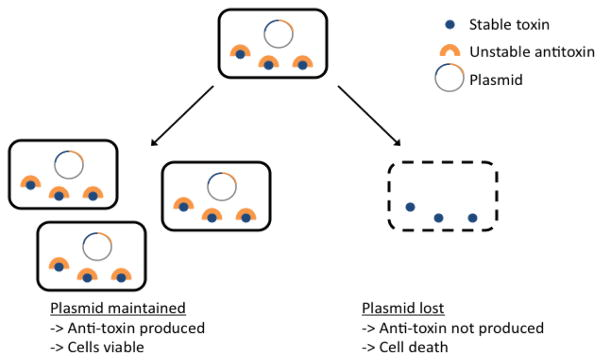
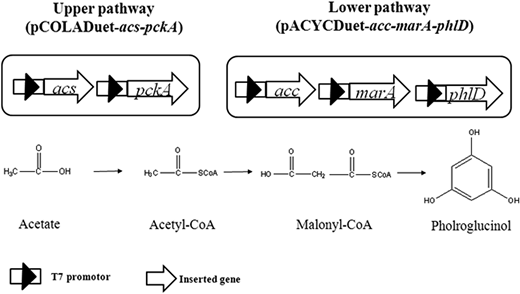
Plasmids can be both helpful and harmful. Horizontal transfer of plasmids encoding for antibiotic resistance poses a major global health risk (Darphorn et al. 2021). However, plasmids can also be introduced into a bacteria to allow the bacteria to synthesize useful compounds in bioreactors. For example, the E.coli strain BL21(DE3) was modified by introducing a plasmid that encodes for phloroglucinol (PG). PG is a useful polyketide with over 700 pharmaceutical and industrial applications. Unfortunately, the artificial synthesis of PG products involves fossil fuel feedstocks, and has major safety and pollution concerns (Singh et al. 2010). The new biosynthesis pathway (Figure 2) is safer and cleaner, but suffered from plasmid loss leading to some bacteria no longer producing PG, lowering purity and percent yield.
Researchers mitigated this by introducing an antibiotic resistance gene to the plasmid then saturating the bioreactor with antibiotics, thereby selecting for bacteria with the plasmid. However this is expensive and not always effective. Therefore, a new study introduced a PAS to the plasmid which reduced plasmid loss and increased PG production without the use of antibiotics (Wang et al. 2024). Others have developed toxin-antitoxin PAS using missense mRNA as an antitoxin to improve industrial fermentation of amino-acids (Li et al. 2018). The field is still evolving, with researchers finding new ways to addict bacteria to improve biosynthesis chemistry.
References
Darphorn, Tania S., Keshia Bel, Belinda B. Koenders-van Sint Anneland, Stanley Brul, and Benno H. Ter Kuile. 2021. “Antibiotic Resistance Plasmid Composition and Architecture in Escherichia Coli Isolates from Meat.” Scientific Reports 11 (1): 2136. https://doi.org/10.1038/s41598-021-81683-w.
Li, Ya-jie, Ya Liu, Zheng Zhang, Xiao-jing Chen, Ya Gong, and Yue-zhong Li. 2018. “A Post-Segregational Killing Mechanism for Maintaining Plasmid PMF1 in Its Myxococcus Fulvus Host.” Frontiers in Cellular and Infection Microbiology 8 (August): 274. https://doi.org/10.3389/fcimb.2018.00274.
Singh, Inder Pal, Jasmeen Sidana, Sandip B. Bharate, and William J. Foley. 2010. “Phloroglucinol Compounds of Natural Origin: Synthetic Aspects.” Natural Product Reports 27 (3): 393–416. https://doi.org/10.1039/b914364p.
Tsang, Jennifer. 2017. “Bacterial Plasmid Addiction Systems and Their Implications for Antibiotic Drug Development.” Postdoc Journal : A Journal of Postdoctoral Research and Postdoctoral Affairs 5 (5): 3–9.
Wang, Ji-ming, Yu-jin Cao, Xiao Men, and Hai-bo Zhang. 2024. “Construction of a grpE-Based Plasmid Addiction System in Escherichia Coli and Its Application in Phloroglucinol Biosynthesis.” Journal of Applied Microbiology 135 (5): lxae116. https://doi.org/10.1093/jambio/lxae116.
Xu, Xin, Mo Xian, and Huizhou Liu. 2017. “Efficient Conversion of Acetate into Phloroglucinol by Recombinant Escherichia Coli.” RSC Advances 7 (80): 50942–48. https://doi.org/10.1039/c7ra09519h.


Leave a Reply
You must be logged in to post a comment.