The Physics of Cat Butts: The Science of How Felines Rotate Without Torque

If you drop a tennis ball, it obeys gravity and falls straight down. If you drop an inverted feline, however, it performs a high-speed, zero-gravity gymnastic routine mid air to land cleanly on all four paws. This phenomenon is famously known in physics as the “falling cat problem” and it seems to violate one of the most fundamental laws in mechanics the conservation of angular momentum (Essén and Nordmark 2018).


According to Newton’s laws, an object initially at rest with zero total angular momentum ( L = 0 ) cannot rotate its entire body without having an external torque pushing against it (Kane and Scher 1969). Free falling in mid air, a cat has nothing to push off. Yet, within less than half a second, it executes a complete 180 degree flip.

The secret lies in the cat’s flexible anatomy, which allows it to act not as a single rigid cylinder, but as two independent cylinders connected by a flexible joint (Kane and Scher 1969; Figure 1).
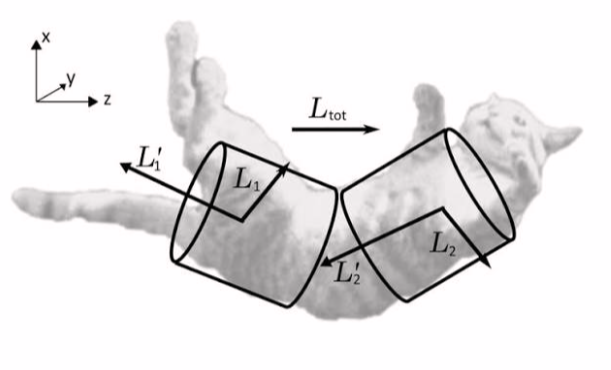
Figure 1. A falling cat modelled as two cylinders, one for the front half of its body and one for the rear, joined at a bent spine. Each half has its own angular momentum as it rotates (Flückiger et al. 2024).

To achieve rotation without external torque, the cat bends its spine at a central angle, effectively splitting its body into a front half and a back half. It then tucks its front paws in close to its chest while extending its rear legs outward. In rotational dynamics, moment of inertia (I) measures an object’s resistance to rotation and depends on how mass is distributed relative to the axis of rotation (I = Σ mᵢrᵢ²). By tucking its front legs, the cat minimizes (I) front, allowing its upper body to rotate rapidly with minimal effort. Simultaneously, extending its hind legs maximizes (I) rear, keeping the back half relatively stationary (Essén and Nordmark 2018).

Once the front half completes its 180° turn to face the ground, the cat reverses the process as it extends its front legs (increasing (I) front) and tucks its rear legs (decreasing (I) rear), swiftly rotating its back half into alignment. Because the counter rotations of the front and rear halves cancel each other out mathematically, net angular momentum remains exactly at zero throughout the fall (Kane and Scher 1969):

L total = (I) front·ω front + (I) rear·ω rear = 0

This clever trick shows how a cat’s anatomy has evolved to work within the laws of physics. The vestibular system in the inner ear senses which way is down and triggers a reflex that coordinates the cat’s muscles in milliseconds (Crémieux et al. 1984). By changing its moment of inertia, the cat rotates each half of its body in turn, obeying the laws of physics while still landing safely on its feet.


References

Crémieux, J., et al. 1984. “Development of the Air Righting Reflex in Cats Visually Deprived since Birth.” Experimental Brain Research 54 (3): 564–66.
https://pubmed.ncbi.nlm.nih.gov/6723872/

Essén, Hanno, and Arne Nordmark. 2018. “A Simple Model for the Falling Cat Problem.” European Journal of Physics 39 (3): 035004.
https://iopscience.iop.org/article/10.1088/1361-6404/aaac06

Flückiger, Patrick, Florent Cosandier, Hubert Schneegans, and Simon Henein. 2024. “Design of a Flexure-Based Flywheel for the Storage of Angular Momentum and Kinetic Energy.” Machines 12 (4): 232.
https://www.mdpi.com/2075-1702/12/4/232

Kane, Thomas R., and M. P. Scher. 1969. “A Dynamical Explanation of the Falling Cat Phenomenon.” International Journal of Solids and Structures 5 (7): 663–70. https://www.sciencedirect.com/science/article/pii/0020768369900869

Comments

5 Responses to “The Physics of Cat Butts: The Science of How Felines Rotate Without Torque”

  1. Aveline Desousa Avatar
    Aveline Desousa

    Hi Hassan,

    I thought this was a really interesting blog post! I liked how you combined physics with animal behavior. I have a few suggestions that I hope will help with your editing process:

    Make sure you use the DOI links in your citations for pubmed, iopscience, MDPI, and ScienceDirect, you can find them under “cite”

    I think it would be interesting to expand more on the evolution of cat anatomy to work with these mechanisms in your last paragraph

    Otherwise I thought this was a very cool topic and was really well written, I hope these suggestions help!

    Aveline

  2. Berk Coskun Avatar
    Berk Coskun

    Hi Hassan,
    First of all, great blog post and very engaging! I especially liked Figure 1, because I could have never imagined that a dual cylinder model would fit a cat.

    Here is some small advice to make the post even better:
    – For your figure caption, bold “Figure 1.” and change the text type to annotation to separate it from body text.
    – Centre the equation “L total = (I) front·ω front + (I) rear·ω rear = 0”
    – The sentence “The vestibular system in the inner ear senses which way is down and triggers a reflex that…” feels like it comes suddenly without relevance. Adding a prior sentence that connects to the previous text would help flow!
    – The last paragraph should usually be a conclusion that summarizes previous paragraphs and does not introduce any new information. Shortening long paragraphs and including a final concluding sentence would help bring the blog together to a final point.

    Happy editing,
    Berk 🙂

  3. Ava Petteplace Avatar
    Ava Petteplace

    Hii Hassan, I love your topic so much and it instantly drew me in!

    Suggestions:

    – I would maybe remove the spaces between your paragraphs because it removes some of the flow, but that is also a stylistic thing so my opinion is relative.
    – Your entire intro made me happy!
    – “According to Newton’s laws, an object initially at rest with zero total angular momentum ( L = 0 ) cannot rotate its entire body without having an external torque pushing against it (Kane and Scher 1969). Free falling in mid air, a cat has nothing to push off. Yet, within less than half a second, it executes a complete 180 degree flip.” I would maybe name the law and explain what momentum is at a base level and define what L is (potentially with an equation?).
    – I would maybe centre your equation.

    Overall, Amazing Job!! – Ava

  4. Kai Fusch Avatar
    Kai Fusch

    Hello Hassan!
    This was a joy to read and I found the figure of the cat just falling funny!

    I have a few suggestions for you to make it even better:
    – First edit I would suggest is the formatting of the image caption (and making sure its apart of the image) and removing the spaces between each paragraph
    – Secondly, I found the (I) standing in for inertia to be clunky and disrupt the flow of the blog
    – Third is that I would replace all the links with there DOIs

    Otherwise, I was a blast to read and I cant wait to see the finished result!
    – Kai Fusch

  5. Brand Hu Avatar
    Brand Hu

    Hi Hassan,

    Great blog! This was an interesting read for sure, heres some feedback:
    P1S2: “zero-gravity” is wrong, since gravity acts throughout. Use “free-fall.”
    P1S3: Add a colon before “the conservation…”
    P3S1: The halves are coupled, not “independent.”
    P4S3: I resists changes in rotation, not rotation itself.
    P4S5: The rear counter-rotates slightly; it isn’t stationary.
    P5S2: Drop “mathematically” and “exactly.”
    Overall, great job! Look forward to seeing the final draft.

    Best,
    Brand

Hey Isci, I chose this topic because I was curious how a cat can flip in midair without breaking the laws of physics. It connects physics concepts like angular momentum and moment of inertia with biology, like the cat’s anatomy and reflexes.