You have been at school since 9 a.m. You finally enter the parking lot, waving your key fob around goodness knows where. After a long day at iSci, it is hard to remember exactly where you parked. You try holding the fob under your chin – BEEP BEEP! Your car responds! But how does it work from so far away?
Key fobs are remote keyless entry (RKE) systems that communicate with vehicles using low-power radio frequency (RF) transmissions (Garcia et al., 2016). These systems use electromagnetic waves to wirelessly transmit commands and identification data over short distances without requiring a high-power transmitter. The relatively long wavelengths used by these systems allow radio waves to diffract around certain obstacles and pass through materials such as walls and windows, helping signals reach their intended receivers.
A study by Rezapourian et al. (2026) investigated why holding a key fob against one’s head, particularly beneath the chin, could increase its operating range. Using a Volkswagen Touran with a 433.92 MHz key fob, researchers conducted range measurements with nine participants. They tested five head-contact configurations (Figure 1). Participants moved away from the vehicle in 5 m increments until the key fob stopped working, then returned in 1 m increments to determine the maximum operating distance.
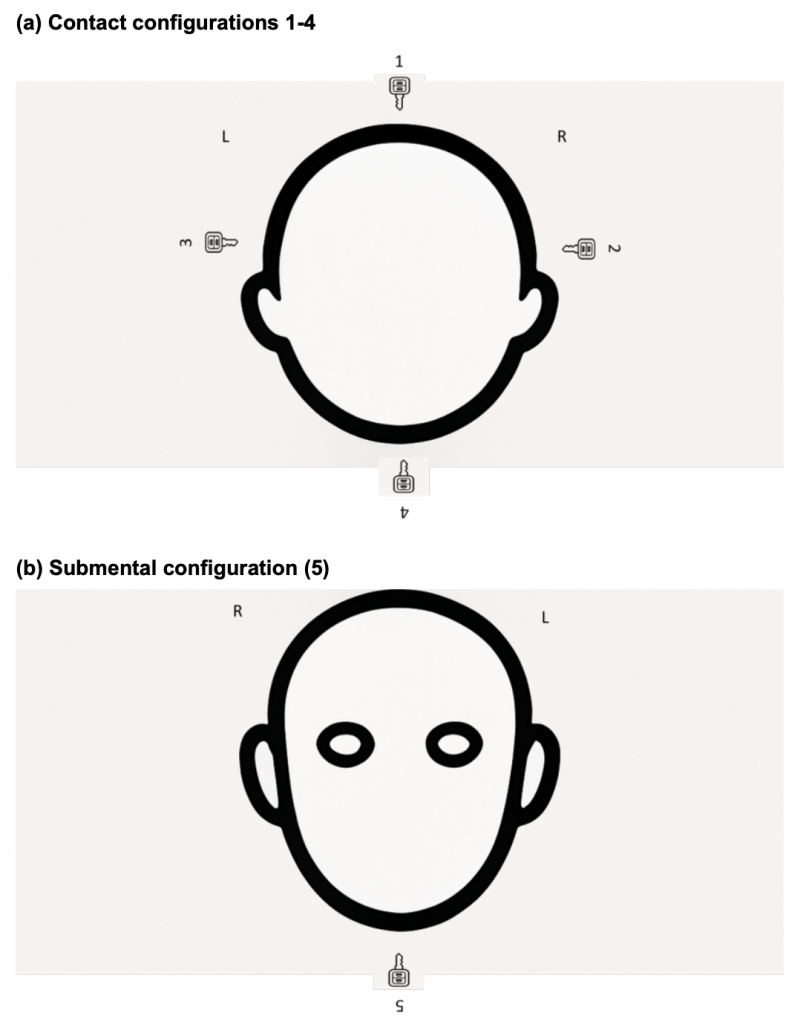
Figure 1. Schematic of the five tested head-contact configurations: (1) above the forehead (frontal); (2) and (3) against the right and left sides of the head (temporal); (4) at the back of the head (occipital); and (5) beneath the chin (submental). Key symbols indicate the contact locations (Rezapourian et al. 2026).
This staircase procedure established the contact range (R contact), which was compared against the baseline reference range (R reference). The difference between these measurements represented the range gain (Equation 1).
Interestingly, the occipital configuration produced no additional range in four trials, meaning that touching the key fob to the back of the head performed no better than holding it in the air. However, the submental configuration produced positive range gains for all nine participants and demonstrated the highest mean and median gains among the five configurations (Figure 2). These findings suggest that the position of the key fob against the body can influence its operating range.
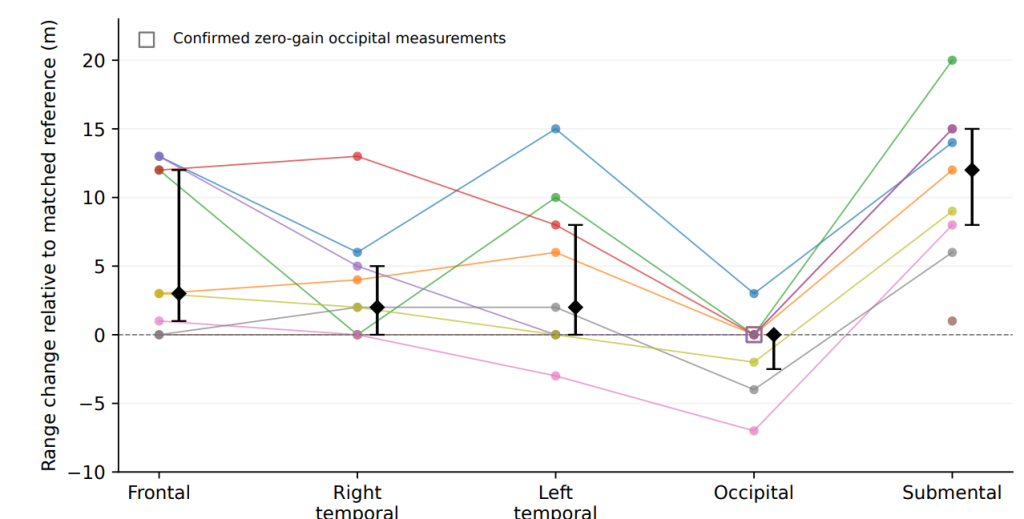
Figure 2. Recorded human range gains across contact configurations. Each colored circle represents a gain calculated from one staircase-derived contact operating threshold and its matched reference. Colors identify participants, and connecting lines link the different configurations measured within each participant. Black diamonds and bars represent the medians and interquartile ranges (IQRs), which describe the spread of the middle 50% of observations (between the 25th and 75th percentiles). The x-axis shows the contact configuration, while the y-axis represents the change in operating range relative to the matched reference (Rezapourian et al. 2026).
One possible explanation involves the human body’s electrical properties and its ability to interact with electromagnetic fields. The human body can behave like an antenna, coupling with and reradiating electromagnetic energy rather than simply absorbing it. When exposed to alternating electromagnetic fields, the body’s conductive tissues can influence signal propagation, potentially changing how the radio signal travels (Kibret, 2016).
Research into human body communication (HBC) further demonstrates how biological tissues interact with electrical signals. Galvanic coupling is a method of transmitting electrical signals through the body using electrodes in contact with the skin. This form of HBC uses low-frequency electrical currents (below 10 MHz) to transfer information, particularly between wearable electronic devices. Studies have shown that different tissues influence signal transmission differently: muscle tissue primarily affects the signal near the transmitter, while skin influences signals farther along the arm. Additionally, electrode–skin contact impedance can act as a high-pass filter, reducing lower-frequency components of the signal.
Ultimately, holding your key fob under your chin may do more than make you look a little silly in a parking lot! This phenomenon demonstrates an interesting connection between physics, chemistry, and biology, showing how the electrical properties of the human body can influence everyday wireless technology.
References
Rezapourian et al. “Use Your Head? Exploring Configuration-Dependent Variation in Key Fob Range.” Applied Sciences 16, no. 21 (2026): 10449. https://doi.org/10.3390/app162110449.
Kibret, Behailu Mulatu. The Human Body Antenna: Characteristics and Its Application. PhD diss., Victoria University, January 2016. https://vuir.vu.edu.au/31012/3/KIBRET%20Behailu-thesis_nosignature.pdf
Garcia, Flavio D., David Oswald, Timo Kasper, and Pierre Pavlidès. 2016. “Lock It and Still Lose It—On the (In)Security of Automotive Remote Keyless Entry Systems.” In Proceedings of the 25th USENIX Security Symposium, 929–944. USENIX Association. https://files.usenix.org/s3fs-public/cdn/sec16_paper_garcia.pdf


Leave a Reply
You must be logged in to post a comment.