I’m sure many of you have been bitten by a mosquito or stung by a bee. Insects have plenty of ways to defend themselves, including camouflage, physical barriers and stingers. The bombardier beetle has a rather different approach. When threatened, it releases a hot chemical spray that can reach temperatures close to 100°C which makes it an effective defence even against much larger predators (Vogel et al. 2025). One of the interesting things about it is that this reaction takes place inside the beetle’s own body. So, how does it produce that much heat without damaging itself?
Temperatures approaching 100°C can damage proteins and cell membranes which makes it difficult for most organisms to survive under these conditions. Some microorganisms, known as thermophiles, are adapted to grow in high-temperature environments (González-Tokman et al. 2020). But these organisms can have thermostable enzymes and specialized membrane properties that allow them to remain functional at high temperatures (Mehta et al. 2016). However, the bombardier beetle cannot be considered a thermophile, since it does not live or grow in an extremely hot environment. Instead, it produces intense heat for a brief period of time within a specialized part of its body. It’s defensive glands contain a reaction chamber lined with cuticular material and this helps protect the surrounding cells from the heat and chemicals. The reactants are also kept in a separate reservoir until the beetle is threatened.
The chemical reaction occurs within the beetle’s pygidial glands, which contain three main structures: a reservoir chamber (RSC), reaction chamber (RXC), and exit channel (EC) (Vogel et al. 2025) (Figure 1). The reservoir chamber stores an aqueous solution containing approximately 25% hydrogen peroxide and 10% p-hydroquinones, along with 10% n-alkanes, which act as a non-reactive solvent.
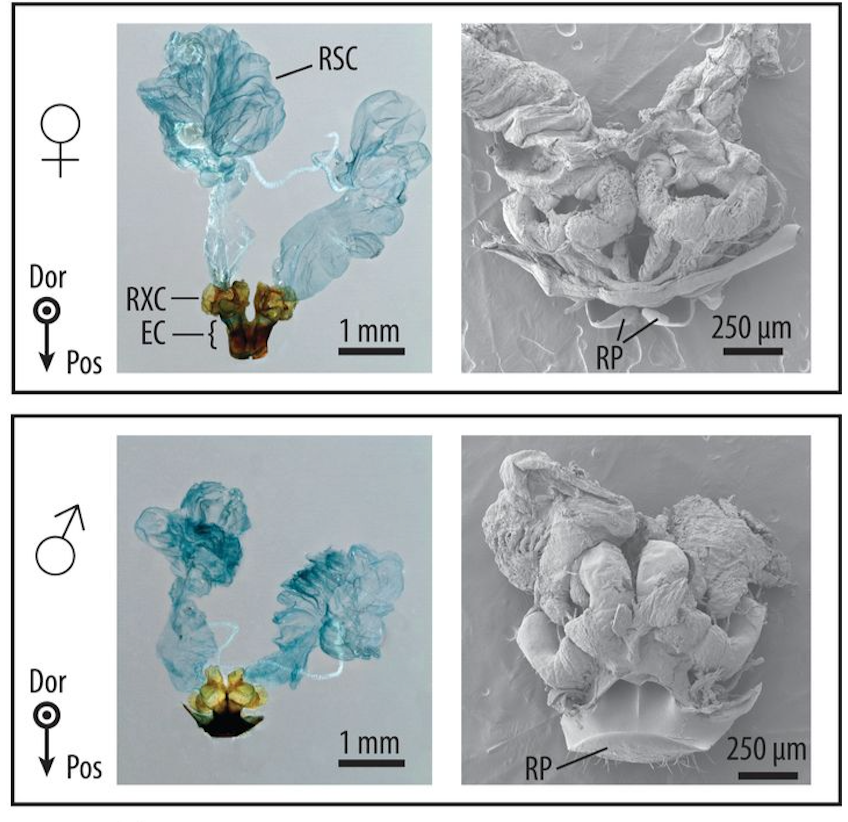
Source: Arndt et al. (2015).
When threatened, muscles surrounding the reservoir chamber contract and this forces the reactants through a one-way valve into the reaction chamber. Here, catalase and peroxidase enzymes facilitate an explosive exothermic reaction that produces p-benzoquinones (p-BQs), oxygen gas, and water. The reaction releases approximately 48.5 kcal of thermal energy per mol of p-BQs produced. This energy release increases the temperature and pressure within the reaction chamber. This is how it can reach temperatures of up to 100°C (Vogel et al. 2025). The resulting pressure propels the hot, chemically irritating spray through the exit channel at speeds of up to 10 m/s (Arndt et al. 2015) (Figure 2). All in all, the beetle uses the energy released through an exothermic chemical reaction as part of its defensive mechanism.
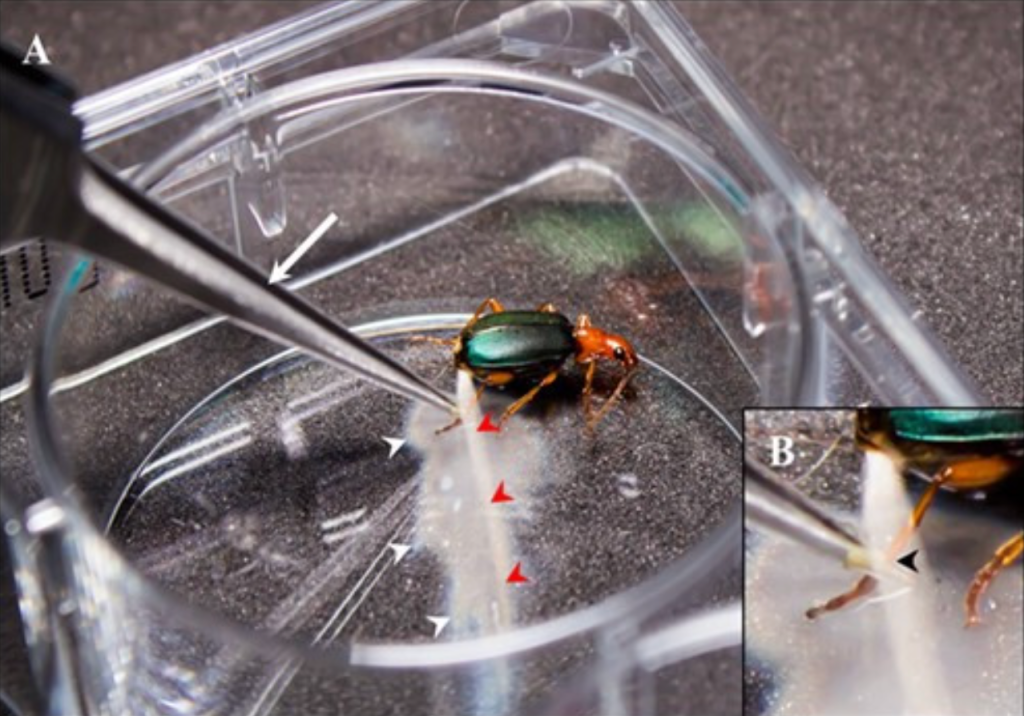
Source: Vogel et al. (2025).
Although the mechanism of the bombardier beetle’s spray is interesting for chemical analysis and to further understand life around us, it has also provided inspiration for engineering. Researchers developed an experimental spray device called μMist, using a heated chamber to recreate some of the high-speed discharge behaviour (James et al. 2013). The proposed applications include inhalers and nebulizers, fire extinguishers and fuel-injection systems. Interestingly, the device could recreate the spray using rapid heating and flash evaporation, without needing to reproduce the beetle’s actual chemical reaction (James et al. 2013). Ultimately, a defence mechanism found in a small insect has become a model for designing systems that can rapidly and efficiently eject liquids.
References
Arndt, Eric M., Wendy Moore, Wah-Keat Lee, and Christine Ortiz. 2015. “Mechanistic origins of bombardier beetle (Brachinini) explosion-induced defensive spray pulsation.” Science 348 (6234): 563-567. https://doi.org/10.1126/science.1261166
González-Tokman, Daniel, Alex Córdoba-Aguilar, Wesley Dáttilo, Andrés Lira-Noriega, Rosa A. Sánchez-Guillén, and Fabricio Villalobos. 2020. “Insect Responses to Heat: Physiological Mechanisms, Evolution and Ecological Implications in a Warming World.” Biological Reviews 95 (3): 802–21. https://doi.org/10.1111/brv.12588.
James, Alex, Ken Morison, and Simon Todd. 2013. “A Mathematical Model of the Defence Mechanism of a Bombardier Beetle.” Journal of the Royal Society Interface 10 (79): 20120801. https://doi.org/10.1098/rsif.2012.0801.
Mehta, Ridhi, Paavan Singhal, Hardeep Singh, Dhanashree Damle, and Anil K. Sharma. 2016. “Insight into Thermophiles and Their Wide-Spectrum Applications.” 3 Biotech 6 (1): 81. https://doi.org/10.1007/s13205-016-0368-z.
Vogel, Heiko, Nicolai Rügen, Natalie Wielsch, Richard M. Twyman, Miray Tonk-Rügen, and Andreas Vilcinskas. n.d. “Molecular Basis of the Explosive Defence Response in the Bombardier Beetle Brachinus Crepitans.” Royal Society Open Science 12 (5): 241823. https://doi.org/10.1098/rsos.241823.


Leave a Reply
You must be logged in to post a comment.