When we consider how the world is viewed, sight immediately comes to mind. However, sight relies less on visual perception but how our brains interpret information.
Complex auditory tools are used in many biological organisms, and it has recently been found that humans can learn skills used by echolocating animals through the clicks of our tongues (Norman et al. 2021). Echolocation is typically associated with bats and whales, and the mechanism behind this tool involves many different movements, environments, and parts of the nervous system (Moss and Surlykke 2010).
Echolocation is used in animals to perceive their surrounding environments through the production and processing of sound waves. Mobile animals such as bats and whales are in a dynamic acoustic environment during their action. This results in echo parameters that vary based on time as a consequence of received frequencies from prey, their own movement, and their surroundings (Moss and Surlykke 2010). Bats have evolved to use specialized mechanisms to help them identify prey by exploiting the doppler shift (Yoshida et al. 2026). This is done through the emission of signals with both constant frequency and frequency-modulated components. A Doppler shift is induced by the reflection of constant frequency components off of a moving surface, providing information about potential prey or predators. Bats also create a Doppler shift from their own movement, which is combatted by the lowering of frequencies emitted by the bat, allowing frequencies that are reflected to remain constant (Yoshida et al. 2026).
The reception of sound wave frequencies in echolocating animals is mediated by the nervous system (Fitzpatrick et al. 1993). Similar to other animals, neurons in the primary auditory complex of bat species Pteronotus parnellii, the Mustache Bat, respond to single frequencies. However, due to the reception of many signals, different neural activity can be exhibited. It has been found that neuronal facilitation, the response of a neuron being stronger upon the stimulation from 2 signals at once rather than the response from the individual stimulation of those signals, occurs in the doppler-shifted constant-frequency area of the brain (Figure 1). This response is sensitive to echo delays, corresponding to distances of around four metres away. This is the typical distance for this species to respond to prey, demonstrating how sounds can elicit the brain’s extraction of spatial information (Fitzpatrick et al. 1993). Different classes of neurons were displayed in Pteronotus parnellii: tracking neurons and range-tuned neurons. Tracking neurons have a delayed response that gets shorter as the bat is in a closer range to the reflected signal, and range-tuned neurons have a constant delay that only responds within a certain range of signal reception. These neuron types provide evidence for the vast system of neurons in echolocating species that respond to different target distances (O’Neill and Suga, 1979).
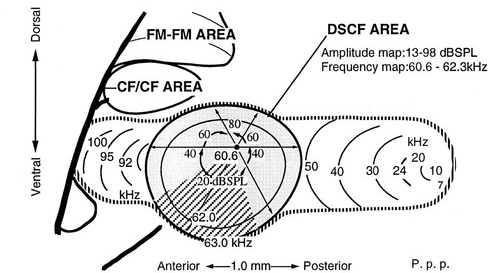
The mechanisms of echolocation demonstrate the relationship between neurological processes and the physics of sound, exhibiting how invisible waves of sound can be transformed into meaningful information for spatial awareness.
References:
Fitzpatrick, Dc, Js Kanwal, Ja Butman, and N. Suga. 1993. “Combination-Sensitive Neurons in the Primary Auditory Cortex of the Mustached Bat.” The Journal of Neuroscience 13 (3): 931–40. https://doi.org/10.1523/JNEUROSCI.13-03-00931.1993.
Kanwal, Jagmeet S., Douglas C. Fitzpatrick, and Nobuo Suga. 1999. “Facilitatory and Inhibitory Frequency Tuning of Combination-Sensitive Neurons in the Primary Auditory Cortex of Mustached Bats.” Journal of Neurophysiology 82 (5): 2327–45. https://doi.org/10.1152/jn.1999.82.5.2327.
Norman, Liam J., Caitlin Dodsworth, Denise Foresteire, and Lore Thaler. 2021. “Human Click-Based Echolocation: Effects of Blindness and Age, and Real-Life Implications in a 10-Week Training Program.” PLOS ONE 16 (6): e0252330. https://doi.org/10.1371/journal.pone.0252330.
O’Neill, William E., and Nobuo Suga. 1979. “Target Range-Sensitive Neurons in the Auditory Cortex of the Mustache Bat.” Science 203 (4375): 69–73. https://doi.org/10.1126/science.758681.
Surlykke , Annemarie, and Cynthia F. Moss. 2010. “Probing the Natural Scene by Echolocation in Bats.” Frontiers in Behavioral Neuroscience, ahead of print. https://doi.org/10.3389/fnbeh.2010.00033.
Yoshida, Soshi, Haruhito Mastumoto, Kohta I. Kobayasi, and Shizuko Hiryu. 2026. “Horseshoe Bats (Rhinolophus Nippon) Suppress Clutter Noise through Echolocation Frequency Control to Detect Prey.” Communications Biology 9 (1): 663. https://doi.org/10.1038/s42003-026-10217-9.


Leave a Reply
You must be logged in to post a comment.