Imagine living on a world where the Sun never sets—eternally hanging on the horizon—while the other side of your planet sits forever in cool darkness. Just 40 light-years away, there exists a system of seven Earth-sized planets, all orbiting much closer to their star than Mercury does to the Sun, but many still remarkably residing within the habitable zone (Major 2026). The planets are all tidally locked to their cool, red-dwarf host star and are thought to have formed between 5.4 and 9.8 billion years ago (NASA Science 2017). This TRAPPIST-1 system is a nearby, captivating prospect in the search for extraterrestrial life, but could life really have persisted through the high levels of harmful radiation and flaring events characteristic of red-dwarf stars?
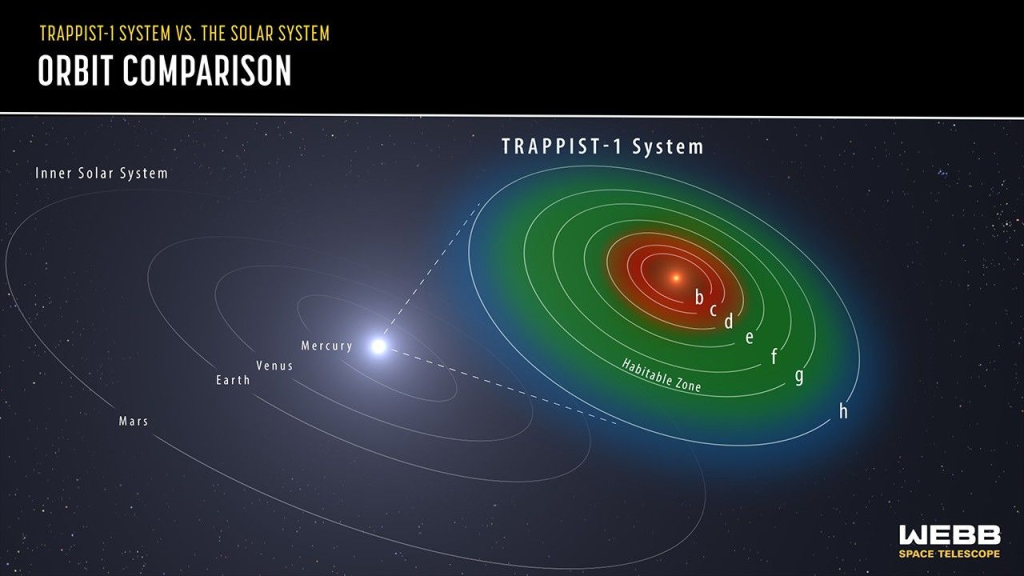
Red-dwarfs, or M stars, are smaller and dimmer than Sun-like G-stars but are the most common star in the galaxy (NASA Science 2025). Because they emit much less energy, planets in their systems must orbit much closer to obtain sufficient warmth for liquid water to exist on the surface. Thus, the habitable zones of red-dwarf stars are significantly closer than the habitable zone of our own solar system. According to Eric T. Wolf (2017), TRAPPIST-1e is a viable candidate for habitability, lying close to the middle of the system’s habitable zone. This climate modelling shows that the closely orbiting planets of red-dwarf solar systems still have the potential to maintain stable climates and liquid surface water.
These red-dwarf habitable zones, however, present an interesting paradox in terms of biological potential (Segura et al. 2010). On one hand, these stars are the most abundant in the galaxy, making them an ideal target for habitable planets. However, these closely orbiting planets would be subject to severe space weather conditions associated with M stars, including stellar flares and stellar wind, which risk stripping orbiting planets of their atmospheres (CFA 2014).
But what if these solar flares were exactly the right ingredient for abiogenesis? Early Earth is thought to have been an UV-rich environment, which influenced many prebiotic pathways (Ranjan et al. 2017). Planets orbiting M stars actually obtain less UV radiation than other solar-type stars, which is hypothesized to be a challenge for the development of prebiotic chemistry. Ranjan et al. (2017) suggests that the red-dwarf solar flares may be able to compensate for the low UV energy emitted by the stars, potentially catalyzing prebiotic pathways for the origin of extraterrestrial life.
Further planetary exploration is sure to reveal more about red-dwarf stars and the potential habitability of their orbiting planets. Exploration on the nearby TRAPPIST-1 system continues as the James Webb Space Telescope continues to collect observations (Major 2026) which may reveal how the seemingly inhospitable conditions of red-dwarf systems may actually be exactly what life needs!
References
CFA. 2014. “Harsh Space Weather May Doom Potential Life on Red-Dwarf Planets.” Center for Astrophysics – Harvard & Smithsonian, June 2. https://www.cfa.harvard.edu/news/harsh-space-weather-may-doom-potential-life-red-dwarf-planets.
Major, Abigail. 2026. “What Is Webb Revealing About the TRAPPIST-1 System?” James Webb Space Telescope (JWST). NASA, January 15. https://science.nasa.gov/mission/webb/science-overview/science-explainers/what-is-webb-revealing-about-the-trappist-1-system/.
NASA Science. 2017. “TRAPPIST-1 Is Older Than Our Solar System.” Exoplanets. NASA, August 11. https://science.nasa.gov/universe/exoplanets/trappist-1-is-older-than-our-solar-system/.
NASA Science. 2025. The Habitable Zone. Exoplanets. September 3. 141. https://science.nasa.gov/exoplanets/habitable-zone/.
Ranjan, Sukrit, Robin Wordsworth, and Dimitar D. Sasselov. 2017. “The Surface UV Environment on Planets Orbiting M Dwarfs: Implications for Prebiotic Chemistry and the Need for Experimental Follow-Up.” The Astrophysical Journal 843 (2): 110. https://doi.org/10.3847/1538-4357/aa773e.
Segura, Antígona, Lucianne M. Walkowicz, Victoria Meadows, James Kasting, and Suzanne Hawley. 2010. “The Effect of a Strong Stellar Flare on the Atmospheric Chemistry of an Earth-like Planet Orbiting an M Dwarf.” Astrobiology 10 (7): 751–71. https://doi.org/10.1089/ast.2009.0376.
Wolf, Eric T. 2017. “Assessing the Habitability of the TRAPPIST-1 System Using a 3D Climate Model.” The Astrophysical Journal Letters 839 (1): L1. https://doi.org/10.3847/2041-8213/aa693a.


Leave a Reply
You must be logged in to post a comment.