The revelation that ribonucleic acid (RNA) can act as a catalyst in many biologically important reactions revolutionized our understanding of life’s origins, placing RNA at the heart of the “RNA World” hypothesis (Higgs and Lehman 2015). Therefore, understanding the origin of the building blocks that make up RNA is a crucial step in uncovering how life emerged on Earth. While significant progress has been made in understanding how nucleobases and phosphates formed, the prebiotic origin of the sugar backbone remains a subject of debate (Omran 2023).
In 1859, Alexander Butlerov discovered the formose reaction, demonstrating that heating formaldehyde under alkaline conditions yielded a mixture of sugars, which was verified through Butlerov’s own tasting of the solution (Omran et al. 2020). Because formaldehyde has been abundantly found in interstellar space and could have been delivered to Earth via meteorites, the formose reaction has long been considered the key pathway for prebiotic synthesis of essential sugars, such as ribose (Omran 2023). However, despite its geochemical plausibility, the reaction’s relevance to prebiotic chemistry faces doubts due to the inherent instability of sugar under alkaline conditions (Benner et al. 2012). Furthermore, the formose reaction, when reproduced in a lab at ambient temperatures, yields a mixture containing unwanted branched ketoses and tar formation. These drawbacks complicate the argument that the formose reaction alone provided the ribose needed for life on early Earth, with researchers proposing alternate pathways and environments for prebiotic sugar synthesis (Krishnamurthy and Liotta 2023).
Supported by recent detections of extraterrestrial sugars in meteorites, another leading hypothesis proposes an exogenous origin, suggesting that prebiotic sugars were delivered to Earth. The first discovery of extraterrestrial ribose was reported by Furukawa et al. in 2019, where ribose, arabinose, xylose, and lyxose were identified in the Murchison meteorite. Subsequently, in 2026, analysis of samples from the asteroid Bennu also revealed many of these biologically relevant sugars . These discoveries raised an intriguing question regarding the chemical pathways that drove sugar synthesis in extraterrestrial environments.
Interestingly, comparing the relative abundance of these extraterrestrial sugars with those produced by the formose reaction under laboratory conditions revealed a resemblance (Figure 1). When heated under a prolonged period of time (390 minutes), it was found that formation of linear aldopentoses was favoured over unwanted branched ketoses (Furukawa et al. 2026). This shift in the distribution of products, along with the similarity between the relative abundance of sugars found on Bennu, demonstrates that prebiotic sugar synthesis may have been more favourable in the warm, alkaline aqueous environments of asteroid bodies.
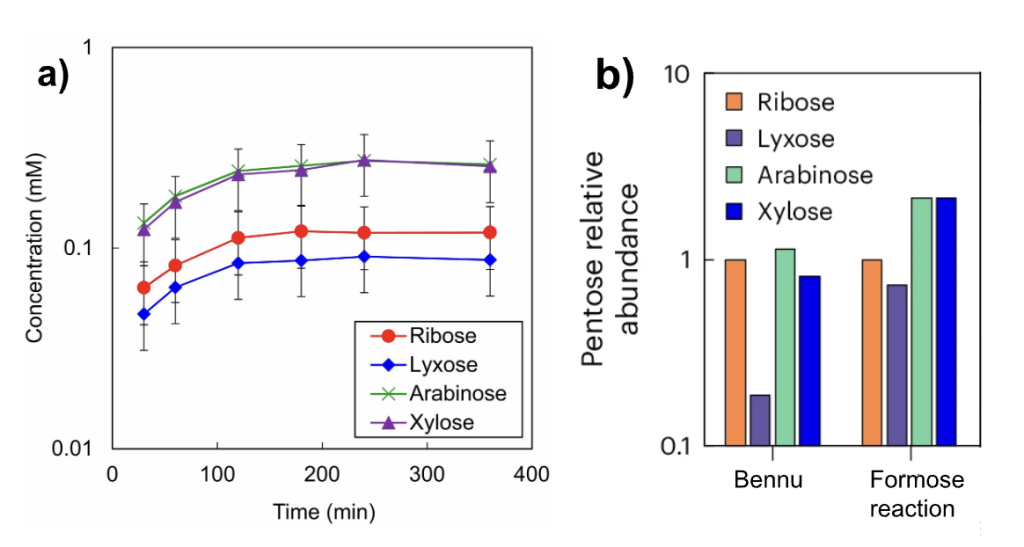
Figure 1. (A) The concentrations of aldopentoses in a formose-like reaction product conducted with 100 mM formaldehyde, 10 mM glycolaldehyde dissolved in ammonia buffer (pH 9.6) at 90ºC (Furukawa et al. 2019). (B) Relative abundances of pentoses in Bennu compared to that observed in the formose-type reaction in (A) (Furukawa et al. 2026).
Ultimately, these findings demonstrate the plausibility of the formose reaction occurring outside of Earth, opening up another avenue for sugar synthesis beyond terrestrial environments. Given the recency of these discoveries, more research is needed to accurately determine the reasons why sugar synthesis was more favourable on asteroids bodies than on early Earth. Nonetheless, the case study of prebiotic sugars exemplifies how the underlying reaction does not necessarily need to change, but only where and when it takes place.
References
Benner, Steven A., Hyo-Joong Kim, and Matthew A. Carrigan. 2012. “Asphalt, Water, and the Prebiotic Synthesis of Ribose, Ribonucleosides, and RNA.” Accounts of Chemical Research 45 (12): 2025–34. https://doi.org/10.1021/ar200332w.
Furukawa, Yoshihiro, Yoshito Chikaraishi, Naohiko Ohkouchi, et al. 2019. “Extraterrestrial Ribose and Other Sugars in Primitive Meteorites.” Proceedings of the National Academy of Sciences 116 (49): 24440–45. https://doi.org/10.1073/pnas.1907169116.
Furukawa, Yoshihiro, Sako Sunami, Yoshinori Takano, et al. 2026. “Bio-Essential Sugars in Samples from Asteroid Bennu.” Nature Geoscience 19 (1): 19–24. https://doi.org/10.1038/s41561-025-01838-6.
Higgs, Paul G., and Niles Lehman. 2015. “The RNA World: Molecular Cooperation at the Origins of Life.” Nature Reviews Genetics 16 (1): 7–17. https://doi.org/10.1038/nrg3841.
Krishnamurthy, Ramanarayanan, and Charles Liotta. 2023. “The Potential of Glyoxylate as a Prebiotic Source Molecule and a Reactant in Protometabolic Pathways—The Glyoxylose Reaction.” Chem 9 (4): 784–97. https://doi.org/10.1016/j.chempr.2023.03.007.
Omran, Arthur. 2023. “Plausibility of the Formose Reaction in Alkaline Hydrothermal Vent Environments.” Origins of Life and Evolution of Biospheres 53 (1): 113–25. https://doi.org/10.1007/s11084-020-09599-5.
Omran, Arthur, Cesar Menor-Salvan, Greg Springsteen, and Matthew Pasek. 2020. “The Messy Alkaline Formose Reaction and Its Link to Metabolism.” Life 10 (8): 125. https://doi.org/10.3390/life10080125.


Leave a Reply
You must be logged in to post a comment.