Most people think of weeds as small, rapidly spreading plants like dandelions or plantains. So what happens when the trees become weeds? The Tree of Heaven (Ailanthus altissima) is anything but heavenly, instead a native to China and northern Vietnam. It has become invasive in many regions like in North America and Europe due to rapid growth, abundant wind-dispersed seeds, the ability to produce new shoots from its roots, and chemical compounds that can interfere with other plants (Soler & Izquierdo 2024).
One of Tree of Heaven’s best-studied chemical strategies is allelopathy. This occurs when a plant releases chemicals into its surroundings that affect the germination, growth or development of other plants. Researchers have focused on a secondary metabolite known as ailanthone, which are part of a broader group known as quassinoids. These specialised chemicals influence interactions between plants and their environment (Chuang et al. 2022) to net Tree of Heaven an advantage over the competition. Chuang et al. also traced the first three steps in quassinoid biosynthesis to provide a biochemical foundation for understanding how Tree of Heaven produces these metabolites (Figure 1).
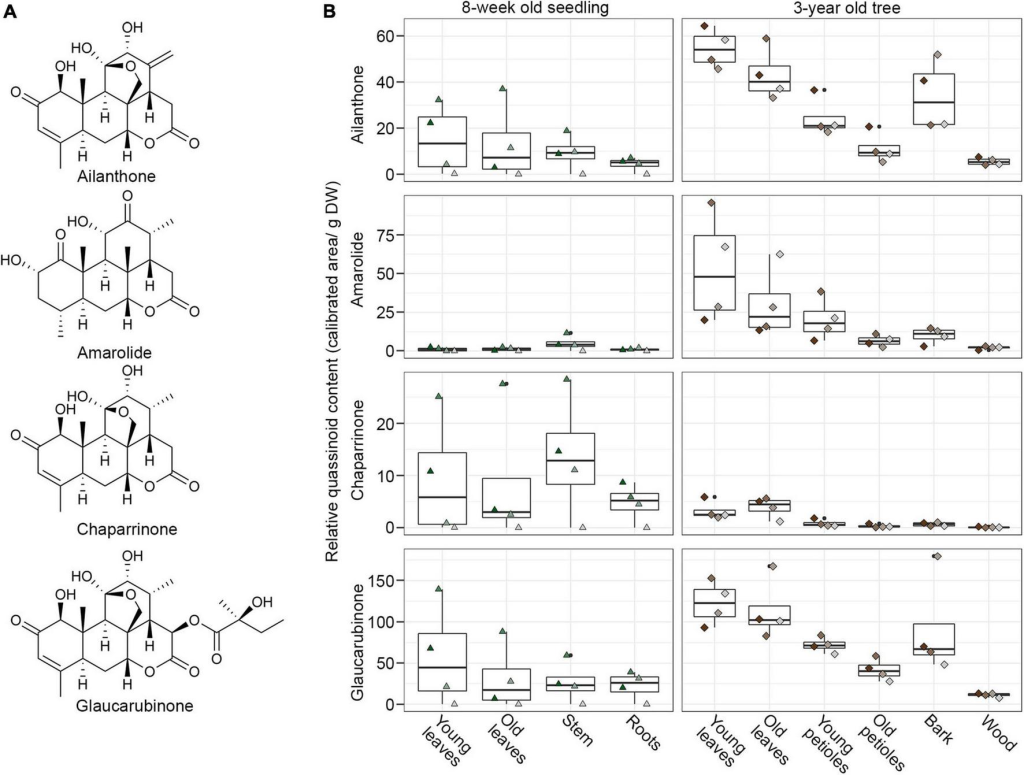
There is also evidence of phytotoxic substances within Trees of Heaven. Heisey (1990) found that extracts and powdered material from roots and leaves inhibited the growth of garden cress. The strongest activity was associated with root bark. Fine roots also reduced the growth of nearby seedlings. These suggest that the tree’s root system may cause chemical interference, potentially affecting any plants attempting to grow nearby.
In addition to chemical interference, Tree of Heaven also has great damage tolerance, letting it outlast competitors. With an extensive root system capable of producing new shoots (known as root suckers) following damage to the main stem, their root systems can produce vigorous regrowth even when the trees are cut down. This allows populations to persist despite repeated disturbance (Soler & Izquierdo 2024).
The Tree of Heaven is also an r-selected species, with rapid growth and high reproductive rate, letting it rapidly infest suitable areas and push native competitors out. Female Tree of Heaven individuals can produce up to 300,000 seeds annually, begin flowering as early as their fourth year, and disperse seeds through wind. Root suckering further increases their vegetative reproduction offering another way for populations to expand (Soler & Izquierdo 2024).
Together this suggests that the Tree of Heaven’s invasiveness is a combination of being more tolerant than its competitors and the ability to use secondary metabolites to decrease the competitive abilities of native plants. The quassinoids it produces hinders the growth of surrounding competitors and the short maturity time, large scale seed releases, and root puckering let the species be incredibly tolerant of otherwise devastating environmental damage.
References:
Chuang, L., Liu, S., Biedermann, D., & Franke, J. (2022). Identification of early quassinoid biosynthesis in the invasive tree of heaven (Ailanthus altissima) confirms evolutionary origin from protolimonoids. Frontiers in Plant Science, 13, 958138. https://doi.org/10.3389/fpls.2022.958138
Gómez-Aparicio, L., & Canham, C. D. (2008). Neighbourhood analyses of the allelopathic effects of the invasive tree Ailanthus altissima in temperate forests. Journal of Ecology, 96, 447–458. https://doi.org/10.1111/j.1365-2745.2007.01352.x
Heisey, R. M. (1990). Evidence for allelopathy by tree-of-heaven (Ailanthus altissima). Journal of Chemical Ecology, 16(6), 2039–2055. https://doi.org/10.1007/BF01020515
Soler, J., & Izquierdo, J. (2024). The invasive Ailanthus altissima: A biology, ecology, and control review. Plants, 13(7), 931. https://doi.org/10.3390/plants13070931

Leave a Reply
You must be logged in to post a comment.