The origins of how Earth formed has historically been highly debated, even to this day there is no universally agreed theory. In the early 1800s the European Western world widely believed that the Earth had biblical origins; James Ussher even attempted aging the Earth based on the bible where he calculated Earth’s creation at 4004 BCE (Friedman and Endress 2020).
Around the 1970s, mineralist Abraham Werner popularized a new school of thought called Neptunism which believed that the Earth was originally covered by ocean that the continental crust was precipitated from (Jenkins 2016). This set of ideas got pushback from geologists at the time, including James Hutton, who in 1785 became a main supporter of the Plutonism theory. Plutonists believed that Earth’s crust formed predominantly from the cooling of magma from volcanic activity (Master 2009).
George Greenough (1778-1856) was an English geologist who is not as popular in the discussion of how neptunist and plutonist views began falling out of public favour, however he nevertheless was an important piece in this shift (Rudwick 1962a). He was interested in, like many other geologists at the time, understanding Earth’s origins and eventually acclaimed fame after studying phenomena in Scotland in the early 1800s. In 1805 he travelled to Scotland on land for over 900 miles (1448 kilometers) and over 700 miles (1126 kilometers) by sea (“The Geological Society – Scotland,” n.d.), (Rudwick 1962b). Most of the records from this trip are of his personal written observations in which he comments on the geologic landforms, and how his observations agree with or differ from others at the time. On this trip, he brought with him lawyer and artist James Skene, who made drawings of the visited landforms. Some of these drawings were later donated to The Geologic Society that were matched to the described locations by Greenough in his journal.
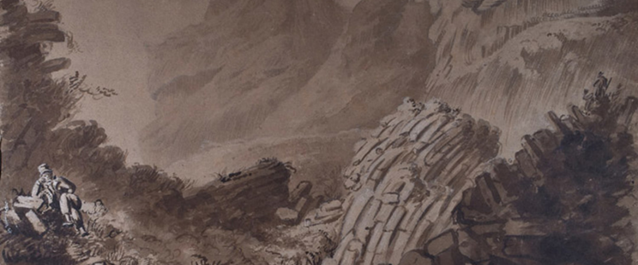
Figure 1 – ‘Scur Eigg in the Hebrides’ created by James Skene in approximately 1805 depicting the igneous rock of the Sgurr of Eigg Pitchstone in the Isle of Eigg of Northwest Scotland. Drawings were donated to The Geologic Society in January of 1810 (Brown and Bell 2013).
Greenough didn’t agree with the approach popular geologists such as Hutton and Werner had on an all-encompassing theory on how Earth was formed (Rudwick 1962b). Instead, he believed that both sides made interesting points, with explanations from both sides potentially having merit.
Greenough looked at basalt that did not match the surrounding rock layers, or visible dikes, that had a different interpretation from Werner. Werner proposed (from his Neptunist view) that as the basalt formed in the oceans, there were small cracks that filled with precipitated minerals that became the dikes. However Greenough pointed out that the basaltic dikes cut across both what Werner called ‘primitive’, the oldest layer of rock that formed first, and ‘secondary’, the layers that formed on top of older rock layers. Therefore, not agreeing with his ideas on sedimentary primitive and secondary rock layers being precipitated out of the ocean (Rudwick 1962b).
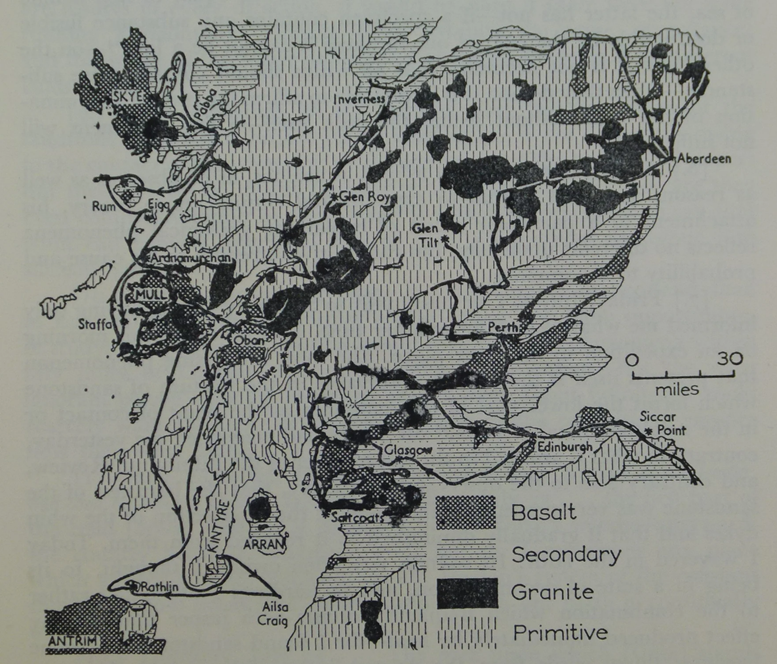
Figure 2 – Map of path that George Greenough took on his two month journey through Scotland in 1805. The dark lines with arrows show the direction of his path through the country. The geology comes from modern interpretations of the geology at the time, including what was thought of as primitive (crystalline, oldest rock layer) and secondary rock (flat-layered rock with fossils) (Rudwick 1962b).
The layers of basalts between sedimentary rock observed by Greenough, called sills, were believed to be injected from below by James Hutton. This idea was rejected by Greenough when he states in his observations that this would require a large amount of force to push the basalt up, to which the layers seemed undisturbed (Rudwick 1962a), (Rudwick 1962b).
With his observations, it was certain that no singular explanation for how Earth was formed could be agreed on. George Greenough’s investigations further pushed a new wave of ideas to follow in the future, ones that were less strict on one singular event or process, but of a series of processes. One such being with Charles Lyell’s theories on Uniformitarianism, which without Greenough’s observations would be less widely accepted.
References
Brown, David J., and Brian R. Bell. 2013. “The Emplacement of a Large, Chemically Zoned, Rheomorphic, Lava-like Ignimbrite: The Sgurr of Eigg Pitchstone, NW Scotland.” Journal of the Geological Society 170 (5): 753–67. https://doi.org/10.1144/jgs2012-147.
Friedman, William E., and Peter K. Endress. 2020. “Alexander Moritzi, a Swiss Pre-Darwinian Evolutionist: Insights into the Creationist-Transmutationist Debates of the 1830s and 1840s.” Journal of the History of Biology 53 (4): 549–85. https://doi.org/10.1007/s10739-020-09619-0.
Jenkins, Bill. 2016. “Neptunism and Transformism: Robert Jameson and Other Evolutionary Theorists in Early Nineteenth-Century Scotland.” Journal of the History of Biology 49 (3): 527–57. https://doi.org/10.1007/s10739-015-9425-4.
Master, Sharad. 2009. “Plutonism versus Neptunism at the Southern Tip of Africa: The Debate on the Origin of Granites at the Cape, 1776–1844.” Earth and Environmental Science Transactions of The Royal Society of Edinburgh 100 (1–2): 1–13. https://doi.org/10.1017/S1755691009016193.
Rudwick, M. J. S. 1962a. “Hutton and Werner Compared: George Greenough’s Geological Tour of Scotland in 1805.” The British Journal for the History of Science 1 (2): 117–35.
Rudwick, M. J. S. 1962b. “Hutton and Werner Compared: George Greenough’s Geological Tour of Scotland in 1805.” The British Journal for the History of Science 1 (2): 117–35. https://doi.org/10.1017/S000708740000131X.

Leave a Reply
You must be logged in to post a comment.