When you walk across a beach, the sand underfoot simply makes a soft, sad crunch. Step onto the steep face of certain desert dunes in Morocco, Oman, or California, however, and your footsteps can create hums – music, even – audible kilometres away. Early travellers blamed eerie desert spirits. Terrified modern-day backpackers might also do that. Whatever the case, the dunes’ sounds have been compared to propeller planes or cello noises, which brings up the question: how can millions of grains of sand suddenly coordinate to play a clear musical note?
Solving the mystery of these singing dunes requires us to look back at how they were formed. Winds in the area sweep sand up a dune, sorting sand grains until they are uniformly rounded (Hunt and Vriend 2010). These grains build up a crescent-shaped dune, also known as a barchan dune, with one steep and one gentle face. When disturbed by your boot, the sand on the steep face starts to cascade downward in something called a sand avalanche (Figure 1).
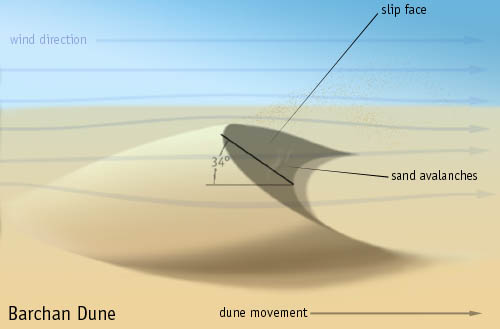
Instead of gliding smoothly down, grains hop and roll over the stationary sand below and drop into pockets between neighbours, each bounce compressing a minute puff of air (Bagnold 1966). Tens of thousands of grains, and millions of collisions, create a synchronized vibration between 70 and 105 hertz. Coincidentally, this happens to be roughly where the lowest string of the cello lies (Douady et al. 2006; Hunt & Vriend 2010).
Surface chemistry is just one half of the piece, however. Sand carries a thin, glassy mineral coat called “desert glaze” that helps vibrations travel cleanly between grains. Rub that smooth layer away through repeated sliding, and it goes mute (Douady et al. 2006). Dryness of the sand matters just as much – even a little humidity lets sand grains stick to each other and form a sandy mush (Hunt and Vreind 2010). This is why the phenomenon will not occur after a rare desert rain.
Still, it is debated how these sand sheets project sound across a valley. Andreotti (2004) showed that elastic waves rippling through the sand nudge grains into an even tighter lockstep, amplifying the resulting sound wave. Looking at the whole dune, Vriend et al. (2007) proposed a natural sound channel produced by the differences in the dry outer layer over the denser, damper core. Thanks to differences in the speed of sound depending on how dense the medium is, sound becomes trapped between the lower and upper layers, and as sound waves ricochet everywhere they build up into one giant wavelength thanks to a phenomenon called constructive interference (where sound waves with similar wavelengths will reinforce each other). This giant soundwave will eventually break its way free into the air, with its pitch determined by the thickness of the top layer (Vriend et al. 2007; Hunt and Vriend 2010).
In the end, many things must go right for this mystical phenom to materialize. Grains of sand must be rolled around until they are bone dry and at the right size. Add any blocker, like rain, and no music happens. When everything falls into place, though, the results are nothing short of magical. Perhaps the legends were true – the spirits might be the ones deciding if you are lucky enough to hear the desert’s music.
Works Cited
Andreotti, B. 2004. “The Song of Dunes as a Wave-Particle Mode Locking.” Physical Review Letters 93 (23): 238001. https://doi.org/10.1103/physrevlett.93.238001.
Bagnold, Ralph Alger. 1966. “The Shearing and Dilatation of Dry Sand and the ‘Singing’ Mechanism.” Proceedings of the Royal Society of London. Series A. Mathematical and Physical Sciences 295 (1442): 219–32. https://doi.org/10.1098/rspa.1966.0236.
Douady, S., A. Manning, P. Hersen, et al. 2006. “Song of the Dunes as a Self-Synchronized Instrument.” Physical Review Letters97 (1): 018002. https://doi.org/10.1103/physrevlett.97.018002.
Hunt, Melany L., and Nathalie M. Vriend. 2010. “Booming Sand Dunes.” Annual Review of Earth and Planetary Sciences 38 (1): 281–301. https://doi.org/10.1146/annurev-earth-040809-152336.
Vriend, Nathalie M., Melany L. Hunt, Robert W. Clayton, Christopher Earls Brennen, Katherine S. Brantley, and Angel Ruiz-Angulo. 2007. “Solving the Mystery of Booming Sand Dunes.” Geophysical Research Letters 34 (16). https://doi.org/10.1029/2007gl030276.
Wikimedia Commons. n.d. A Diagram of a Barchan Dune (Crescent Duna, Arc Dune).https://commons.wikimedia.org/wiki/File:Barchan.jpg.

Leave a Reply
You must be logged in to post a comment.