Located in the heart of Africa lies the Great Rift Valley. Situated on a divergent plate boundary, this 7000 km series of trenches has fashioned a string of great lakes. The greatest of them all, Lake Tanganyika. As the second oldest lake and second largest lake by volume, Tanganyika has been an evolutionary powerhouse for the past 10 million years (Scheffel, R.L., 1980). This freshwater system has evolved to act with great resemblance to an ocean, housing a colourful assemblage of diverse species such as jellyfish, snails, sponges, crabs, turtles, and over 300 species of fish (Kelly West, 2001).
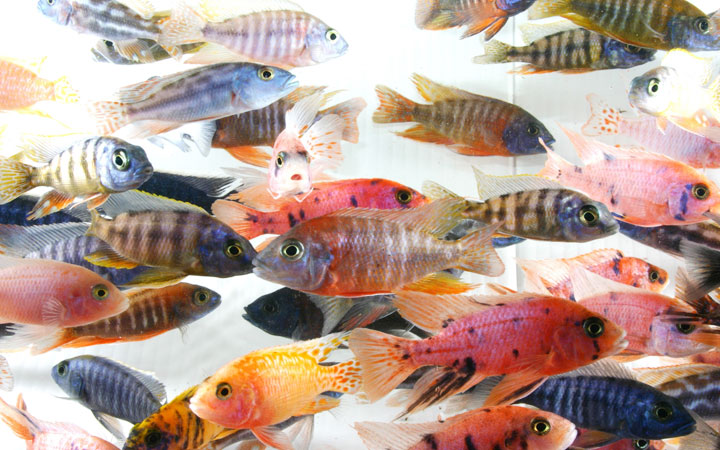
Of all the species to colonize this massive body of water, the most dominant force was a small and unassuming family of fish called Cichlidae. Over 250 species of Cichlid fish can be found in Lake Tanganyika and nearly all of them (98%) are endemic, meaning they cannot be found anywhere else in the world (Takahashi and Hori, 2012). Cichlids represent the most diverse extent of adaptive radiation observed globally for all vertebrates, making them an extraordinary case study for speciation and evolution (Meyer, Matschiner and Salzburger, 2015). This rapid diversification of species is clear by observing the community of stunning fish in Figure 1 below.
The vast adaptive radiation of these remarkable fish can be distilled down into three main stages of speciation mechanisms (see Figure 2). The first influential stage is habitat divergence, represented by the distinct rock- and sand-dwelling Cichlids (Kocher, 2004). This form of allopatric speciation, when a species separates into two separate groups, will influence the second stage which is characterized by the diversification of morphological feeding apparatuses (Danley and Kocher, 2001a). Selective pressures presented challenges for generalists which resulted in extensive mouth morphologies specialized for certain trophic adaptations. Distinguished by natural selection from trophic competition, Cichlid species diverged, becoming herbivores, detritivores, planktivores, insectivores, scale-eaters, and much more. Finally, the third major stage of speciation is characterized by colour patterns, which implies individualized sexual selection (Danley and Kocher, 2001a). It has been found that the male of most Cichlid species contribute absolutely no genes to their offspring. This has led to sexual dimorphism in many cichlid species due to the runaway evolution of male traits dictated by female mating preferences, for example, brighter coloured males (Kocher, 2004).

Cichlids are known to be incredibly social and have been observed to form complex social hierarchies. Both male and female fish strive to climb the dominance hierarchy. When given the opportunity for social status ascent, fish will engage in more aggressive behaviours such as chasing or mouth fighting another fish. If successful, social status ascension will better their chances of reproduction, particularly in males (Alonso et al., 2012). Cichlids also have a wide range of social parental care practices, including mouthbrooding by housing offspring in their mouth for extended periods of time. Once these offspring develop further, another common tactic is collaborative parental care of the free-swimming juvenile offspring for several weeks (Kocher, 2004).
All of these factors act in confluence and are vital in creating niche differentiation to allow for more unique species to coexist within the same population. By better understanding Cichlid speciation, we gain a magnified lens into evolutionary biology and the selective mechanisms at play during adaptive evolution.
References
Alonso, F., Honji, R.M., Guimarães Moreira, R. and Pandolfi, M., 2012. Dominance hierarchies and social status ascent opportunity: anticipatory behavioral and physiological adjustments in a Neotropical cichlid fish. Physiology & Behavior, 106(5), pp.612–618. https://doi.org/10.1016/j.physbeh.2012.04.003.
Danley, P.D. and Kocher, T.D., 2001a. Speciation in rapidly diverging systems: lessons from Lake Malawi. Molecular Ecology, 10(5), pp.1075–1086. https://doi.org/10.1046/j.1365-294x.2001.01283.x.
Danley, P.D. and Kocher, T.D., 2001b. Speciation in rapidly diverging systems: lessons from Lake Malawi. Available at: <10.1046/j.1365-294x.2001.01283.x> [Accessed 14 February 2022].
Fabian, 2021. 10 Most Colorful African Cichlids. [Photograph] Available at: <https://www.aquariumnexus.com/colorful-african-cichlids/>.
Kelly West, 2001. Lake Tanganyika: Results and Experiences of the UNDP/GEF Conservation Initiative (RAF/92/G32) in Burundi, D.R. Congo,Tanzania, and Zambia. Available at: <https://iwlearn.net/resolveuid/042764c4d828970e559f86feeb1ce710> [Accessed 14 February 2022].
Kocher, T.D., 2004. Adaptive evolution and explosive speciation: the cichlid fish model. Nature Reviews Genetics, 5(4), pp.288–298. https://doi.org/10.1038/nrg1316.
Meyer, B.S., Matschiner, M. and Salzburger, W., 2015. A tribal level phylogeny of Lake Tanganyika cichlid fishes based on a genomic multi-marker approach. Molecular Phylogenetics and Evolution, 83, pp.56–71. https://doi.org/10.1016/j.ympev.2014.10.009.
Scheffel, R.L., 1980. Reader’s Digest Natural Wonders of the World. Readers Digest.
Takahashi, T. and Hori, M., 2012. Genetic and Morphological Evidence Implies Existence of Two Sympatric Species in Cyathopharynx furcifer (Teleostei: Cichlidae) from Lake Tanganyika. International Journal of Evolutionary Biology, 2012, p.e980879. https://doi.org/10.1155/2012/980879.
Comments
9 Responses to “Cichlid Speciation Explosion in Lake Tanganyika”
Hello iSci!
I decided to write my blog post about the Cichlid fish I will be experimenting with for my IP. Although my project will only involve the Neolamprologus pulcher, also known as the Daffodil Cichlid, I wanted to highlight the unique circumstances which produced such a rare species richness in the Cichlidae family. I hope this post helps you appreciate the remarkable evolutionary history, adaptive physiology, and behavioural psychology of Cichlids. I look forward to hearing your feedback!
Cheers,
André
Hey André!
This is a really cool blog post! My appreciation for cichlids continues to grow by the day as I learn more about them. The fact that nearly all genes come from the female is really interesting and I’m glad you included that point. I just have a few suggestions:
1. It looks like you have a little bit of room to add more information in your post. I think it would be beneficial to expand more on the social hierarchies that cichlids form and how those have come about from the unique evolutionary environment the species’ find themselves in. You could also add a figure for this to help visualize the different types of interactions.
2. If you are going to expand your discussion on social interactions I would suggest making it a new paragraph in your post. As it stands right now your two paragraphs are quite long and I would even suggest splitting your first paragraph into two after the Kelly West, 2001 citation.
3. In your first paragraph you might want to consider including a citation for your statement that cichlids cannot be found anywhere else in the world. That’s a really cool fact and it would have more impact if supported by a paper.
Overall, this was a great post. I particularly enjoyed the tone with which you wrote the post – it really drew me in and I had a good time reading it. I hope my suggestions are helpful and happy editing!
Best regards,
Eric
Hi Eric!
Thanks for the citation and expansion suggestions. I’ve divided some paragraphs, added citations, and expanded on the social hierarchies.
Cheers,
André
Dear Andre,
I enjoyed reading your blog post immensely. I thought it was informative, creative, and well-written. It definitely reminded me of conversations about biology and science we’ve had in the past, and during class. I have suggestions to improve the post:
– I think you could use a distinct introductory paragraph to hook the reader and slowly guide them through your topic instead of diving straight into the science.
– I think your third to last sentence in paragraph one should be split into two sentences or condensed because it has two “and”‘s in it and a couple different ideas. Changing this would improve the coherency of the concepts being written.
– For figure captions, you don’t need to state “this figure is”, you can simply state the function of the figure directly.
– I think your second to last paragraph could also be split up as it, like your first paragraph, is very dense and the reader may get lost in the details. Try starting a new paragraph before covering the third major stage concept.
Sincerely, Muhammad
Hi Mo!
Thanks for the sentence and paragraph structure suggestions. I’ve divided some paragraphs and changed some sentences to improve flow.
Cheers,
André
Hi Andre,
Loved this post! Super cool to learn about adaptive radiation as it pertains to a real-world example.
Here are a few suggestions to consider while editing:
1. When you introduce Cichlids, make sure to include the complete name of the family, Cichlidae.
2. Consider supporting your second paragraph with a figure—it would be very helpful to illustrate the mechanisms behind this process and differentiate the forces at play.
3. There are a few terms throughout that would benefit from a definition, as the reader may not be immediately familiar with them, including ‘allopatric speciation’ and ‘mouthbrooding’.
4. The second paragraph is quite detailed and offers a great summary of how the adaptive radiation has occurred. It would be very interesting to provide some insight as to how these conclusions were drawn from evidence—are there some examples of laboratory or in-situ studies that provided the basis for these findings? I would suggest describing one or two of them briefly and separating the paragraph in two!
5. I would suggest supporting the information you have provided in the second part of the post with a few more citations to emphasize to the reader that these conclusions are widely accepted, and so that they can find out more if they’d like!
Hope these help!
Henry
Hi Henry!
Thanks for the citation and expansion suggestions. I’ve added some definitions, extra citations, and an additional figure to demonstrate the mechanisms of speciation.
Cheers,
André
Hi Andre,
Great post! I also enjoyed your tone of writing. I felt like I was reading a story which fit really well in this context! I just have a few suggestions for you:
1) I think you can add another comma to the second sentence of your first paragraph for better clarity in the sentence (i.e. “This 7000 km series of trenches, dividing a divergent plate boundary, forms a string of great lakes.”.
2) You call Cichlids “stunning” in both the last sentence of your second paragraph and the first sentence of your third paragraph. You could use another adjective in one of these instances to describe the fish more and prevent repetition!
3) In your fourth sentence, you have an extra ‘s’ on the end of the word million!
Thank you for sharing!
Take care,
Gillian
Hi Gill!
Thanks for the spelling and sentence structure suggestions. I’ve added your corrections and adjusted my word choice.
Cheers,
André