As the world has gained more insight into the disastrous effects lead can have on the human body, a large push has been made towards water quality testing. Perhaps most importantly, its links to causing neurological impairments have shed light on the importance of ensuring the availability of safe drinking water for all. Although it is well known that lead is not good for the human body, its long-term health effects and the ways in which it is detected are not as well understood.
Lead is a naturally occurring metal found in the Earth’s crust that has been a prominent part of human construction since the Romans used it in their aqueducts and water pipes (Morris, 2016). Unlike other metals, lead is easily malleable, explaining its constant use throughout human history (Morris, 2016). The negative effects of lead on human health truly began to gain more attention during the Industrial Revolution; however, lead pipes and paints within Canada were only officially banned in 1990 (Health Canada, 2021).
Lead is perhaps most dangerous due to its effects on the nervous system and brain development in children. Low levels of lead exposure may cause no observable symptoms; however, it can cause behavioural changes such as reduced attention span, intelligence quotient, and social behaviour in youth. Perhaps most distressingly, the neurological effects of lead currently have no treatment and cannot be reversed. Upon inhalation or ingestion, the chemical quickly travels through the bloodstream and is absorbed into many important bodily tissues and organs, such as the brain, heart, kidneys, liver, and bones. Over time, most of the lead present will accumulate in the teeth and bones and is released back into the bloodstream during pregnancy, posing a large health risk to a developing fetus (World Health Organization, 2023).
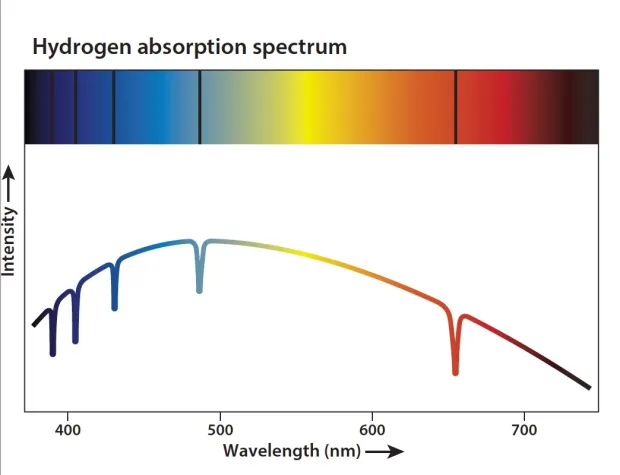
Luckily, humans have recently been able to use many different methods to detect lead in drinking water, one of which is through the use of atomic absorption spectroscopy. Atomic absorption spectroscopy plays on the fact that every metal will absorb light at a certain wavelength due its unique electron configuration (Visser, 2021). For this reason, if a certain element is exposed to its specific wavelength spectra, it will enter an excited state and absorb photons corresponding to that energy level. This will cause a striped pattern to appear (as can be seen in Figure 1) as certain colours are absorbed by an element while others are reflected. A detector can then record this data and determine which metal elements are present within a given sample. Additionally, as the amount of light absorbed by a given element is directly proportional to its concentration, the amount of a metal present in a given sample can also be determined from absorption spectroscopy (Visser, 2021).
Sadly, the testing equipment required for the detection of lead through the use of atomic absorption spectroscopy is very expensive (Wu et al., 2023). As a result, developing countries are often the most impacted by lead poisoning (Visser, 2021). However, as technology advances it can be hoped that innovation will allow for newer and cheaper methods of lead detection. When paired with international standards and funding, this may take the world one step closer to solving “the lead issue.”
Reference List
Health Canada, 2021. Lead Information Package – Some Commonly Asked Questions About Lead and Human Health. [frequently asked questions;education and awareness] Government of Canada. Available at: <https://www.canada.ca/en/health-canada/services/environmental-workplace-health/environmental-contaminants/lead/lead-information-package-some-commonly-asked-questions-about-lead-human-health.html> [Accessed 18 February 2024].
Johnson, R., 2019. Ask Astro: How do scientists determine the chemical compositions of the planets and stars? | Astronomy.com. Astronomy Magazine. Available at: <https://www.astronomy.com/science/how-do-scientists-determine-the-chemical-compositions-of-the-planets-and-stars/> [Accessed 18 February 2024].
Morris, F., 2016. Before It Was Dangerous, Lead Was The Miracle Metal That We Loved. NPR. [online] 6 Apr. Available at: <https://www.npr.org/2016/04/06/473268312/before-it-was-dangerous-lead-was-the-miracle-metal-that-we-loved> [Accessed 18 February 2024].
Visser, D., 2021. Atomic Absorption Spectroscopy, Principles and Applications. [online] Analysis & Separations from Technology Networks. Available at: <http://www.technologynetworks.com/analysis/articles/atomic-absorption-spectroscopy-principles-and-applications-356829> [Accessed 18 February 2024].
World Health Organization, 2023. Lead poisoning. [online] World Health Organization. Available at: <https://www.who.int/news-room/fact-sheets/detail/lead-poisoning-and-health> [Accessed 18 February 2024].
Wu, D., Hu, Y., Cheng, H. and Ye, X., 2023. Detection Techniques for Lead Ions in Water: A Review. Molecules, 28(8), p.3601. https://doi.org/10.3390/molecules28083601.
Comments
17 Responses to “The Lead Issue”
Hi iSci!
When going over absorption and emission spectrums in chemistry I was very intrigued to learn of the important role atomic absorption spectroscopy plays in lead detection. I have also always been interested in learning more about the ways in which lead will affect the human body, which is why I decided to write my 2nd blog post about the ways in which lead can be detrimental to a person’s health (especially in children) and how it can be detected.
Please feel free to leave comments on what can be edited or improved!
HI Ella, this was a really well-done post and I enjoyed reading it! It was easy to follow along and made complete sense in the order and structure of your post. I just have a couple of suggestions that I hope will be helpful!
-In the second sentence of your first paragraph, I would suggest rewording the sentence to sound a little more clear. I would tweak it as follows: “Perhaps most importantly, its links to causing neurological impairments have shed light on the importance of ensuring the availability of safe drinking water for all. Changing “has” to “have” and “shone’ to “shed” makes the sentence more grammatically correct when enforcing past/present tense.
-It is a good idea to italicize your figure caption.
-In the fourth sentence of the third pargraph, I would suggest changing a couple of things for this part of the sentence: “….important bodily tissues and organs, such as the brain, heart, kidneys, liver, and bones. I would suggest placing “and” in between bodily tissues and organs because you are clearly identifying two different things and then defining each of them. Additionally, make sure to put a comma after liver as you have a list with 3 or more clauses so that comma is needed.
-In the fourth paragraph, you wrote an excellent explanation of the different spectrums. Your figure was about the spectrums of hydrogen, but I would suggest being a little more specific in including a picture that relates to detecting lead in a sample. Additionally, in this sentence: “A detector can then record this data and determine which metal elements are present within a given sample” I would suggest specifying what exact data you would be looking at. What should the data show, is the spectrum taken in water, and how does this relate specifically to lead (what wavelengths would be absorbed or emitted, etc) Instead of generalizing, being more specific to lead would help the reader understand how this detection method would be useful.
Overall, really well done post I am excited to read the final copy!
Happy editing!
Kristen
Hi Kristen, thank you for the feedback.
I will be sure to fix many of the formatting issues mentioned. As for the figure, those that are specific to lead sadly contain excess data that would most likely confuse the reader. For this reason I will stick with hydrogen as its absorption data is not overly complex. Also, I would love to go into greater detail of the technology used to detect lead; however, this would bring me too far over the word count.
Thanks again for the amazing feedback!
Hi Ella,
This was an interesting post and you did a great job including interdisciplinary elements! I have a couple quick suggestions I hope will help with your editing:
-In the following sentence, “its links to causing neurological impairments has shone light”, “has” should be “have”
-At the end of your first paragraph, you write: “true effects it has on humans”. I’m wondering what you mean by true effects. Consider saying something like “biological effects it has on humans,” or “long-term health effects it has on humans” depending what you mean, in order to avoid ambiguity.
-The second sentence of your third paragraph could use a polishing for grammar. I think you may be missing a couple words after the semicolon and however. Also consider varying your word choice from the word “leads” just because it could be confused with the subject of your post, lead.
-Since the only source you’ve cited in your third paragraph is “Lead Poisoning, 2023”, you can cite it once at the end of the first sentence and once at the end of the last sentence, and the material in between is assumed to come from the same source. This would apply to your fourth paragraph as well. On this note, I would recommend trying to find a couple more academic journal sources for some information, as these sources can lend more scientific depth to your post.
-For the citations for “Lead information package” and “Lead poisoning”, I would recommend rather than having the title first, you write the organization who produced the information as the author, as per the Anglia Ruskin Harvard guidelines for websites: https://library.aru.ac.uk/referencing/harvard.htm. For example, I believe this would be Health Canada for “Lead information package”
-Your fourth paragraph is very well written and I thought you explained this concept very well! For your figure, I think it would be beneficial to include spectra with a couple more labels such as an x-axis for wavelength. Perhaps you could find a slightly better one, or modify your current one.
-I think you have forgotten to include “Wu, et al” in your reference list, which you cite in your last paragraph
Great job, and best of luck with the editing process!
Jessica
Hi Jessica, thank you for the amazing feedback!
I agree that saying “true effects it has on humans” does not convey the message I am trying to make and have changed it accordingly. The tips on in-text citations and the reference list are also extremely helpful. I have also now changed the figure to include more information, icluding a graph that gives greater detail of the wavelengths associated with absorption.
Again thank you so much for the amazing feedback!
Hi Ella,
I really enjoyed reading your blog post! Here are some suggestions that you may consider for your final copy:
– In sentence 1 of paragraph 1, consider changing “to” into “into”, such that it becomes “as the world has gained more insight into the disastrous effects lead can have on the human body, a large push has been made towards water quality testing”.
– Since the word “impairments” is in its plural form, “have” should follow instead of “has” in paragraph 1 sentence 2.
– Consider capitalizing the term “Industrial Revolution” in the third sentence of paragraph 2.
– I believe sentence 2 of paragraph 4 should be “atomic absorption spectroscopy plays on the fact that every metal will absorb light at a certain wavelength due to its unique electron configuration” instead of “atomic absorption spectroscopy plays on the fact that every metal will absorb light at a certain wavelength due its unique electron configuration”.
– It is unnecessary to cite consecutive sentences with the same source at the end of every sentence.
– Your conclusion should not contain any new information.
Overall, I found your blog interesting and easy to understand. I can’t wait to see your final product.
Happy editing!
Alesia
Hi Alesia, thank you for the feedback!
Your tips on formatting and correct grammar were extremely helpful! The advice on in text citations was especially helpful and took away much of the repetition I had not noticed before.
Thanks again!
Hey Ella,
I really appreciate that you brought attention to this issue with your blog post. We really do not know the chemical content of what we consume daily so this is a good opportunity to learn more about it. I do have some suggestions and points on your blog post:
– I like that it is easy to comprehend and we can use real life examples to relate to your topic.
– Look out for punctuation errors especially comma splices.
– I would recommend reducing the size of the image so it does not take away from your point at the bottom. Also you can include more spacing in that area.
– All your citations look nice and well written.
– I would consider rewording this for clarity “However, although it is well known that lead is not good for the human body, the true effects it has on humans and the ways in which it is detected are not as well understood.”
Other than that everything else looks amazing, I cannot wait to see the final draft.
– Tinu
Hi Tinu, thank you for the feedback!
I worked on formatting the image and was able to get the caption to be centred and in line with it as well. Will also work on ensuring better flow at the end of the first paragraph.
Thanks again!
Hi Ella,
This was a very informative blog post and very well-structured. I really enjoyed reading it!
Here are some of my suggestions:
– I noticed that when making your in-text citations, you cite the same source frequently in between your sentences for each paragraph. I think that just citing it once at the beginning of your paragraphs should be fine as it is implied that the following information is from the same source.
– I think you are missing a word in the second sentence of your third paragraph; “however, leads to many behavioural changes” seems to be missing an “it” between “however” and “leads”.
– Your figure description is well explained! I would centre it.
– I think the last part of your reference list has a slightly messed up format so I would just check that over.
– It was nice to see how what we learned in the Chemistry iCons could be applied to real-world situations through atomic absorption spectroscopy.
Overall, great work with the post! I can’t wait to read your final draft.
Jenny
Hi Jenny,
Thank you for the feedback! I will definetly ensure that the figure capture is centred. Thank you for mentioning the issues with the reference list! I had not realized that two of the references had somehow combined. The tips on in-text citations are also greatly appreciated.
Thanks again!
Hi Ella,
It was really interesting to read about lead, and its dangers. It was great to learn more about a topic that concerns all of us in our daily lives.
Here are some editing suggestions:
In the first paragraph the sentence, “Perhaps most importantly, its links to causing neurological impairments has shone light on the importance of ensuring the availability of safe drinking water for all,” you should consider rewording it a bit to remove filler words in the beginning of the sentence.
Try something like, “Its links to neurological impairments has shown light on the importance of ensuring the availability of safe drinking water for all.”
In the last sentence of the first paragraph consider removing ‘humans’ to not sound as repetitive and use only one transition word at the beginning of the sentence. Try something like, “Although its negative effects on the body are well understood, the extent of these effects as well as detection methods are not yet well understood.”
The first sentence in the second paragraph needs some commas.
In the sentence, “The negative effects of lead on human health truly began to gain more attention during the industrial revolution,” consider removing the word truly, as it sounds like a filler word.
In the sentence, “Upon inhalation or ingestion of lead, the chemical quickly travels through the bloodstream and is absorbed into many important bodily tissues/organs, such as the brain,” consider removing the word ‘lead’ as it was used a lot in this paragraph, and it sounds a bit repetitive. Try just writing, “Upon inhalation or ingestion, it quickly travels…”
I love the visual component of the image you used, however you should center the figure caption.
In the sentence, “Due to this and various other factors, third world countries are generally the most impacted by lead poisoning,” remove the word ‘generally’. The first part of the sentence sounds very vague when mentioning ‘other factors’ Consider something like, “As a result, third world countries…”
I really enjoyed your topic and I love how I can connect it exactly to our iCons.
Great work,
Filipa
Hi Filipa,
Thank you for the feedback. The tips on general formatting, structure, and flow are all extremely helpful! For the last paragraph, I did not want to lead readers into believing that the costs of testing equipment is the only reason for increased risk of lead poisoning in third world countries, which is why I wanted to add the “various other factors.”
Thanks again!
Hi Ella,
Awesome blog post! You explained complex topics in a way that was easy to follow, and I was hooked from beginning to end. I also felt your post did a great job incorporated the disciplines of chemistry with biology and psychology. I have a few suggestions that I hope help with your editing process:
-P1S3: To improve the flow of this sentence, instead of saying “however, although”, you could just say “although”. This would change the sentence to: “Although it is well known that lead is not good for the human body, the true effects it has on humans and the ways in which it is detected are not as well understood”
-P3S2: To improve the flow of the list in this sentence, instead of repeating “reduced” twice, you could reword the list to something like :”…such as reduced attention span, intelligence quotient, and social behaviour in youth”
-P4S4: The word figure should be capitalized in this sentence.
– I think your blog would benefit from a conclusion consisting of 2-3 sentences summarizing the main points discussed in your post. The current concluding paragraph you have introduces new ideas. Another idea is to break up your current concluding paragraph so it does not contain new ideas. A way you could do this is by adding the first two sentences of this paragraph to the fourth paragraph, as I feel the last two sentences are perfect for the conclusion.
– Consider making references a header to separate it from the rest of your post and allow it to stand out
Overall, this was a great read, and I hope my suggestions helped.
-Jasleen 🙂
Hi Jasleen, thank you for the feedback!
I will definitely be taking these comments into consideration when looking to improve the structure and flow of the blog post. Will also adjust the reference header.
Thanks again!
Hi Ella, great blog post! Before submitting your final draft, here are a few things you might want to consider:
– This is just a personal preference, but your figure caption should either be centre-aligned or italicized to make them stand out from the body text.
– Throughout your blog post, you cite the same source after each sentence. Instead, consider citing every other sentence or every two sentences, until you change your source.
– Since the introduction is important for grabbing the reader’s attention, I suggest adding a statistic or thought provoking question related to lead at the start of your introduction!
– In the first sentence of your first paragraph, replace “to” with “into.” In the second sentence of that same paragraph, I believe you meant “neurological impairments have shed light on the importance of ….” Thus, replace “has” with “have” and “shone” with “shed.” You can further reduce your word count by replacing “the ways in which” with “how” in the last sentence of your first paragraph.
– In the third sentence of your second paragraph, remember to capitalize Industrial Revolution.
– In the fourth sentence of your fourth paragraph, remember to capitalize the word figure.
– Typically you don’t have citations in your conclusion. I suggest you remove them and replace them with a short summary of all your key points.
Overall, great work and happy editing!
-Sayna
Hi Sayna, thank you for the feedback.
I will definitely be taking these comments into consideration when looking to improve the structure and flow of the blog post. In the conclusion I really wanted to mention some of the fallbacks of absorption spectroscopy which is why I have included a brief mention of new information, although nothing too factual.
Thanks again!