“According to all known laws of aviation, there is no way a bee should be able to fly,” is a quote from Dreamworks’ 2007 animation Bee Movie. This fictitious claim originated from French entomologist, August Magnan, and mathematician Andre Sainte-Lague, who calculated that it should be impossible for bees to fly (Altshuler et al., 2005). In reality, the way in which bees fly can be easily explained using Newtonian physics.
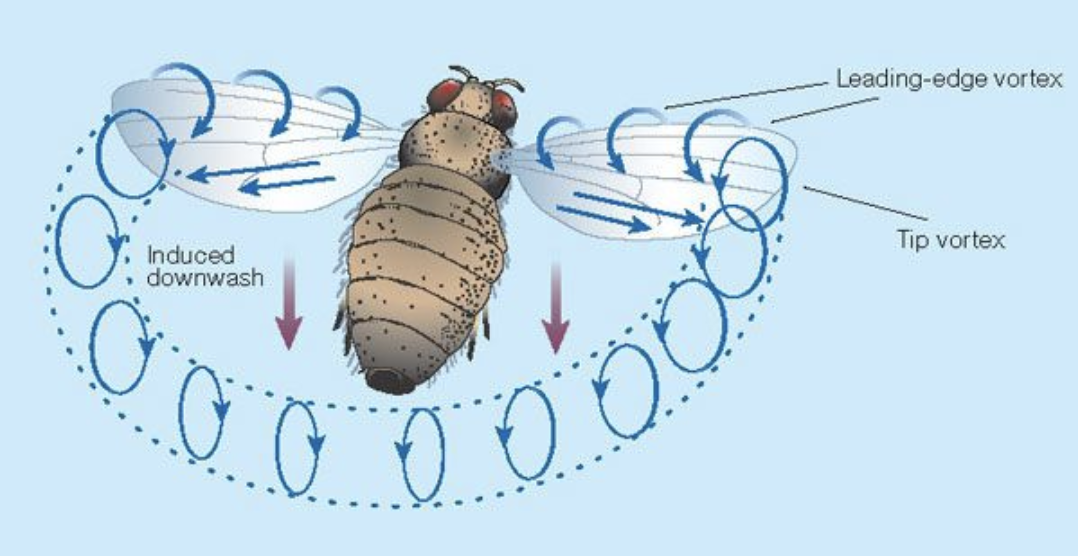
When a bee flies, its wings make a figure-8 pattern that pushes air downwards to create lift (Landell-Mills, 2019). This motion creates a leading-edge vortex (LEV), a whirlwind of air which helps keep the bee in the air (Figure 1). The LEV occurs as the bee’s wings rotate rapidly, splitting the air current over the leading edge of the wing (Bhat and Thompson, 2022). The LEV remains attached to the wing, affecting the lift it generates as it lets the bee maintain an angle of attack greater than 45 degrees without stalling (Altshuler, et al., 2005; Linton, 2007).

Furthermore, how insects create lift can be visualized with this equation (Landell-Mills, 2019):
Lift = m x dv/dt
In this equation, m is the mass of air the wings pass through, dt is the change in time, and dv is the change in the air’s downwards velocity as it is pushed down. To give the Bee Movie credit, one thing this equation makes apparent is that bees fly very inefficiently. Their small wings do not push down a large mass of air, however, that air is pushed down at a high velocity (Figure 2) (Landell-Mills, 2019). This is achieved by the bee’s high wingbeat frequency, as they can rotate their wings 200 times per second (Linton, 2007). This lower efficiency stroke may be due to the bee’s high sugar diet of flower nectar, giving it sufficient energy for physically taxing flight (Altshuler et al., 2005). It may also be caused by the bee’s flight muscles, which are different from those of other insects as they are designed to generate power at fast and constant velocities (Svitil, 2005). Bees can maintain this velocity as they have the highest metabolism in relation to body weight of all known animals as oxygen is rapidly delivered to the mitochondria in their wing muscles (Syromyatnikov et al., 2019).

Apart from flying, bees can also hover. Their low stroke amplitude and high wingbeat frequency make them stand out from other insects such as fruit flies, who have much wider wingstroke amplitudes (Altshuler et al., 2005). Bees are also unique in that their front and hind wings move together, and they are able to carry 80% of their body weight while flying (Feaster, Battaglia, and Bayandor, 2017). When hovering, bees have both the forward and backward stroke, both of which generate lift. This is because both half strokes push air downwards, unlike birds, which push a small amount of air upwards during their upstroke (Landell-Mills, 2019).
It was never a miracle that bees could fly. Physics can be used to explain how their tiny wings can lift them off the ground despite their relatively large body size. While they may not be the most efficient flyers, their evolved method of flight is still viable as bees are still extant today. The Bee Movie may have been wrong, however it still serves as a mediocre form of entertainment.
Works Cited
Altshuler, D.L., Dickson, W.B., Vance, J.T., Roberts, S.P. and Dickinson, M.H., 2005. Short-amplitude high-frequency wing strokes determine the aerodynamics of honeybee flight. Proceedings of the National Academy of Sciences, 102(50), pp.18213–18218. https://doi.org/10.1073/pnas.0506590102.
Bhat, S.S., and Thompson, M.C., 2022. Effect of leading-edge curvature on the aerodynamics of insect wings. International Journal of Heat and Fluid Flow, 93, p.108898. https://doi.org/10.1016/j.ijheatfluidflow.2021.108898.
Landell-Mills, N., 2019. How insects fly according to Newtonian physics, including bees and butterflies.
Linton, J.O., 2007. The physics of flight: III. Hovering. Physics Education, 42(5), pp.496–501. https://doi.org/10.1088/0031-9120/42/5/009.
Svitil, K., 2005. Deciphering the Mystery of Bee Flight. California Institute of Technology. Available at: <https://www.caltech.edu/about/news/deciphering-mystery-bee-flight-1075>
Syromyatnikov, M.Y., Gureev, A.P., Vitkalova, I.Y., Starkov, A.A. and Popov, V.N., 2019. Unique features of flight muscles mitochondria of honey bees (Apis mellifera L.). Archives of Insect Biochemistry and Physiology, 102(1), p.e21595. https://doi.org/10.1002/arch.21595.