You see a bee landing on a flower, the interaction seems quite simple, however something beyond our vision is occurring right under our nose, that being electromagnetic fields produced by bees. Research shows that bees become electrically charged when interacting with pollen-producing plants and use this charge to communicate with other bees. Additionally, interactions occur between bees and naturally transpiring fields providing environmental information (Warnke, 2007). This phenomenon has opened new areas of research, including but not limited to electric ecology (Clarke et al. 2017).
As bees fly through their environment, their bodies create and accumulate an electric charge. The triboelectric effect is a mechanism where electric charge can be produced, where friction and overcontact from plants and materials the bees come into contact with could cause electron transfer. From this friction, bees get a positive electric charge of approximately +30 to 50pC (Clarke et al. 2017). Due to bees having a relatively low capacitance, they have a considerable voltage associated with the charge they carry, based on the equation V=Q/C, where capacitance and voltage are inversely related. That being said, we can understand that this electric field is not only affecting bees but also the environment around them.
This electric field from bees allows for complex interaction with flowers, as they too have an electric field. Flowers, as well as other plants, distort Earth’s natural vertical field as they are grounded (Clarke et al. 2017). Thus, when a bee with a positive electric charge gets in close proximity to a flower, there are electrostatic interactions that get stronger as the distance is shorter, particularly strong at 2-3 cm with 5kV/m (Clarke et al. 2017). These electrostatic forces can contribute to pollination as they influence pollen transfer from flower to flower as they help pollen stick to the bee as they move between different flowers as seen in Figure 1. This proves that pollination is not just a physical mechanism but a physical force beyond that, that plays a role (Vaknin et al. 2000).
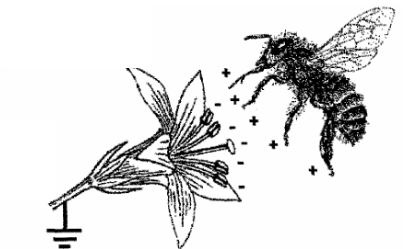
Figure 1. Positively charged bee inducing an opposite charge on the flower, thereby creating temporary forces (Vaknin et al. 2000).
Bees not only interact with these electric fields, but they can also detect them from other bees. An example of this is seen through bumblebees, in which they can detect electric fields through small hairs on their bodies. Whereas honey bees use a slightly different mechanism to detect these electromagnetic waves by using their antennae. These mechanisms are extremely important for communication such as the waggle dance, which allows honey bees to communicate about foraging information (Greggers et al. 2013).
This information helps us understand the whole relationship of pollination and all the factors involved beyond what can be seen through our eyes. However, these interactions are not fully understood by researchers regarding the information that bees get from electrical fields or how the environment can influence the signals they receive. So next time you see a bee approach a flower, think about interactions beyond what you can just see and appreciate how complex and efficient nature around us is!
References
Clarke, Dominic, Erica Morley, and Daniel Robert. 2017. “The Bee, the Flower, and the Electric Field: Electric Ecology and Aerial Electroreception.” Journal of Comparative Physiology A 203 (9): 737–48. https://doi.org/10.1007/s00359-017-1176-6.
Greggers, Uwe, Gesche Koch, Viola Schmidt, et al. 2013. “Reception and Learning of Electric Fields in Bees.” Proceedings of the Royal Society B: Biological Sciences 280 (1759): 20130528. https://doi.org/10.1098/rspb.2013.0528.
Vaknin, Y., S. Gan-Mor, A. Bechar, B. Ronen, and D. Eisikowitch. 2000. “The Role of Electrostatic Forces in Pollination.” Plant Systematics and Evolution 222 (1–4): 133–42. https://doi.org/10.1007/bf00984099.
Warnke Ulrich, Dr. 2008. BEES, BIRDS and MANKIND.


Leave a Reply
You must be logged in to post a comment.