When people think of the most terrifying creepy crawlies, earwigs may come to mind. Their name comes from a Western myth that claims they crawl into people’s ears to lay eggs in the brain (Ren et al., 2019). In reality, these arthropods prefer to hide under rocks, foliage and in moist crevices, not in human bodies. While many are fearful of them, earwigs are fascinating animals who may even have an impact on the wine industry.
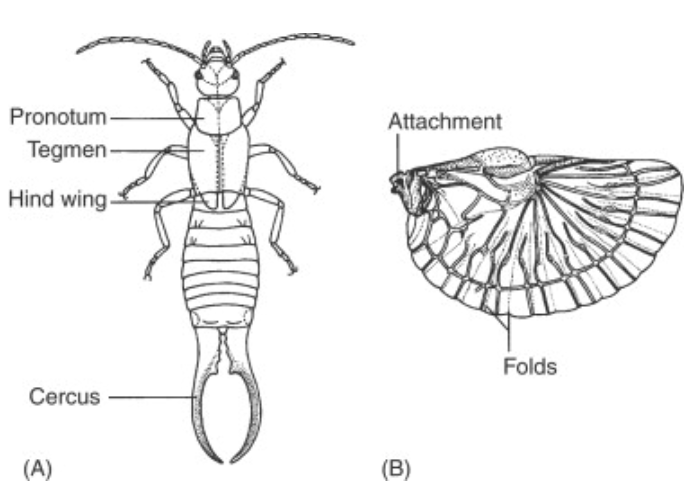
Earwigs are insects of the order Dermaptera, meaning “skin wing,” due to their leather-like forewings. They are omnivores who will eat anything from decaying plant matter to live plants and insects (Ren et al., 2019). Their most striking feature is their cerci, the two forcep-like pincers located on their rear end (Figure 1). These cerci can be used for self defense, but more interestingly, they are used for intrasexual selection (Radesäter and Halldórsdóttir, 1993). When two males encounter each other in the presence of a female, they will use their cerci to fight each other, a butt battle one could say (Briceño and Eberhard, 1995).

Figure 1: A labeled diagram of an earwig. A) The cerci can be seen at the terminal end of the insect. The pronotum is a plate-like structure that covers the thorax, while the tegmen are thickened forewings. These thick forewings serve to protect the more delicate hindwings, and their leathery nature is where the order Dermaptera derives its name. B) A closer look at the opened wing of an earwig. (Rankin and Palmer, 2009).
Due to their omnivorous nature, earwigs can be beneficial to crop systems such as vineyards (Orpet, Crowder and Jones, 2019). They prefer small and soft prey, making them a potential biological control factor for pests such as aphids. However, because they also eat live plants, it is debated as to whether they are primarily beneficial or detrimental to crop health. A dissection of the guts of the European earwig (Forficula auricularia), which is commonly found in vineyards, revealed a consistent combination of varied plant and insect matter (Orpet, Crowder and Jones, 2019). This generalistic feeding behavior gives earwigs the potential to control a variety of crop pests, but also damage a variety of crops. In vineyards, the damage caused by earwigs is poorly studied, however, it is suggested that the incorporation of at least 5-10 earwigs per kilogram of grapes leaves a noticeable taint in pinot noir wines (Burdet et al., 2013). Earwigs can also spread fungal pathogens when they damage grapes via feeding, leading some farmers to control their populations using baits and insecticides. Another effective method of reducing earwigs is to till the soil and remove ground cover where earwigs like to nest (Orpet, Crowder and Jones, 2019).
Earwigs have one other defense that may actually harm the wine making process. When threatened, they release the chemical 2-methyl-1,4-benzoquinone from their abdominal glands (Bleyer et al., 2011). Not only is this substance foul-smelling, but it can leave a taint in wine when present in high concentration. In general, quinones are intermediates in wine oxidation and react with thiols such as 3-sulfanylhexanol (Nikolantonaki et al., 2014). The result of these reactions is the loss of desirable aromas in the wine. Therefore, when large numbers of earwigs are harvested alongside grapes, the grape quality may decline (Bleyer et al., 2011).
Currently, it is unclear wether earwigs are beneficial or harmful to vineyards. There is a small to nonexistent body of literature detailing the role they play in vineyards specifically, as they are not considered a major pest. The main concern to viticulturists is the earwig’s potential to taint wine with their chemical secretions. However, wether they need to be controlled is subject to each viticulturist’s perspective. Outside of agriculture, earwigs are harmless and fascinating insects, undeserving of their fear-inspiring reputation.
Works Cited
Bleyer, G., Kassemeyer, H.-H., Breuer, M., Krause, R., Viret, O. and Dubuis, P.-H., 2011. ‘VitiMeteo’ a future oriented forecasting system for viticulture. Bull IOBC/WPRS, 67, pp.69–77.
Briceño, R.D. and Eberhard, W.G., 1995. The functional morphology of male cerci and associated characters in 13 species of tropical earwigs (Dermaptera: Forficulidae, Labiidae, Carcinophoridae, Pygidicranidae). [online] Available at: <https://repository.si.edu/bitstream/handle/10088/5244/SCtZ-0555-Lo_res.pdf>.
Burdet, J.-P., Karp, J., Deneulin, P., Linder, C. and Kehrli, P., 2013. Occurrence of earwigs in vineyards and their impact on aroma and flavour of ‘Chasselas’ and ‘Pinot Noir’ wines. IOBC-WPRS Bull., 85, pp.165–171.
Nikolantonaki, M., Magiatis, P. and Waterhouse, A.L., 2014. Measuring protection of aromatic wine thiols from oxidation by competitive reactions vs wine preservatives with ortho-quinones. Food Chemistry, 163, pp.61–67. https://doi.org/10.1016/j.foodchem.2014.04.079.
Orpet, R.J., Crowder, D.W. and Jones, V.P., 2019. Biology and Management of European Earwig in Orchards and Vineyards. Journal of Integrated Pest Management, 10(1), p.21. https://doi.org/10.1093/jipm/pmz019.
Radesäter, T. and Halldórsdóttir, H., 1993. Two Male Types of the Common Earwig: Male-male Competition and Mating Success. Ethology, 95(2), pp.89–96. https://doi.org/10.1111/j.1439-0310.1993.tb00460.x.
Rankin, S.M. and Palmer, J.O., 2009. Chapter 70 – Dermaptera: (Earwigs). In: V.H. Resh and R.T. Cardé, eds. Encyclopedia of Insects (Second Edition). [online] San Diego: Academic Press. pp.259–261. https://doi.org/10.1016/B978-0-12-374144-8.00079-5.
Ren, M., Shih, C., Xing, C. and Ren, D., 2019. Dermaptera – Earwigs. In: Rhythms of Insect Evolution. [online] John Wiley & Sons, Ltd. pp.149–156. https://doi.org/10.1002/9781119427957.ch11.