“Hello, can I please get a turkey footlong on Italian Herb and cheese bread? Can I also add some bacon on that as well?”
Although this iconic Subway order may be difficult to resist, the processed meat in the sandwich can degrade health in many ways that consumers do not realize. Being one of the few foods classified as a Group 1 carcinogen by the International Agency for Research on Cancer, it is placed in the same category as the effects of smoking tobacco, alcohol use, asbestos exposure, and radiation exposure (American Cancer Society 2024). Although the effects of processed meats are not necessarily equivalent to these carcinogens, this classification provides evidence of the link between processed meat consumption and cancer in humans.
Chemical additives and processing methods are used to preserve shelf life, but they are the very reason that these meats have become a growing health concern. Nitrite (NO2–)is the most common additive in processed meats (either added directly or formed from nitrate), as it is responsible for preventing any bacterial growth that forms (Zhang et al. 2023). Additionally, NO2– is responsible for inducing a chemical reaction that produces the pink pigment on deli meats, as opposed to red pigment that it naturally has (Shakil et al. 2022). This chemical change begins with the conversion to nitric oxide during the curing process and further binds to the iron in myoglobin. This produces a pink compound, called nitrosomyoglobin, that is active for the remainder of the meat’s shelf life. When consumed, the chemical reactivity of NO2– leads to many negative effects within the body. In the stomach, where the pH levels indicate high acidity, NO2– reacts with the acid and promotes endogenous nitrosation with amines and amides from proteins (Ward 2009). This process produces various N-nitroso compounds, including a carcinogenic subgroup known as N-nitrosamines (Figure 1).
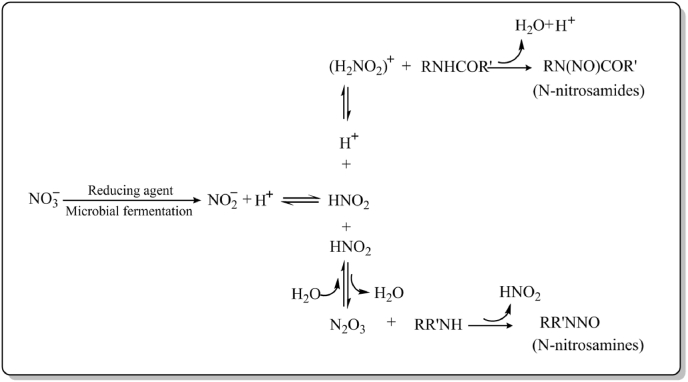
This group of compounds are dangerous since they are metabolized into reactive intermediates that form DNA adducts, which are abnormal chemical attachments to DNA (Li and Hecht 2022). These DNA attachments can introduce mutations that interfere with cell growth and division since the DNA is responsible for carrying cellular instructions. If these mutations involve cell-cycle control or DNA repair processes, the cell may stop responding to normal growth signals (Ward 2009). Therefore, cells may divide uncontrollably and lead to cancer.
This is especially concerning since NO2– is advertised as improving the quality of the product, but its chemical behaviour clearly leads to worse effects at the cellular level (Karwowska and Kononiuk 2020). Although completely removing processed meats from one’s diet is most ideal, scientists have begun to explore alternatives to lower reliance on NO2–. For example, using plant-derived antioxidants is an emerging approach in preserving meats and is a much safer option (Shakil et al. 2022).
So next time you are at Subway, think twice about getting that nitrite-infused turkey sandwich!
References
American Cancer Society. 2024. “Known and Probable Human Carcinogens.” https://www.cancer.org/cancer/risk-prevention/understanding-cancer-risk/known-and-probable-human-carcinogens.html.
Karwowska, Małgorzata, and Anna Kononiuk. 2020. “Nitrates/Nitrites in Food-Risk for Nitrosative Stress and Benefits.” Antioxidants (Basel, Switzerland) 9 (3): 241. https://doi.org/10.3390/antiox9030241.
Li, Yupeng, and Stephen S. Hecht. 2022. “Metabolic Activation and DNA Interactions of Carcinogenic N-Nitrosamines to Which Humans Are Commonly Exposed.” International Journal of Molecular Sciences 23 (9): 4559. https://doi.org/10.3390/ijms23094559.
Shakil, Mynul Hasan, Anuva Talukder Trisha, Mizanur Rahman, et al. 2022. “Nitrites in Cured Meats, Health Risk Issues, Alternatives to Nitrites: A Review.” Foods (Basel, Switzerland) 11 (21): 3355. https://doi.org/10.3390/foods11213355.
Ward, Mary H. 2009. “Too Much of a Good Thing? Nitrate from Nitrogen Fertilizers and Cancer.” Reviews on Environmental Health 24 (4): 357–63. https://doi.org/10.1515/reveh.2009.24.4.357.
Zhang, Yin, Yingjie Zhang, Jianlin Jia, et al. 2023. “Nitrite and Nitrate in Meat Processing: Functions and Alternatives.” Current Research in Food Science 6 (February): 100470. https://doi.org/10.1016/j.crfs.2023.100470.
Comments
11 Responses to “The Science Behind the Sandwich: Exploring Processed Meats”
Hey iSci,
I hope you enjoyed reading my blog post. I wrote this blog after discovering that processed meats are a group 1 carcinogen, as I was completely unaware. It is a common food that most people our age consume, so I believe that people should be aware of this. It also ties into relevant topics we learned in our WineSci project. Please leave feedback!
Arjun
Hey Arjun I really liked your blog post, I thought it was very interesting!
A couple suggestions I have include:
-try to avoid using contractions, I noticed you used “don’t” in your second paragraph, consider replacing it with “do not”.
-Also in your second paragraph I would consider shorting the sentence: “Being one of the few foods classified as a Group 1 carcinogen by the International Agency for Research on Cancer, it is placed in the same category as the effects of smoking tobacco, alcohol use, asbestos exposure, and radiation exposure (American Cancer Society, n.d.)” to “Being one of the few foods classified as a Group 1 carcinogen by the International Agency for Research on Cancer, it is placed in the same category as smoking tobacco, alcohol use, asbestos exposure, and radiation exposure (American Cancer Society, n.d.)” (cutting out “the effects of”)
-In your third paragraph there is a double space in front of the sentence: “When consumed, the negative effects of (NO2)– is demonstrated because of its chemical reactivity within our body” Also I would consider rewording it to something like: “(NO2) when consumed, has additional negative effects due to its chemical reactivity within organ systems”
Overall great work and I am excited to read the final copy.
-Jaden
Hey Jaden,
Thanks for taking time to read my blog! I removed the contractions, and fixed the double space. I also edited my sentences based on your suggestions!
Thanks,
Arjun
Hi Arjun,
This is a really interesting topic! A quick edit you could make is to fix the spelling of “sandwhich” to “sandwich” in your title.
Joycee
Hey Joycee,
Great catch! I just finished it, thanks!
Arjun
Hey Arjun! Super cool blog post on Subway and their meats. Here are a few things to keep in mind for your final!
1) I would change the sentance from “the processed meat in the sandwich can degrade health” to “the processed meat in the sandwich can have harmful effects on health”.
2) This sentence may be redundant “where the pH levels are low and highly acidic,”.
3) I would stick to using DOI sources for your blog post!
Other than that, super cool blog post! I look forward to reading your final post.
Hey Vibi,
Thanks for leaving suggestions. I changed the sentence where I talked about pH to avoid redundancy. I also am choosing to keep the one non DOI source since it is still a website published by a reliable source.
Hi Arjun,
This was a really interesting post and I enjoyed learning more.
A few suggestions:
– The significance of nitrite binding to myoglobin (other than colour change) is not entirely clear, it would be great if you could expand on this. Could nitrite pose a risk of outcompeting oxygen in binding to Hb or Mb heme groups in our bodies in a similar fashion to carbon monoxide poisoning?
– The nitrite ion can simply be represented by NO2^- (with subscript 2 and superscript -), no brackets are necessary, nor are they conventional
Looking forward to the final version!
Best,
Riley
Hey Riley,
Thanks for taking time to comment on my post! I further expanded on the significance of nitrite to myoglobin now, so thank you! Also, thanks for the suggestion about formatting the nitrite ion! I implemented it in.
Thanks,
Arjun
Hi Arjun,
What a wonderfully written blog post! The title summarizes your topic well and is very creative. I have a few suggestions for you to consider implementing:
– This is not a suggestion, but I think your introduction is brilliant! I too cannot resist that Subway order 🙂
– For the American Cancer Society source, if you scroll down far enough, you will see that the information was last updated in 2024 which can be used as the date in your citations.
– In your second paragraph, I do not think “is demonstrated” make sense in the sixth sentence. I recommend changing the following sentence to something along the lines of: “When consumed, the chemical reactivity of (NO2)– leads to many negative effects within the body.”
– While I understand what you were trying to show with the figure, I do not think it is necessary. Generally, if something isn’t referenced in the text, it should not be included in the figure. If you wish to keep the figure, I recommend editing it to make it match your writing more.
– If word count permits, I think it would be interesting to explain the plant-derived solution in more detail! I am really interested in how antioxidants preserve meats differently than nitrites!
Overall, I really enjoyed reading your post and thought it was very well written! I cannot wait to read the final version.
Happy editing,
Chloe
Hey Chloe,
Thanks for the in depth feedback!
I included your suggestion for the second paragraph into the post, so thank you for that. I also updated the citation with the correct date for the American Cancer Society citation. I do feel that the figure is important, so I decided to leave it in.
Thank you!