Freshwater shortages are becoming a growing global challenge. Climate change, population growth, and increasing demand for potable water are placing pressure on freshwater systems worldwide (Michalak et al. 2023; Rosińska et al. 2024). At the same time, salinity in freshwater and agricultural environments is rising, which can damage soils and reduce water availability for both ecosystems and human communities. These pressures are forcing many regions to look toward saline water sources such as seawater or brackish groundwater for drinking and agricultural use (Michalak et al. 2023).
Conventional desalination technologies such as reverse osmosis are widely used to convert saline water into freshwater, but they require substantial energy and infrastructure (Rosińska et al. 2024). Because of these energy demands, researchers are exploring alternative approaches that may improve sustainability. One emerging approach is biodesalination, which uses microorganisms to remove salt ions from water through biological and electrochemical processes (Saini et al. 2024).
Microbial desalination systems rely on the metabolic activity of microorganisms to drive electrochemical processes (Saini et al. 2024). In microbial desalination cells, microorganisms oxidize organic compounds and release electrons that travel through an external circuit. Figure 1 demonstrates this electron flow that drives ion transport across membranes, allowing salts to migrate out of the desalination chamber and lowering the salinity of the treated water (Saini et al. 2024). Because these systems rely on microbial metabolism rather than large external energy inputs, they are being explored as a potentially lower energy technology that can combine desalination with wastewater treatment and energy generation (Rabiee et al. 2024; Saini et al. 2024).
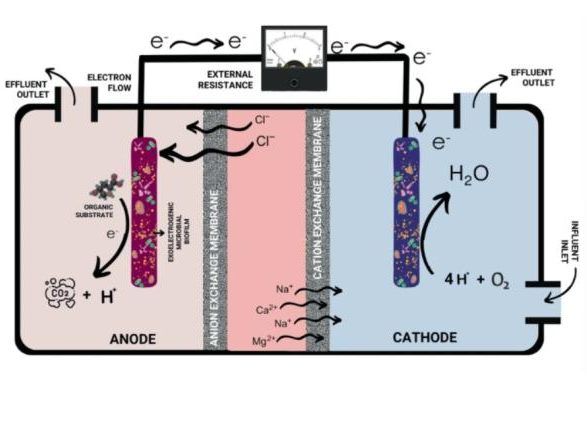
Recent studies demonstrate that algae and cyanobacteria may improve the efficiency of these systems. For example, experiments using the microalga Chlorella vulgaris in microbial desalination systems have reported desalination rates approaching 77 percent under controlled conditions (Balasubramaniyan et al. 2024). Other studies examining algae based microbial desalination cells treating saline wastewater have reported salt removal efficiencies ranging from approximately 58 to 78 percent (Rabiee et al. 2024). These findings suggest that photosynthetic microorganisms may enhance desalination performance while also contributing to wastewater treatment processes.
Selecting microorganisms capable of tolerating different salinity conditions is an important challenge for developing biodesalination systems. Some cyanobacteria and microalgae can survive across wide salinity ranges (Figler et al. 2019). For example, the cyanobacterium Aphanothece halophytica can tolerate high concentrations of sodium chloride, while species of the genus Dunaliella are well known for their ability to survive in highly saline environments through osmotic regulation. These physiological adaptations allow such organisms to maintain ion balance in environments that would inhibit most other microorganisms (Figler et al. 2019). However, several technical barriers remain before biodesalination can be widely applied. Microbial desalination cells can experience challenges such as biofouling, pH imbalance, and reduced conductivity, all of which can decrease desalination efficiency (Saini et al. 2024). In addition, harvesting algae that accumulate salts during treatment may require additional energy, which complicates large scale implementation.
Despite these challenges, biodesalination represents an interdisciplinary research area that combines microbiology, environmental engineering, and water resource management. As global water scarcity intensifies, technologies that reduce the energy demands of desalination could play an important role in improving access to freshwater. Continued research into microbial species selection, system design, and ion transport processes will help determine whether biological desalination can contribute to sustainable water solutions in the future.
References
Balasubramaniyan, Monisha, Dinesh Kasiraman, and S. Amirtham. 2024. “Chlorella Vulgaris in Biodesalination: A Sustainable Future from Seawater to Freshwater.” Marine Development 2 (1): 7. https://doi.org/10.1007/s44312-024-00019-0.
Figler, A., B-Béres, V., Dobronoki, D., Márton, K., Nagy, S. A., & Bácsi, I. (2019). Salt tolerance and desalination abilities of nine common green microalgae isolates. Water, 11(12), 2527. https://doi.org/10.3390/w11122527
Michalak, Anna M., Jun Xia, Damir Brdjanovic, et al. 2023. “The Frontiers of Water and Sanitation.” Nature Water 1 (1): 10–18. https://doi.org/10.1038/s44221-022-00020-1.
Rabiee, R., Sedighi, M., & Zamir, S. M. (2024). Desalination of the power plant salty wastewater by use of an algae-based photosynthetic microbial desalination cell. Journal of Environmental Management. https://doi.org/10.1016/j.jenvman.2024.123019
Rosińska, Weronika, Jakub Jurasz, Kornelia Przestrzelska, Katarzyna Wartalska, and Bartosz Kaźmierczak. 2024. “Climate Change’s Ripple Effect on Water Supply Systems and the Water-Energy Nexus – A Review.” Water Resources and Industry 32 (August). https://doi.org/10.1016/j.wri.2024.100266..
Saini, K., et al. (2024). Microbial desalination cell (MDC): A next-generation environmental technology for wastewater treatment and bioelectricity generation. In Microbiology-2.0 Update for a Sustainable Future. Springer.

Leave a Reply
You must be logged in to post a comment.