Climate change has been on many of our minds recently – but what if it physically affects some people’s brains? Emerging research predicts that elevations in climate change-related air pollution can increase incidence of neurological disorders (Xu, Ha and Basnet, 2016). One of these disorders is multiple sclerosis (MS), an autoimmune disorder characterized by neuroinflammation (Esmaeil Mousavi, et al., 2017). Individuals with MS suffer lesions on the brain in sections of neurons that lose their myelin sheaths, impairing neural signaling (Huang, Chen and Zhang, 2017). The potential for air pollution to trigger MS is concerning given the projected increases in air pollution.
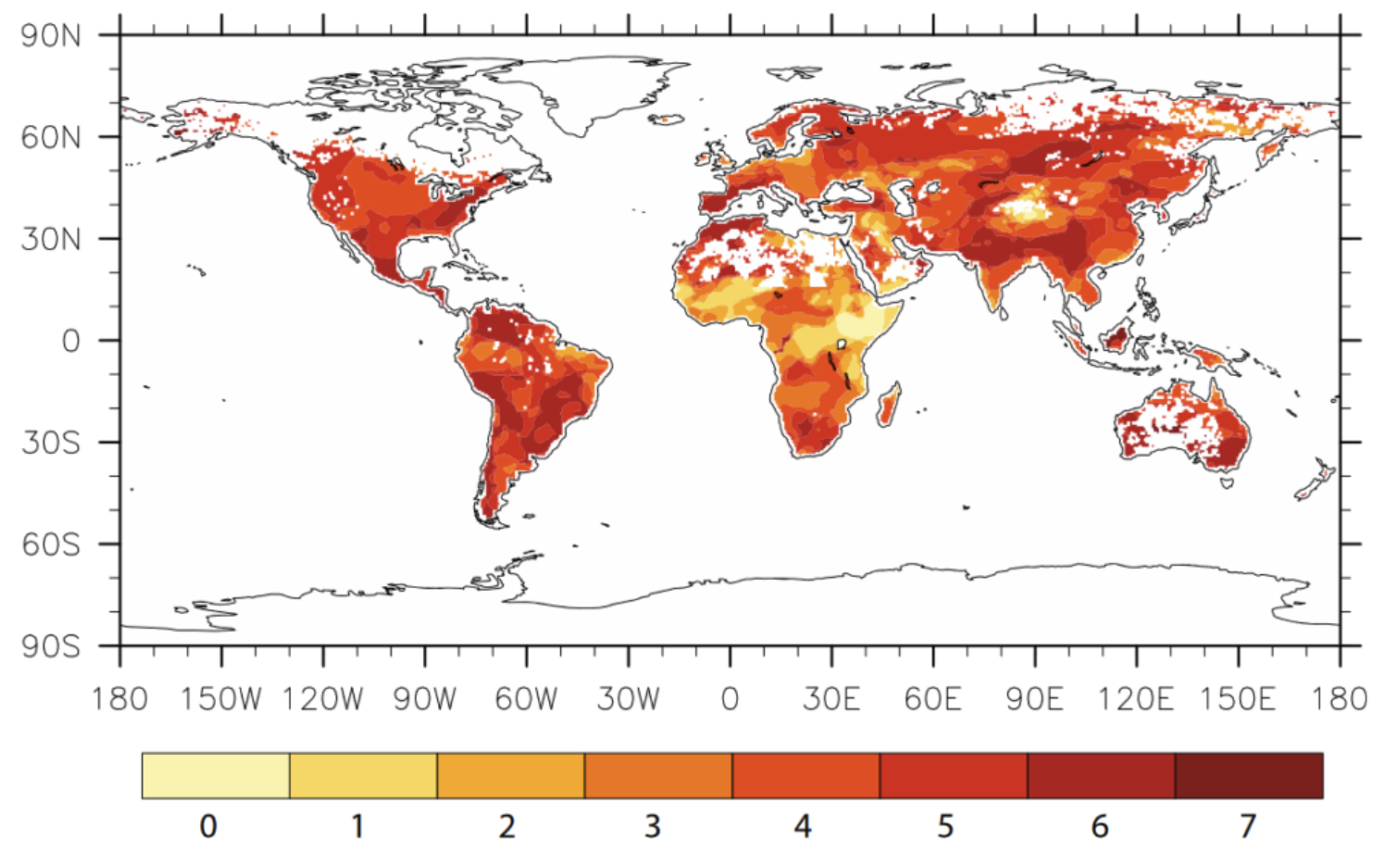
Anthropogenic climate change imposes a burden on human health by contributing to global increases in air pollutants (Orru, Ebi and Forsberg, 2017; Allen, et al., 2019). Surface warming and wildfires are both potential sources for the increases in pollutants associated with climate change, such as particulate matter and gases (Jacob and Winner, 2009). Particulate matter (PM) consists of fine particles capable of penetrating the respiratory system, and may be described as PM2.5 for particles less than 2.5 µm or PM10 for particles less than 10 µm in diameter (PM10). Numerous models predict increases of PM2.5 in most continents, contributing to increases in premature mortality (Figure 1) (Park, Allen and Lim, 2020).

Air pollution may be one of the many potential triggers for MS (Figure 2) (Fu, et al., 2022). While genetic factors are sometimes implicated in the development of MS, incidences are often correlated with environmental factors like smoking and vitamin D deficiency, which affect levels of neuroinflammation (Olsson, Barcellos and Alfredsson, 2017). Animal studies by Guo et al. (2021) demonstrated that PM10 exposure in rats causes neuronal cell loss and increases in inflammatory immune signaling markers called inflammatory cytokines.

Numerous studies have recently correlated incidences of MS with air pollution, such as Tateo et al. (2019) who found significantly higher MS prevalence in urban areas in Italy with higher PM2.5 exposure compared to villages and countryside. Bergamaschi et al. (2018) found a significant correlation between elevated levels of PM10 in the 25 days prior to testing for MS, and the detection of MS lesions. Another study found that PM2.5 may also be a risk factor for MS relapse, particularly for non-smokers, while supporting the finding that PM10 was a significant risk for the overall population (Elgabsi, et al., 2021). However, findings are inconsistent; an Ontario study found no significant association of PM2.5 with incidence of MS, but that ozone exposure may be related (Bai, et al., 2018). A systematic review and meta-analysis by Tang et al. (2021), which incorporated six studies, concluded that PM10 could be correlated with MS, whereas other pollutants are not. Further research is clearly needed to distinguish causal relationships and reveal the underlying mechanisms of how air pollution impacts MS. One suggested method is through the use of personal monitoring devices by MS patients to track air pollution they encounter in their daily lives and correlate this to their disease severity or relapses (Esmaeil Mousavi, et al., 2017).
Due to the potential for air pollution to increase or exacerbate MS, it is critical to continue investigating the role of air pollution in human disease. With the increasing global health burden of air pollution, there is no doubt that climate change will remain on the minds of the population, especially those affected by MS.
References
Allen, R.J., Hassan, T., Randles, C.A. and Su, H., 2019. Enhanced land–sea warming contrast elevates aerosol pollution in a warmer world. Nature Climate Change, 9(4), pp.300–305. https://doi.org/10.1038/s41558-019-0401-4.
Bai, L., Burnett, R.T., Kwong, J.C., Hystad, P., van Donkelaar, A., Brook, J.R., Tu, K., Copes, R., Goldberg, M.S., Martin, R.V., Murray, B.J., Kopp, A. and Chen, H., 2018. Long-term exposure to air pollution and the incidence of multiple sclerosis: A population-based cohort study. Environmental Research, 166, pp.437–443. https://doi.org/10.1016/j.envres.2018.06.003.
Bergamaschi, R., Cortese, A., Pichiecchio, A., Berzolari, F.G., Borrelli, P., Mallucci, G., Bollati, V., Romani, A., Nosari, G., Villa, S. and Montomoli, C., 2018. Air pollution is associated to the multiple sclerosis inflammatory activity as measured by brain MRI. Multiple Sclerosis Journal, 24(12), pp.1578–1584. https://doi.org/10.1177/1352458517726866.
Elgabsi, M., Novack, L., Yarza, S., Elgabsi, M., Shtein, A. and Ifergane, G., 2021. An impact of air pollution on moderate to severe relapses among multiple sclerosis patients. Multiple Sclerosis and Related Disorders, 53, p.103043. https://doi.org/10.1016/j.msard.2021.103043.
Esmaeil Mousavi, S., Heydarpour, P., Reis, J., Amiri, M. and Sahraian, M.A., 2017. Multiple sclerosis and air pollution exposure: Mechanisms toward brain autoimmunity. Medical Hypotheses, 100, pp.23–30. https://doi.org/10.1016/j.mehy.2017.01.003.
Fu, C., Kuang, D., Zhang, H., Ren, J. and Chen, J., 2022. Different components of air pollutants and neurological disorders. Frontiers in Public Health, [online] 10. Available at: <https://www.frontiersin.org/articles/10.3389/fpubh.2022.959921> [Accessed 4 November 2023].
Huang, W.-J., Chen, W.-W. and Zhang, X., 2017. Multiple sclerosis: Pathology, diagnosis and treatments (Review). Experimental and Therapeutic Medicine, 13(6), pp.3163–3166. https://doi.org/10.3892/etm.2017.4410.
Jacob, D.J. and Winner, D.A., 2009. Effect of climate change on air quality. Atmospheric Environment, 43(1), pp.51–63. https://doi.org/10.1016/j.atmosenv.2008.09.051.
Olsson, T., Barcellos, L.F. and Alfredsson, L., 2017. Interactions between genetic, lifestyle and environmental risk factors for multiple sclerosis. Nature Reviews Neurology, 13(1), pp.25–36. https://doi.org/10.1038/nrneurol.2016.187.
Orru, H., Ebi, K.L. and Forsberg, B., 2017. The Interplay of Climate Change and Air Pollution on Health. Current Environmental Health Reports, 4(4), pp.504–513. https://doi.org/10.1007/s40572-017-0168-6.
Park, S., Allen, R.J. and Lim, C.H., 2020. A likely increase in fine particulate matter and premature mortality under future climate change. Air Quality, Atmosphere & Health, 13(2), pp.143–151. https://doi.org/10.1007/s11869-019-00785-7.
Tang, C., Li, Q.-R., Mao, Y.-M., Xia, Y.-R., Guo, H.-S., Wang, J.-P., Shuai, Z.-W. and Ye, D.-Q., 2021. Association between ambient air pollution and multiple sclerosis: a systemic review and meta-analysis. Environmental Science and Pollution Research, 28(41), pp.58142–58153. https://doi.org/10.1007/s11356-021-14577-z.
Tateo, F., Grassivaro, F., Ermani, M., Puthenparampil, M. and Gallo, P., 2019. PM2.5 levels strongly associate with multiple sclerosis prevalence in the Province of Padua, Veneto Region, North-East Italy. Multiple Sclerosis Journal, 25(13), pp.1719–1727. https://doi.org/10.1177/1352458518803273.
Xu, X., Ha, S.U. and Basnet, R., 2016. A Review of Epidemiological Research on Adverse Neurological Effects of Exposure to Ambient Air Pollution. Frontiers in Public Health, [online] 4. Available at: <https://www.frontiersin.org/articles/10.3389/fpubh.2016.00157> [Accessed 4 November 2023].