There is a pattern present throughout history; when a society is faced with overwhelming crisis, they rarely confront the complex forces causing their pain. Instead, they look for someone to blame. Whether it was the terrified Puritans of 17th-century Massachusetts or modern populations navigating today’s struggling world, the underlying psychological reasons stay the same. When societies face systemic stress and scarcity, they default to scapegoating vulnerable groups.
During the Salem witch trials, the combination of societal, economic, and environmental pressures fueled the unlawful prosecution of women (Fraser 2020). Coined the “Little Ice Age,” Salem endured severe weather patterns and crop failures that triggered food shortages, agricultural collapse, widespread economic distress, and sickness (Mixon 2005; Fraser 2020). Rather than facing these uncontrollable realities, the community sought a tangible way to restore order, allowing authorities to capitalize on their panic by framing these hardships as a battle against witchcraft (Fraser 2020). Residents directed their frustrations toward marginalized individuals whose identities aligned with pre-existing stereotypes, specifically targeting women. By labeling these women as “evil”, the misfortunes were given a human face. This created the illusion that executing a few “witches” would solve their crisis.
Today, societies are dealing with intense systemic pressures: post-pandemic anxiety, inflation, and severe housing and job crises. Just like Salem’s residents, public frustration latched onto visible targets. Already facing heavy discrimination and harmful stereotypes, immigrants became easy targets. Many began to believe that newcomers are the root of their struggles, creating the illusion that being rid of them would solve all their issues.
Though on a larger scale, this mirrors the social psychology concept of the fundamental attribution error, which is the tendency to overemphasize personal character while ignoring situational factors (Berry 2015). Rather than analyzing the complex issues behind their struggles, the public attributes societal struggles to the character of immigrants. This is further accelerated by group polarization, which is when discussion within a group strengthens a shared point of view, pushing individuals to hold more extreme attitudes than they did initially (Sunstein 1999). This creates echo chambers that surround people with like-minded voices, validating their fears and turning anxiety into hostility.
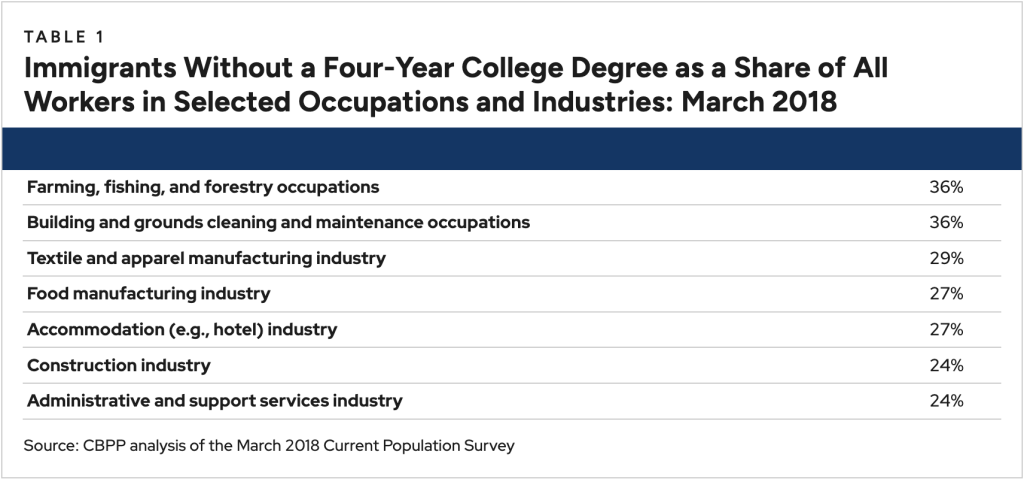
Within these spaces, cherry-picked statistics paint immigrants as a burden, hiding data that shows they participate in the workforce at higher rates, fill critical labour shortages in important industries, and generate billions in economic efficiency gains (Sherman et al. 2019). As seen in Table 1, immigrants without a college degree account for roughly one in four construction workers and over a third of the workforce in farming and building maintenance.
Societies under severe stress rely on scapegoating vulnerable populations as a coping mechanism; we’ve seen this occur time and time again. Driven by psychological phenomena, communities misdirect their fear and frustration toward easy targets rather than confronting the complex reality behind it all. By identifying when this occurs, we can stop pointing fingers at our vulnerable neighbours and start demanding real solutions to the systemic issues holding us back; we can break the cycle.
References
Berry, Zachariah. 2015. “Explanations and Implications of the Fundamental Attribution Error: A Review and Proposal.” Journal of Integrated Social Sciences 5 (1): 44–57.
Fraser, Devon. 2020. “Society, Suspicion, and the Supernatural: The Factors Behind the Salem Witch Trials.” The Great Lakes Journal of Undergraduate History 7 (1). https://doi.org/10.22329/gljuh.v7i1.8882.
Mixon, Franklin. 2005. “Weather and the Salem Witch Trials.” Journal of Economic Perspectives 19 (1): 241–42.
Sherman, Arloc, Danilo Trisi, Chad Stone, Shelby Gonazales, and Sharon Parrott (Center on Budget and Policy Priorities). 2019. “Immigrants Contribute Greatly to U.S. Economy, Despite Administration’s ‘Public Charge’ Rule Rationale | Center on Budget and Policy Priorities.” August 15. https://www.cbpp.org/research/immigrants-contribute-greatly-to-us-economy-despite-administrations-public-charge-rule.
Sunstein, Cass R. 1999. “The Law of Group Polarization.” SSRN Scholarly Paper No. 199668. Social Science Research Network, December 1. https://doi.org/10.2139/ssrn.199668.


Leave a Reply
You must be logged in to post a comment.