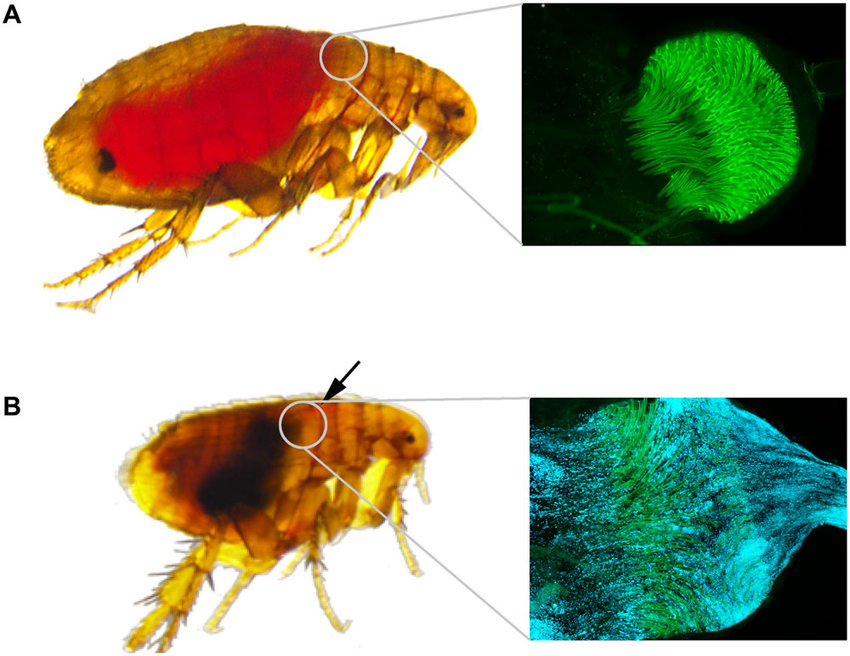
The Black Death is known as one of the deadliest plague pandemics in human history. The plague was a combination of bubonic, pneumonic, and septicaemia plague strains, all caused by the same bacterial infection via Yersinia pestis (Y. pestis). These strains are differentiated by the locations they infect: the lymph nodes, lungs, and bloodstream, respectively, which initiate tissue death and organ failure (Benedictow 2004). The pandemic spanned the majority of the Western world from 1347 to 1351, killing about 25-50% of the population. It is now understood that Y. pestis was present in fleas, which were in turn present on rats, making them a vector for transmission to humans. The plague’s origin and spread were inexplicable by physicians at the time, and as a result, there was no form of immunization against it (Gottfried 2010).
From an evolutionary perspective, the pervasive spread of this disease became a selective pressure for certain loci on the human genome, specifically the gene that encodes Endoplasmic Reticulum Amino Peptidase (ERAP2). Based on the theory of Darwinian evolution, it can be reasoned that the traits encouraging survival would be selected for in those who outlived the plauge versus those who did not. Endert & Kupier 2023, sorted through several DNA regions that possessed immune-related genes in those who had been buried in radiocarbon-dated cemeteries between the years 1000-1250 (pre-pandemic), 1348-1349 (during), and 1350-1539 (post-pandemic) (Kuiper and van Endert 2023).
To do this, they used single-nucleotide polymorphisms, which are single-base changes in DNA at one place in the genome that can differ between individuals. In this context, an allele is the type of SNP that the subject carries, and using said information, the authors were able to estimate the frequency of each allele. SNPs themselves are not functional genes, but they act as markers in the genome, since alleles close together tend to be inherited together. If a certain SNP is seen more frequently post-pandemic, researchers know that a gene near that nucleotide was favoured during selection (Morin et al. 2004).
It was apparent that the strongest increase in allele frequency was observed for the rs2549794 SNP, which is located adjacent to a cluster of genes that encode peptidases, proteins that cleave peptide bonds in other molecules (Klunk et al. 2022). This SNP was most strongly correlated with ERAP2 as it is located in its intron and is most strongly upregulated when monocytes interact with Y. pestis. More specifically, the function of ERAP2 is to cleave pieces of pathogen proteins for presentation to other immune cells. Those homozygous for the SNP allele were 40% more likely to have survived the pandemic than those who were not (Kuiper and van Endert 2023), which makes sense as the more frequent antigen presentation becomes, the more likely the body is to recognize and respond to the pathogen quickly.
Although having a reactive immune system was advantageous at the time, there are two sides to that coin. Today, those same genetic mutations are associated with autoimmune disorders like Crohn’s, Rheumatoid Arthritis, and Lupus. Strong innate activation lowers the threshold of an immune response, amplifies inflammation, and enhances antigen presentation, which increases the likelihood that self-reactive adaptive immune cells become activated (Gibbons 2022). Most evolutionary benefits come at a cost, but oddly enough, it’s a cost we are still paying 700 years later.
References
Benedictow, Ole Jørgen. 2004. The Black Death, 1346-1353: The Complete History. Boydell & Brewer.
Gibbons, Ann. 2022. “How the Black Death Left Its Mark on Immune System Genes.” Science (New York, N.Y.) 378 (6617): 237–38. https://doi.org/10.1126/science.adf3947.
Gottfried, Robert S. 2010. Black Death. Simon and Schuster.
Klunk, Jennifer, Tauras P. Vilgalys, Christian E. Demeure, et al. 2022. “Evolution of Immune Genes Is Associated with the Black Death.” Nature 611 (7935): 312–19. https://doi.org/10.1038/s41586-022-05349-x.
Kuiper, Jonas, and Peter van Endert. 2023. “Uncovering the Genomic Toll of the Black Death.” Trends in Immunology 44 (2): 90–92. https://doi.org/10.1016/j.it.2022.12.001.
Morin, Phillip A., Gordon Luikart, Robert K. Wayne, and the SNP workshop Group. 2004. “SNPs in Ecology, Evolution and Conservation.” Trends in Ecology & Evolution 19 (4): 208–16. https://doi.org/10.1016/j.tree.2004.01.009.


Leave a Reply
You must be logged in to post a comment.