Many of us have heard of the hit film Obsession, a cautionary tale featuring the effects of a “One Wish Willow” told like a romance. But scientifically and textually, Bear’s wish isn’t rooted in true love; what he experiences is instead limerence–the acute, involuntary, and all-consuming cognitive infatuation with a target individual known as the “Limerent Object” or the LO (Willmott and Bentley 2015, 20). It is sustained by uncertainty of possible reciprocation, separating it from love and lust in that capacity by its independence from genuine care for the person (Drevitch 2025). The neurological activity of limerence is centred in the mesolimbic reward center of the brain, activating the same physiological reward pathways seen in gambling addictions and chemical dependency (Bradbury 2024, 418). What’s interesting in the film Obsession is the representation of this fixation, not in “Freaky Nikki” but rather in the characterization of Bear Bailey, the main protagonist of the film.
Unremarkably, Bear’s fixated state is fundamentally catalyzed by a profound threat to his masculinity, as in films of this genre when Nikki straightforwardly tells him she thinks of him like a “little brother” (Barker 2026). Facing this rejection takes a toll on Bear’s psyche, a status threat to his sense of masculinity. Although in a healthy relationship, evolutionarily open mate choice sustains healthy pair bonding (Grant 2025, 2). Bear’s feelings regarding his rejection, he refuses the idea of giving Nikki romantic autonomy for his own benefit (Rowland 2023). With this in mind, we can now understand that it was likely cowardice and self-centeredness that compelled him to break the “One Wish Willow,”.
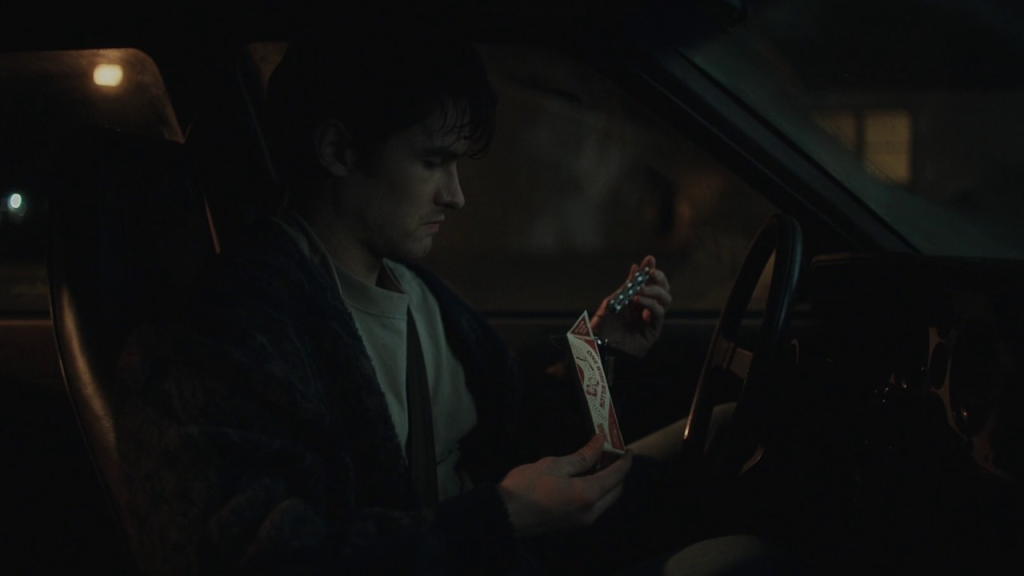
In the argument, he had no idea the wish was effective (Figure 1); the movie continues to show how Bear is, in fact, selfish for his choices. Limerence relies on solipsistic introjection- where the individual creates an idealized internal fantasy of the partner to fill the gaps in reality (Bradbury 2024, 423). This mindset is amplified by the Halo effect— when initial positive feelings cause an individual to gloss over severe negative attributes (Fagan 2025). Bear remains willing to overlook the catastrophic harm Nikki was causing to herself and to others since he benefits in the scenario, building a block for Intrusive rumination—continuous intrusive thoughts—overpowering rational decision-making and showing the self-serving drive limerence comprises (Willmott and Bentley 2015, 28). Creating the right conditions for him to make his most unethical decision in the film.
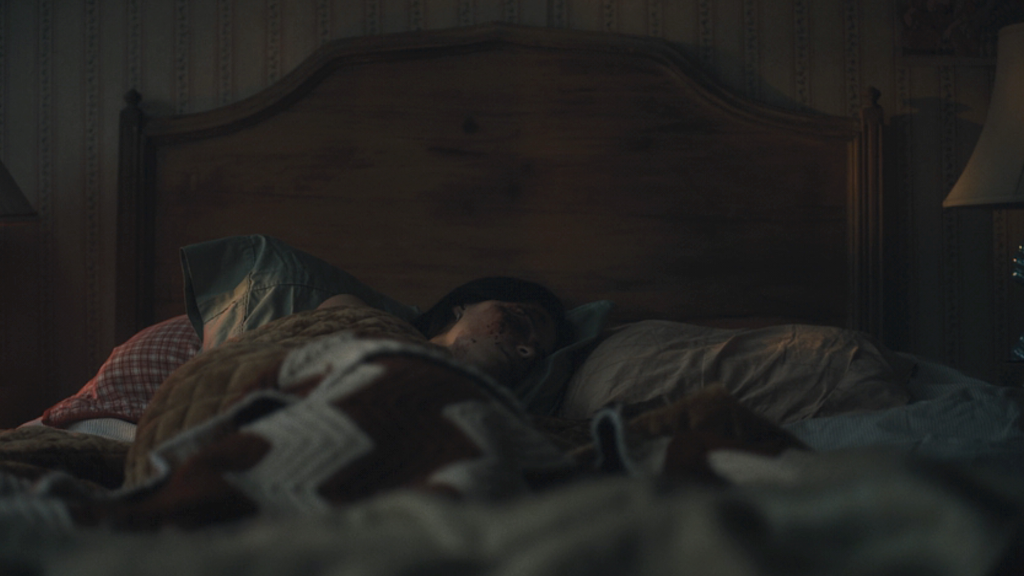
In the minutes before the climax of the film, Nikki briefly resurfaces from her enchanted trance and begs Bear to kill her (Figure 2); her plea represents a desperate bid for autonomy and relief from agonizing psychological and physical trauma. Bear’s dismissive response—asking, “What’s so bad about being with me?”—shows precisely that he doesn’t love her. Instead, his refusal demonstrates how affective entitlement reduces Nikki to a captive possession whose profound suffering is ignored as long as she makes him feel desired (Rowland 2022, 28).
Thus, we can separate why Bear acts the way he does from love; it lacks the true care and regard for Nikki to be authentic romantic attachment. Ultimately, by letting limerence collapse his crush into psychological horror, Bear proved that his concept of “romance” was just a deadly Obsession
Bibliography
Barker, Curry, dir. 2026. Obsession. Horror. Focus Features.Theatre, 109 minutes.
Bradbury, Paula, Emma Short, and Paul Bleakley. 2024. “Limerence, Hidden Obsession, Fixation, and Rumination: A Scoping Review of Human Behaviour.” Journal of Police and Criminal Psychology 40 (2): 417–26. https://doi.org/10.1007/s11896-024-09674-x.
Drevitch, Gary. 2025. “Limerence.” Psychology Today Canada, December 16, 2025. https://www.psychologytoday.com/ca/basics/limerence.
Fagan, Abigail. 2025. “Halo Effect.” Psychology Today Canada, November 12, 2025. https://www.psychologytoday.com/ca/basics/the-halo-effect.
Grant, Ania. 2025. Evolution, Feminism, and Romantic Fiction: From Mr. Darcy to Mr. Big. Taylor & Francis Group.
Rowland, Allison L. 2023. “Small Dick Problems: Masculine Entitlement as Rhetorical Strategy.” Quarterly Journal of Speech 109 (1): 26–47. https://doi.org/10.1080/00335630.2022.2136739.
Willmott, Lynn, and Bentley, Evie. 2015. “Exploring the Lived-Experience of Limerence: A Journey toward Authenticity.” The Qualitative Report, ahead of print, January 5. https://doi.org/10.46743/2160-3715/2015.1420.
Comments
12 Responses to ““No, no, no, no, no don’t do that!” Limerence isn’t love!”
Hi fellow iSci! I love diving into film and analyzing why characters do what they do—and with Halloween just past, what better movie to look at than this year’s biggest horror flick, Obsession!
The main question driving my research is why Bear Bailey breaks the “One Wish Willow” to force his crush, Nikki Freeman, to love him, and what compells him to keep her in a state of constant, horrific suffering while claiming he “loves” her. This topic is inspired by our recent class conversation about psychological conditioning; I wanted to explore how cultural scripts socialize men to prioritize their own emotional needs at the direct expense of a partner’s autonomy.
Hi Aaliya!!
Holy, did you draw me in with the title! I think this is an extremely interesting topic to cover, especially with how you connect it to pop culture.
Here are a few suggestions to help your editing process:
– P1S2 – your phrasing “in the film, in the beginning” I would modify it a bit for better flow. Something like “At the beginning of the film, Bear Baily and Nikki Freeman are set at a bar with their friends…” This isn’t the only option; I just think some slight sentence reconstruction could be useful.
– I’ve seen a few other posts include their in-text citations with a comma; however, I would double-check this, as it is not the most recent style of Chicago author-date.
– In your third paragraph, when saying limerant object and further using LO as the short form, define the short form earlier, as it may be unclear to readers
Overall, your blog post was very captivating, easy to read, and extremely interesting. Especially with all the loopholes and theories of Bear’s psyche in the movie. Well done, and I’m excited to read the final product!!
Hi Maria! I took your suggestion on paragraph 2 since it did read as a bit wordy and unclear, so I shortened it to what was important to my main point. Someone else also mentioned the citations, so I went ahead and fixed that. I’m glad you enjoyed reading it; it’s a topic I’m very excited about, so I’m glad it’s interesting to others as well 🙂
Hi Aaliya! Honestly, this blog post caught my eye as the choice of title acts as an amazing hook itself. I had a few suggestions as I was reading.
1. Title and P1S1 – I noticed that “limerance” changes to “limerence” later in the post. I’d use “limerence” throughout and give the definition its own sentence. The part about wondering whether someone feels the same way helped me understand the term, so I’d bring that idea closer to the start.
2. P1S2 – “The exact same physiological reward pathways” is a pretty strong claim. I’d check whether Bradbury et al. identify specific pathways or make a broader comparison with addiction. If it’s the latter, “Researchers have drawn parallels between limerence and addiction” would capture the point more precisely.
3. P2S2 – Nikki saying she sees Bear as a little brother deserves its own sentence. You could write, “At the bar, Bear tries to tell Nikki how he feels. A few scenes later, she tells him she thinks of him as a little brother.” Giving her response a little more space makes it clear that she’s already told him where she stands before he makes the wish.
4. P3 – One question I had was what happens to Bear’s uncertainty once the wish takes effect. Your opening says uncertainty sustains limerence, yet Bear can now count on Nikki to act as though she loves him. Does he see her behaviour as proof that she wants him, even though he knows he caused it? I’d be interested in your take on that, especially before the scene where she briefly speaks for herself.
Overall, very interesting topic and I look forward to rereading this after the edits you implement! Happy Editing!
Regards,
Riyal
Hi Aaliya, great blog post. I love how you incorporated pop culture to draw the readers in. I just have a few suggestions as follows:
P1S1: This is a bit of a longer sentence. I would suggest splitting it in two where you have the citation, to allow for better readability. This does happen a few times in the paper so just watch out for run on sentences.
P1: I would make it easier to tell that you’re going to dissect the movie obsession as an example of limerance at the start of the post.
P2S3: You have the acronym HSS stated, but you don’t use it again. As such, I think you can just remove it.
Figures: Ensure you are referencing your figures in text.
Great post.
-Izzy
Hi Izzy! I took your advice on HSS and just cut that component since I agreed it was taking away from the general point I was trying to convey, and I reorganized my introductory paragraph to mention obsession more. Hope you like the final draft!
Hi Aaliya,
This is such an interesting topic to write about, especially as we learn about social psychology and dynamics! Some suggestions I have for you are:
– “seperating” should be “separating” in the first paragraph
– “Limerance” should be “limerence” in the opening paragraph and the title
– Make sure you label the Limerant Object as LO before using this abbreviation
. The paragraph: ‘Both the psychological and biological effects…” is quite long and there are many ideas introduced in it. I’d suggest breaking these phrases apart so that you can highlight intrusive rumination and cognitive justification.
Overall, great work, and I look forward to reading the final draft!
– Swetha S
Hey! Thanks for spell-checking the different limerence spellings I ended up typing; I didn’t even notice that, so good catch! I also made sure to label Limerent Object as LO before I started using it as the abbreviation. Hope you like the final draft!
Hi Aaliya,
Your title really interested me and I liked the topic you chose! To help engage the reader, adding a sentence or two in your introduction would be helpful. Moreover, your comparison of obsession and limerence is slightly inaccurate. You state
“Obsession, or rather limerance is the acute, involuntary, and all-consuming cognitive infatuation with a target individual known as the “Limerent Object” (Willmott and Bentley, 2015, 20).
From my understanding, limerence and obsession can’t be used interchangably because limerence is a form of obsession, not a synonym to obsession. This error in definiton can confuse readers, so I would consider rephrasing this sentence.
Moreover, the full sentence is quite long. A tip I have would be reading your blog outloud to catch any run-on sentences! It can also help you see which defintions you will need to define for readers. For example, “mesolimbic reward center” could be more clearly described.
Another inaccuracy can be found from this sentence:
“For a healthy relationship evolutionarily open mate choice sustains healthy pair bonding (Grant, 2025, 2) and due to Bears feelings regarding his rejection he forgoes the idea of giving Nikki romantic autonomy for his own benefit (Rowland, 2023)”.
Firstly, I would change Bears to Bear’s feelings. Moreover, autonomy is the ability of a person to be independent and make their own decisions without external control. Nikki was not given her own autonomy due to Bear’s wish. I would change this phrasing so that it clearly states that Nikki does not have autonomy in this situation.
Moreover, I really liked your figures, but maybe adding one based on one of the studies you investigated would be helpful!
In conclusion, I would consider looking over your blog again for any minor grammatical errors and also ensure you are using terms correctly. I really enjoyed your topic and I am looking forward to reading the final draft!
Kind regards,
Vanessa Salazar
Hi! While reading it over, I did notice my sentences were a bit unclear, so I refined the first sentence as well as the one about healthy pair bonding for clear understanding. Thanks for the input!
Hi Aaliya,
I found your blog post to be such an interesting read; great work! I also loved the title of this post.
Here are a few pieces of feedback:
– In Chicago author-date style, the in-text citations do not have a comma that separates the author and the year.
– For P1S1, I would recommend splitting up the sentence, so that it would make it easier and smoother to read. For example: you could end the first sentence with “Limerent Object” + the citation, and then start the next sentence with “It is sustained…”
– In P1S3, you can remove the first word “further”, since it sounds better without the need for a transition word, or you can keep the “Further” and uncapitalize the “What’s” in the sentence.
– P3S1, I would recommend specifying the abbreviation for “Limerance Object” beforehand (like the first time you mention it), so the readers know what you are referring to when you use it in this paragraph.
Other than that, great work, and happy editing!
Saanvi
Hi Saanvi! I fixed up my citations and tried to smooth out my sentences so they don’t seem as run-on as before. Thanks for your feedback!