Impulsive purchases, trending products, and other transactions all share a commonality: they are often driven by carefully designed advertising strategies. Over the past few decades, digital advertising has revolutionized consumer engagement, enabling the advertisement industry to expand significantly (Baslandze et al. 2023). Strategies like product positioning are utilized throughout online media and physical establishments, effectively persuading the preferences of consumers to influence buying behaviour (Baslandze et al. 2023; Shaw et al. 2020).
Product positioning refers to the consumer’s perception of the product itself (Shaw et al. 2020). Current literature suggests that a large factor involved in positioning is colour, as it can induce different emotions in a consumer (Singh 2006; Bruce et al. 2014). For example, the colour red can stimulate appetite. Consequently, food packaging is carefully designed to entice consumers through colour choices. A study conducted by Su and Wang (2024) looked at the influence of colour and food type on purchase intention for desserts, salads, as well as cereals. For indulgent foods such as desserts, warm-coloured packaging like orange increased purchase intentions. Conversely, healthier foods like salads increased purchase intentions with cool-coloured packaging, such as blue. Colours act as a conscious or unconscious informational cue to consumers, and as such, can persuade them into making a purchase.
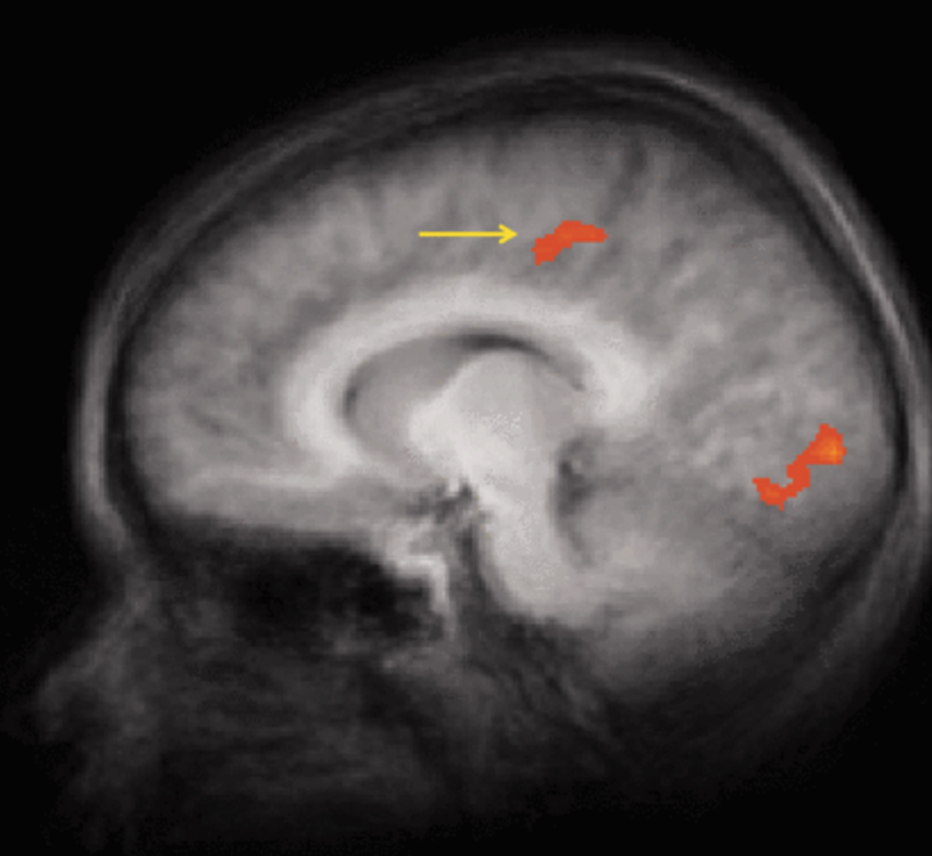
The age demographics of consumers also impacts the effectiveness of product positioning, which a study by Bruce et al. (2014) observed through neural activity in children aged 10-14. In this study, 60 food logos and 60 non-food logos of high familiarity were shown to participants while brain activity was recorded using functional magnetic resonance imaging (fMRI) imaging. Food logos showed greater activation compared to non-food logos in fMRI scans. These activated areas were noted in the right occipital cortex, right paracentral lobule, left parietal, and left lingual gyrus, which is significant as these regions of the brain are responsible for visual stimuli, motivational value, and cognitive control (Figure 1). There were no regions in the brain that showed a greater activation for non-food logos, compared to food logos (Bruce et al. 2014).

The results from the study by Bruce et al. (2014) indicate that younger age demographics are more emotionally salient towards food logos than non-food logos, as food logos increased brain activation in areas associated with motivation and reward processing. This result has critical implications, as most foods marketed for children are high in calories, which is generally unhealthy (Bruce et al. 2014). Nevertheless, the study displays the success of product positioning towards children, and demonstrates that logos and colour associated with food are more popular amongst youth. Additionally, the observed brain activity from Bruce et al. (2014) is similar to another study by Zhang et al. (2024), which measured the neural activity of participants while viewing emotional donation slogans. The Zhang et al. (2024) study found that emotionally uplifting slogans had a stronger activation in the right occipital region. Altogether, both studies showcase that emotionally charged and relevant advertisements led to activation of brain regions dealing with visual processing and memory, which is key in persuading a consumer.
Altogether, the effectiveness of advertisements on a consumer depends on presentation and the demographic it is presented to. By specializing advertisements to the motivations, priorities, and preferences of a consumer, the reception and retention of information can significantly improve. Ultimately, product positioning is a powerful tool that can elicit strong emotional cognitive responses. Advertisements with effective product positioning can consciously or subconsciously shape consumer behaviour, and foster product associations that drive buying behaviours.
References
Baslandze, Salome, Jeremy Greenwood, Ricardo Marto, and Sara Moreira. 2023. “The Expansion of Varieties in the New Age of Advertising.” Review of Economic Dynamics 50: 171–210.
https://doi.org/10.1016/j.red.2023.07.008.
Bruce, Amanda S., Jared M. Bruce, William R. Black, et al. 2014. “Branding and a Child’s Brain: An fMRI Study of Neural Responses to Logos.” Social Cognitive and Affective Neuroscience 9 (1): 118–22.
https://doi.org/10.1093/scan/nss109.
Shaw, Sarah C, Georgia Ntani, Janis Baird, and Christina A Vogel. 2020. “A Systematic Review of the Influences of Food Store Product Placement on Dietary-Related Outcomes.” Nutrition Reviews 78 (12): 1030–45. https://doi.org/10.1093/nutrit/nuaa024.
Singh, Satyendra. 2006. “Impact of Color on Marketing.” Management Decision 44 (6): 783–89. https://doi.org/10.1108/00251740610673332.
Su, Jie, and Shuqi Wang. 2024. “Influence of Food Packaging Color and Foods Type on Consumer Purchase Intention: The Mediating Role of Perceived Fluency.” Frontiers in Nutrition 10.
https://doi.org/10.3389/fnut.2023.1344237.
Zhang, Dianyuan, Jie Yao, and Wenhao Han. 2024. “Why Does Advertising Work? Exploring the Neural Mechanism of Concreteness and Emotional Effects of Donation Advertising Slogans.” Current Psychology 43 (25): 26630–45. https://doi.org/10.1007/s12144-024-05907-8.