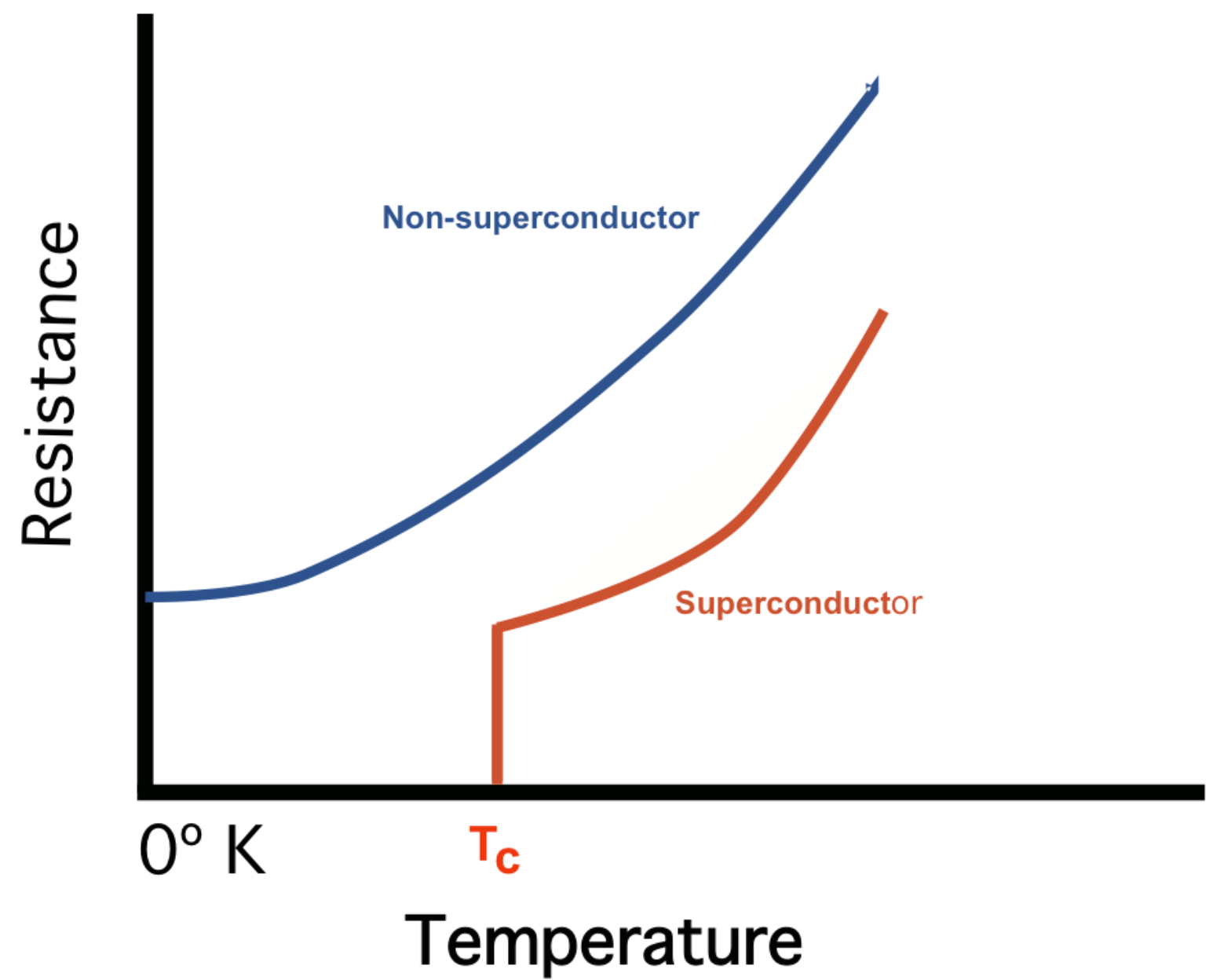
Have you ever noticed that when your laptop is running for sometime it begins to get warm? A common issue across industry, research and even day-to-day activities is overheating technology. Due to electrical resistance in device components, most technology produces heat as a by-product. Electrical resistance was a difficult phenomenon to overcome, but it started with the discovery of superconductivity in 1911, contributing to fundamental physics concepts, specifically quantum mechanics and electromagnetism (U.S. Department of Energy n.d.). The discovery of superconductivity in some materials, specifically in alloys of niobium and titanium when cooled to around 4K (-269°C), led scientists to continue to pursue the study of zero resistance to answer some of the looming questions. (U.S. Department of Energy n.d.).
The theory of superconductivity, which explains the phenomenon through a microscopic view, was formed in 1957 and is still used today in countless physics divisions, including nuclear physics (Bardeen, Cooper, and Schrieffer, 1957). A superconductor is a material that conducts electricity, but under certain conditions, it can do so with no resistance (Bardeen, Cooper, and Schrieffer, 1957). The conditions consist of the material being able to superconduct (not all materials can be superconductors) and cooling the material to its critical temperature, Tc, the temperature at which this material transitions to exhibit superconductivity (Rice, 2019). The highest temperature of a superconductor has a reported Tc value of 200K (-23°C); however, the material requires high pressure to superconduct (Shipley et al. 2020). Under atmospheric pressures, cuprates (copper oxides) hold the highest superconducting Tc value at 138K (-135°C) (Bonn 2006).

All superconducting materials have a common trend where they must be significantly cooled to very low temperatures to superconduct. Yet, they’re still used heavily industrially. For example, magnetic resonance imaging (MRI) uses liquid helium to cool the superconducting wires as electricity runs through them (Mahesh and Barker, 2016). By running electricity through the looped wire, a magnetic field is created, which is needed for the imaging process (Mahesh and Barker, 2016). Since there’s no resistance in the wires, no heat is produced, making it incredibly safe for MRI patients. Similarly, superconductors have applications in maglev trains, nuclear fission reactors, particle accelerators and can enhance communication in power cables, current limiters, radio frequency and microwave filters (Becher, 2023).
Returning to the troublesome issue previously introduced, the overheating of technology such as computers and cellphones. The solution would be a room-temperature superconductor, which would be a material that exhibits conductivity with no resistance at room temperature (Mourachkine, 2004). Such material does not currently exist, so therefore this is a theoretical concept (Mourachkine, 2004). The closest anyone has ever gotten is by producing Lanthanum Decahydride (LaH10); however, this material requires high pressure and is still quite far from room temperature (Semenok et al., 2021). Just last year, a material by the name of LK-99 [Pb9Cu(PO4)6O] was reported to superconduct at room temperatures, but it was quickly disproved, and the sharp drops in electrical resistivity were found to be the result of chemical impurities (Garisto 2023).

After almost a century of superconductor research later, studies reveal that there’s a very likely possibility for this theoretical material to be created (Boeri et al., 2022). No aspect of room temperature superconductivity would defy the laws of physics, explaining the massive interest in this field (Boeri et al., 2022).
Despite the lack of success toward this ambitious goal, labs worldwide are competing to discover the magical material that can superconduct at room temperature. The promise such an invention holds would truly be revolutionary.
References
Bardeen, J., L. N. Cooper, and J. R. Schrieffer. 1957. “Theory of Superconductivity.” Physical Review 108 (5): 1175–1204. https://doi.org/10.1103/PhysRev.108.1175.
Becher, Brooke. 2023. “What Is a Superconductor?” Built In. 2023. https://builtin.com/hardware/superconductor.
Boeri, Lilia, Richard Hennig, Peter Hirschfeld, Gianni Profeta, Antonio Sanna, Eva Zurek, Warren E. Pickett, et al. 2022. “The 2021 Room-Temperature Superconductivity Roadmap.” Journal of Physics: Condensed Matter 34 (18): 183002. https://doi.org/10.1088/1361-648X/ac2864.
Bonn, D. A. 2006. “Are High-Temperature Superconductors Exotic?” Nature Physics 2 (3): 159–68. https://doi.org/10.1038/nphys248.
“DOE Explains…Superconductivity.” n.d. U.S. Department of Energy. Accessed October 22, 2024. https://www.energy.gov/science/doe-explainssuperconductivity.
Garisto, Dan. 2023. “LK-99 Isn’t a Superconductor — How Science Sleuths Solved the Mystery.” Nature 620 (7975): 705–6. https://doi.org/10.1038/d41586-023-02585-7.
Hye-jin, Byun. 2023. “LK-99 Not Superconductor, Says Korean Review Committee.” The Korea Herald. December 13, 2023. https://www.koreaherald.com/view.php?ud=20231213000547.
Mahesh, Mahadevappa, and Peter B. Barker. 2016. “The MRI Helium Crisis: Past and Future.” Journal of the American College of Radiology 13 (12, Part A): 1536–37. https://doi.org/10.1016/j.jacr.2016.07.038.
Mourachkine, Andrei. 2004. Room-Temperature Superconductivity. Cambridge Int Science Publishing. Google Books.
Rice, Maurice. 2019. “Explaining High-Tc Superconductors.” Physics World. 2019. https://physicsworld.com/a/explaining-high-tc-superconductors/.
Semenok, Dmitrii V., Ivan A. Troyan, Anna G. Ivanova, Alexander G. Kvashnin, Ivan A. Kruglov, Michael Hanfland, Andrey V. Sadakov, et al. 2021. “Superconductivity at 253 K in Lanthanum–Yttrium Ternary Hydrides.” Materials Today 48 (September):18–28. https://doi.org/10.1016/j.mattod.2021.03.025.
Shipley, Alice M., Michael J. Hutcheon, Mark S. Johnson, Richard J. Needs, and Chris J. Pickard. 2020. “Stability and Superconductivity of Lanthanum and Yttrium Decahydrides.” Physical Review B 101 (22): 224511. https://doi.org/10.1103/PhysRevB.101.224511.
“Superconductivity.” n.d. Questions and Answers in MRI. Accessed October 22, 2024. http://mriquestions.com/superconductivity.html.