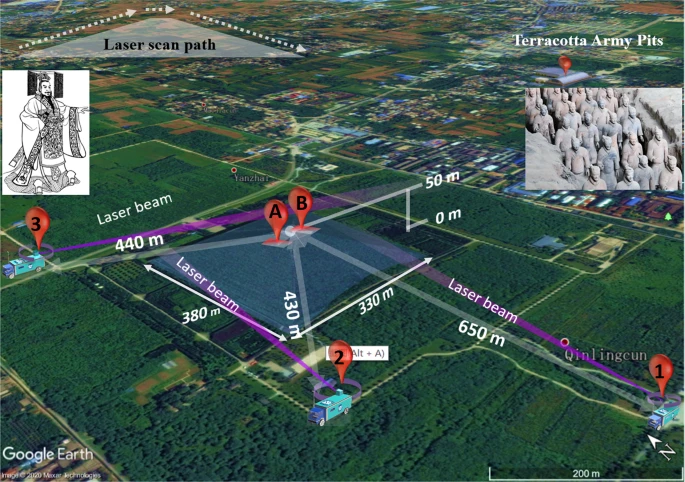
One of the most ambitious funerary constructions in history occurred more than 2200 years ago: the mausoleum of Qin Shihuang, or “First Emperor of Qin” (Sun 2017, 354; UNESCO 1997). It is located in the ancient capital of China, Chang’an, now known as Xi’an (Jiao 2008). Part of the 56 km2 burial site was rediscovered in 1974 by nearby farmers attempting to dig a well, unearthing fragments of what became known as the “Terracotta Army” (UNESCO 1997). These sculptures were meant to protect him in the afterlife (Figure 1). Despite ongoing efforts to excavate countless subsidiary pits, the central tomb chamber remains untouched (Jiao 2008). There are two main concerns: preservation and safety. First, the rapid oxidation of the original vibrant paints on the Terracotta Warriors acts as a cautionary experience (Wang et al. 2022). Second, the elevated concentrations of mercury detected in the land above his tomb (Zhao et al. 2020).
The earliest record of the mercury within Qin Shihuang’s tomb was found in the work of ancient historian Sima Qian, “Records of the Grand Historian”, which denotes rivers and seas of liquid mercury flowing inside (Sun 2017, 354). Mercury’s high vapour pressure at normal temperatures and its distinct atmospheric presence make it detectable with the right technology (Zhao et al. 2020). Using Differential Absorption LiDAR (DIAL), a remote sensing technique that utilizes laser pulses to measure atmospheric concentrations of specific gasses. This allowed measurement of mercury concentration without disrupting the tomb. Zhao et al. (2020) discovered two hotspots, marked by A and B in Figure 1. Its levels reached up to 27 ng/m3, significantly above regional amounts of 5-10 ng/m3. Modern scholars interpret historical accounts to imply around 100 tons of mercury sealed. Current findings corroborate a massive amount. Zhao et al. (2020) roughly estimated the amount of mercury escaped since, determining at least 1 ton. However, how feasible was this thousands of years ago?
Historical sources, including his personal historian, say that Qin Shihuang’s pursuit of eternal life was driven by both the fear of death and the desire to eternally preserve his empire (Sun 2017, 354). The tomb’s alleged rivers and seas of mercury were likely symbolic, replicating China’s geography in a reduced model for the afterlife. Mercury was acquired through ancient metallurgical and alchemical practices, the science of the time (Zhu 2024). Mercury-associated technology has been found to date back as early as 770 BCE. The primary ore for mercury production was cinnabar (HgS). When heated alongside air, cinnabar decomposes, releasing sulfur dioxide (SO2) and mercury (Hg) vapour (Marchini et al. 2022). One technique required two iron kettles: An upper kettle containing crushed cinnabar and the lower kettle with water. Heating it vaporized the cinnabar, dropping condensed mercury into the water as liquid mercury. According to these records, the ability to acquire mercury for Qin Shihuang existed. The capacity was likely a function of the 700,000 people conscripted for the tomb’s creation (Wang et al. 2022).
The scale and design of Qin Shihuang’s mausoleum reflects the ambition of one of China’s most notable emperors. The historical, archaeological, technological, and chemical evidence support the long standing account of large amounts of mercury in his tomb. Together, they showcase the engineering achievements of early civilization without disrupting this significant site, maintaining its preservation until the time comes.
References
Abbas, Syed Tahir. 2024. “Qin Shi Huang’s Legacy: Assessing the First Emperor’s Impact on Chinese History.” Indonesian Journal of Applied and Industrial Sciences (ESA) 3 (2): 175–88. https://doi.org/10.55927/esa.v3i2.8115.
Jiao Nanfeng. 2008. “On the Construction Concept of Western Han Imperial Mausoleums.” Chinese Archaeology 8 (1). https://doi.org/10.1515/CHAR.2008.8.1.178.
Marchini, Marianna, Massimo Gandolfi, Lucia Maini, Lucia Raggetti, and Matteo Martelli. 2022. “Exploring the Ancient Chemistry of Mercury.” Proceedings of the National Academy of Sciences 119 (24): e2123171119. https://doi.org/10.1073/pnas.2123171119.
Sun, Hongmei. 2017. Becoming a Ruin: Breaking into the First Emperor’s Necropolis. Beijing: Frontiers of Literary Studies in China.
UNESCO. 1997. “Mausoleum of the First Qin Emperor.” UNESCO World Heritage Centre, September 18. https://whc.unesco.org/en/list/441/.
Wang, Juanli, Jiaxin Li, Xiaolian Chao, et al. 2022. “Microscopic Imaging Technology Assisted Dynamic Monitoring and Restoration of Micron-Level Cracks in the Painted Layer of Terracotta Warriors and Horses of the Western Han Dynasty.” Polymers 14 (4): 760. https://doi.org/10.3390/polym14040760.
Zhao, Guangyu, Weixing Zhang, Zheng Duan, et al. 2020. “Mercury as a Geophysical Tracer Gas – Emissions from the Emperor Qin Tomb in Xi´an Studied by Laser Radar.” Scientific Reports 10 (1): 10414. https://doi.org/10.1038/s41598-020-67305-x.
Zhu, Shoukang. 2024. “Mercury Application in Ancient Times.” In The ECPH Encyclopedia of Mining and Metallurgy. Springer, Singapore. https://doi.org/10.1007/978-981-99-2086-0_601.
Comments
23 Responses to “The Role of Modern Validations of Historical Insights in Preservation”
Hi iSci,
I was looking into burials for a project and was reminded of this mausoleum. I’d heard of it in passing in my life but wanted to look into it more deeply from a scientific lens to validate the claims I’d been told about. The LiDAR being able to detect and find mercury levels that supports the possibility of having tons of mercury sealed in the tomb was almost more interesting than the fact they had the capacity to make so much in the first place.
Fiona.
Hi Fiona!
This was a very interesting blog post! Here are some suggestions that might help polish it up:
1. Perhaps you could add a figure to your text to break up the writing a bit. Perhaps a schematic of the Differential Absorption LiDAR process could be helpful.
2. Try to avoid contractions if possible (I think in your last paragraph you can change they’re to they are)
3. I think your second last reference (Zhao et al 2020) is not included as an in-text citation. As well, don’t forget to add Zhou et al (2024) to your reference list. Also, I believe for your in-text citation (Zhu 2024), it should be (Shoukang 2024), based on your reference list.
Otherwise, this was a very interesting blog post! Happy editing,
Daniela
Hi Daniela,
I’ll definitely consider adding a figure to break it up and avoid contractions. I think I got mixed up with all the Z last names and put the wrong one into Zotero as both their papers also started with “Mercury…”. As for Shoukang, I’ll go into fix it manually as Zhu should be his surname.
Thanks for your suggestions
Hey Fiona!
Reading this article woke a warrior inside me, a warrior that was dormant for at least 2200 years, yearning the rivers of mercury as a humble home. Seriously though this article was incredibly interesting to read, and I learned many new things. Here are a couple suggestions I would have:
– Firstly, as the previous comment also mentioned, a figure would increase the value of this blog post to insurmountable levels, because the information in this article is so interesting and would be incredibly cool as a visual representation.
– You mention the Song Dynasty in a way that it’s an article, and it took me searching up to realize it was nowhere close. I would recommend making the “in” a “by” or something, and make the “D” of dynasty lowercase. It was also very suddenly mentioned, so I recommend adding something like “many dynasties had their own way of making mercury” or a sentence such as that so that it can be more clear.
– the citation (Sun 2017, 354) seems off, because the citation scheme is supposed to be in author date and this one is not. In fact, looking at the bibliography, I am not even sure where the 354 came from. I would recommend writing the blog first in docs or word so that you can use the zotero extension that links zotero to docs and word in order to put the intext citations.
– In the answer to the previous comment that has been made on this post, you mentioned manually inputting the wrong name into zotero. I want to make sure you are using the chrome extension of zotero in order to link it to the app zotero and make putting citations into the app incredibly easy for you. This changed my life in first year, but I dont know what year you are in so I am just putting this out there. Just in case.
Otherwise I highly enjoyed this blog post. Happy editing!!!
Vihaan
Hi Vihaan, glad you enjoyed the blog and thank you for your suggestions.
I’m in the process of finding a figure as I agree, it would help the piece a lot
I’ll definitely clarify the part on the development and be explicit on how it was more concrete proof of the method being passed down. The ‘d’ in dynasty when writing about a period of time is conventionally capitalized (at least most papers do including other ancient civilizations with these ordinal designations).
The ‘Sun’ citation is from a book and the 354 comes from the page I got it from. I forgot to double check the bibliography but I think Zotero just pulled the chapter pages 352-(3)74.
Thanks for letting me know haha, my mistake was more so pressing the Zotero extension on the wrong paper because their names were so similar both in paper title and author.
Hi Fiona,
Your post was well written and an interesting read. I have a few suggestions
– Your title is very detailed but ideally it should be easy to read at a quick glance. Maybe change it to something like “DIAL Technology: From Historical Insight to Modern Preservation”
– Adding a figure about the structure and function of DIAL would be beneficial
– minor change “One of the most ambitious funerary constructions in history occurred more than 2200 years ago, the mausoleum of Qin Shihuang” should be “One of the most ambitious funerary constructions in history occurred more than 2200 years ago: the mausoleum of Qin Shihuang
Overall, great work and good luck for your final draft!
Veer
Hi Veer,
I have changed the title to be easier to read and more interesting than the original title.
I’ve added a figure on what area they covered and used the DIAL system on.
I’ve changed it to the colon as it makes more grammatical sense.
Thank you for your suggestions
Hey Fiona,
This was an awesome blog post! Very cool topic, the mausoleum of Qin Shihuang seems rather mysterious.
Here is some feedback:
-For some reason I found the wording of P1S7 confusing. I’m wondering if it should be “warriors” not “warrior”? If not, perhaps explain a bit more how these terracotta warriors are related to the mausoleum of Qin Shihuang. One option is “The warriors of the ‘Terracotta Army’ originally possessed vibrant colours…”
-You could also consider rewording P1S8. Here’s an option, “The second concern, originally thought to be a myth but proven true through modern scientific studies, is the presence of an ‘underground palace filled with rivers and lakes of liquid mercury’ (Zhou 2024).
-Who is “his” referring to in P3S1? Is it Qin Shihuang? If yes, maybe swap “his” for “Qin Shihuang”.
Overall this was an awesome blog post and insanely cool topic. Great job!
Emma
Hi Emma,
I’ve changed it to the plural, I was just talking about a singular one. I capitalized the Terracotta Warriors after pluralizing it so it should be clearer that they’re from the Terracotta Army.
I’ve changed the wording to be clearer.
Thank you for your suggestions
Hi Fiona!
This was such an interesting blog post! I love how you connected such cool things from ancient history to science; it shows how much it can be integrated into all subjects.
Just one quick suggestion: in P2S10, you mention some concentration values such as “27 ng/m^3”. I believe you can make it a superscript in Zotero, so it’ll save you using the caret ^.
Overall, awesome blog post, I’m excited to read the final draft!
Hi,
I’ve changed it, thank you
Hey Fiona,
Your blog is really interesting, and I liked how you integrated so much history into it! While you’re editing, I have some suggestions for you:
1. Your (Sun 2017, 354) seems to be a website (based on the formatting of the link), but I can’t find the DOI. The in-text citation also looks like that of a book. Maybe you want to reformat this, and also find a different DOI link that works?
2. In paragraph 1, your final few sentences are a little ambiguous. I understood that one concern is the terracotta warriors’ colours degrading, but then, I’m not sure whether you mean science is PROVING that there are rivers of mercury and such, and that this is a concern for excavators. Consider rewording this entire sentence to eliminate confusion.
3. In paragraph 2, when talking about 2204ppb of mercury levels, consider un-capitalising ‘Earth’, since here, you probably just mean soil.
4. In paragraph 3, you mention ‘his’ in the first sentence. Maybe replace this with the emperor’s name, since you haven’t mentioned him in a while.
5. I really like your writing style! To highlight the ccontents of this paper even further, try to add an image (maybe of the mausoleum, or how LiDAR works, etc.).
This is a really cool blog post though! I hope my comment helps you while you’re editing, good luck!
– Ollin
Hi Ollin,
I took the citation from the online copy of this book and reorganized it to fit the Chicago 18. So it technically is a website but I could just cite the book. I’m not sure why the DOI doesn’t work as it’s the one that was given to me.
I’ve reworded for clarity.
Good catch on the earth!
I agree and have put his name in.
I’ve also added a figure, a mix of an image of his mausoleum and the DIAL research method.
Thank you for your suggestions
Hi Fiona!
I really enjoyed reading your post! It was overall very well written and engaging. A few minor suggestions:
P1S1: consider defining funerary, it might not be common knowledge to your audience
P1S1: a verb is missing in the last clause after the comma
P2S4: consider rephrasing ‘hotspots of mercury concentration, reaching 27’ to ‘hotspots of mercury, reaching concentrations of 27’ to improve flow
Overall, great work! I agree with everyone else that a figure would definitely add interest and improve readability by breaking up the text. I’m looking forward to reading your final draft!
Happy Editing!
Caroline 🙂
Hi Caroline,
I’m opting not to define it as it essentially gets defined in the third sentence, indirectly.
The other suggestions have been reworked from previous comments
Thank you for your suggestions
Hi Fiona!
Really interesting blog post!
Its so different from all the other blog posts I’ve read!
Because this is for an Isci audience, and history might not be the most fascinating of hooks, so maybe try developing a more relatable hook to introduce a topic that ends of being so facinating. The same thing goes for the title, it dosnt grab the attention as much as it has the capacity to.
Overall, such a great job!
Hi Rasmus,
iSci technically does include a history of science course later on but I understand what you mean. It’s more of a personal preference to have a bit of an overarching theme for the title. But I’m glad you enjoyed the piece. Thank you for the suggestion
Hi Fiona!
I love the connection of science and history! I think a lot methods used to analyze historical sites is not always communicated in traditional history tests, only the story they present.
I can see in your figure you have some images that show the artifacts, however I would have liked to see an image of just the tomb mentioned.
I found this very interesting and will keep an eye out for the other fun connections you’ll make to the sciences in the future!
-Brooklyn D.
Hi Brooklyn,
I’ve included a figure now but I do recommend you to take a look online. It’s pretty interesting.
Hello Fiona,
I loved reading about your blog post. I had some knowledge about this before but it was super fun to see the link between history and science. In the last sentence of paragraph 2 you used the phrase “at least” twice in your sentence and in my opinion it makes a bit awkward. I think if you could find a synonym such as “approximately” or reword it in a way to use at least once would make the sentence flow a bit better. Otherwise I think you did an amazing job!
Stephanie
Hi, it’s been changed. Thank you
Hi Fiona,
I really enjoyed this blog post especially how you tied science and history together. The figure implemented was very visually appealing, next time try adding an image of the tomb chamber mentioned it would help clarify the post! Overall amazing post keep up the good work!
Jayaani
That isn’t possible as the article is about how it cannot be opened.