The exciting possibility of extraterrestrial life and alien contact has been a topic of keen human interest for several years. This is exemplified by the countless science-fiction literature, movies, shows, and conversations that expound upon the fantasy of discovering that humans are not alone in this universe. In fact, the first organized, modern scientific project to detect, and possibly make contact with extraterrestrial beings dates back to 1960 (“Project Ozma,” n.d.). This project, named Project Ozma, attempted to detect interstellar radio transmissions around the stars Tau Ceti and Epsilon Eridani. From these two-thousand dollar experiments, humanity has now progressed to multimillion dollar missions, in an effort to collect evidence for the possibility of other lifeforms in the universe.
Generally, when searching for life, humans have sought out qualities seen on Earth and life that is bound to Earth. The criteria for life in space is ever-evolving, but often scientists search for a source of energy, carbon-based chemistry, nitrogen, oxygen, traces of DNA or RNA, and conditions for liquid water to exist, to name a few (McKay 2014). In addition, NASA supports the concept of the Habitable Zone, or the “Goldilocks zone,” which is characterized as a particular distance from a star at which an orbiting planet may contain liquid, surface-level water (NASA 2020). Since liquid water is a hallmark of life on Earth, it seems to be a logical step to look for the same in other planets in search for life. However,what if none of these characteristics are truly the universal requirement for life? The greatest obstacle in finding extraterrestrial life may be human bias and arbitrary assumptions about what life is.
For example, Mars’ geology poses an interesting case study, especially when challenging human notions of what extraterrestrial life may look like. Although Mars today doesn’t present the conditions to sustain liquid water, evidence suggests that Mars had substantial liquid water on its surface 3.7-4 billion years ago, during the Noachian Period (Mitra 2019). Many surfaces of Mars are covered with extensive valley networks and basins that are speculated to have been carved by flowing water in the past (Figure 1) (McCollom 2006). Although surface water doesn’t exist on Mars (or at least not anymore), the planet’s geothermal activity leads to speculation about the potential for groundwater (Stamenkovic et al. 2021). Further analysis of Mars’ mid-crust (∼11.5 to 20 km deep) finds fractured igneous rocks that are saturated with water (Wright et al. 2024).
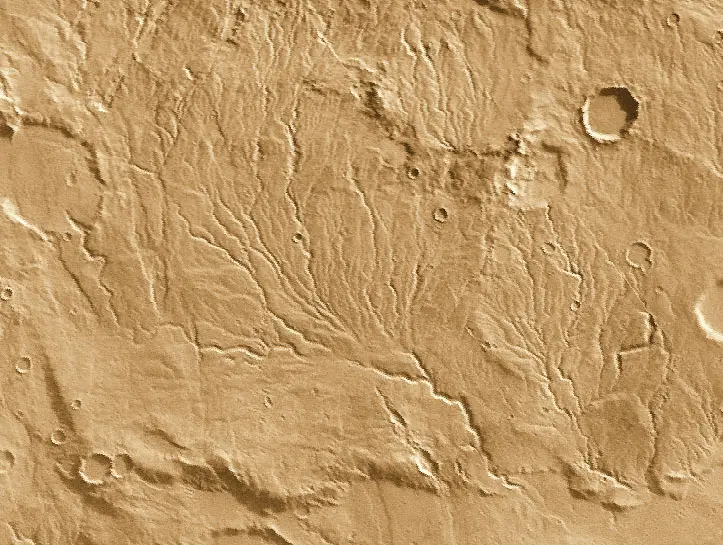
Figure 1: Valley networks suggest that rivers may have once flowed on Mars. This photograph was taken by NASA’s Viking mission (NASA, 2003)
Although these developments about the condition of Mars are incredibly groundbreaking, and push forward the quest of finding life on other planets, they are not entirely indicative that there is life there. The presence of characteristic Earthly biomarkers on Mars does not guarantee that there is life on Mars. It may happen that scientists do not recognize life on mars entirely, because it does not fit the human definition of what “life” is. If the search for extraterrestrial life is shaped by assumptions derived from a single planet, then human bias will be the largest hindrance to astrobiological discovery.
References
Mitra, Kaushik (The Planetary Society). 2019. “Mars Used to Have Water, But We Can’t Explain How.” May 7. https://www.planetary.org/articles/mars-water-stable-paradox.
McCollom, Thomas M. 2006. “The Habitability of Mars: Past and Present.” In Solar System Update, edited by Philippe Blondel and John W. Mason. Springer-Verlag. https://doi.org/10.1007/3-540-37683-6_6.
McKay, Christopher P. 2014. “Requirements and Limits for Life in the Context of Exoplanets.” Proceedings of the National Academy of Sciences of the United States of America 111 (35): 12628–33. https://doi.org/10.1073/pnas.1304212111.
NASA. 2020. The Habitable Zone – NASA Science. Exoplanets. October 26. 141. https://science.nasa.gov/exoplanets/habitable-zone/.
NASA. 2003. “Deep Space 2 Mission: Mission Objectives.” https://www.jpl.nasa.gov/nmp/ds2/mission/objective.html.
“Project Ozma.” n.d. Accessed November 9, 2026. https://www.seti.org/research/seti-101/project-ozma/.
Stamenkovic, Vlada et al. 2021. “Deep Trek: Science of Subsurface Habitability & Life on Mars.” https://www.research-collection.ethz.ch/entities/publication/fe4f9f81-8ee7-4232-92ee-c3a8f2950c66.
Wright, Vashan, Matthias Morzfeld, and Michael Manga. 2024. “Liquid Water in the Martian Mid-Crust.” Proceedings of the National Academy of Sciences 121 (35): e2409983121. https://doi.org/10.1073/pnas.2409983121.


Leave a Reply
You must be logged in to post a comment.