Have you ever found yourself in an unfamiliar environment, feeling uncomfortable or as though you don’t quite belong? Think about the transition from being a senior in high school, surrounded by familiar faces and routines, to becoming a first-year student in university, where everything suddenly feels new. In moments like these, it’s easy to find yourself reminiscing about the past, a time when everything seemed easy, familiar, and comfortable. Feelings of loneliness and negative emotions can trigger nostalgia, bringing back memories that strengthen our sense of social connection (Wildschut et al. 2006). But what if nostalgia does more than just provide emotional comfort? What if going down this nostalgic memory lane could actually make us feel physically warmer?
Nostalgia is often associated with emotional warmth, a comforting feeling that comes from revisiting meaningful moments in our past. However, nostalgia is much more complex than a simple recalling of a happy memory. It is often a bittersweet experience, combining happiness from what we once had with sadness from knowing those moments have passed. Nostalgia is also considered a predominantly positive and social emotion, often involving memories of meaningful relationships (Sedikides et al. 2008). In fact, nostalgia has been described as “an emotion witha strong connotation of warmth” (Zhou et al. 2012, 678). Even more, what makes nostalgia particularly fascinating is the possibility that this emotional warmth may extend beyond our psychological experiences and influence how we physically experience temperature. Our bodies respond to thermal changes through thermoregulation, a process that uses signals from our skin to help maintain a stable internal body temperature (Romanovsky 2014). As shown in Figure 1, the body uses different feedback mechanisms to regulate its internal temperature. However, physically regulating our body temperature and consciously feeling warm are not necessarily the same thing. Recalling nostalgic memories may influence how warm we perceive our surroundings to be, even when the environment remains unchanged (Zhou et al. 2012).
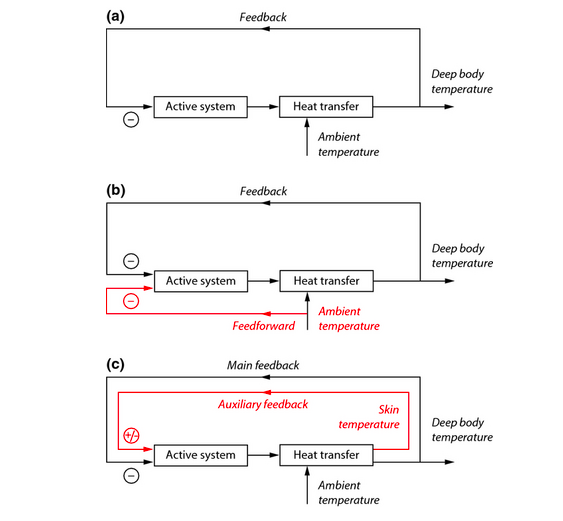
Source: Romanovsky (2014, fig. 1).
To explore the relationship between nostalgia and physical warmth, researchers conducted five studies examining how nostalgic memories influence our experiences with temperature. In one experiment, participants who recalled nostalgic memories perceived their surroundings as warmer than those who recalled ordinary experiences. As described in the study, “Nostalgia, in turn, modulates the interoceptive feeling of temperature” (Zhou et al. 2012, 678). Another experiment found that participants who reflected on nostalgic memories could tolerate painful cold for longer periods. These findings suggest that nostalgia may influence how we experience physical discomfort, rather than simply providing emotional comfort.
So, can memories really keep us warm? The answer may be more complicated than we think. Nostalgia has been associated with “the maintenance of physiological comfort” (Zhou et al. 2012, 678), suggesting that its effects may extend beyond emotional reassurance. However, this does not necessarily mean that our actual body temperature increases. Instead it signifies how closely our emotional experiences, connections and physical sensations are linked. What I find particularly fascinating is how something as simple as remembering the past could change how we experience the present. Thinking back to the transition from high school to university, nostalgia may provide a sense of familiarity when everything around us feels unfamiliar. Although memories cannot physically bring us back to the past, perhaps they can still offer us a little warmth in the present.
References
Romanovsky, Andrej A. 2014. “Skin Temperature: Its Role in Thermoregulation.” Acta Physiologica 210 (3): 498–507. https://doi.org/10.1111/apha.12231.
Sedikides, Constantine, Tim Wildschut, Jamie Arndt, and Clay Routledge. 2008. “Nostalgia: Past, Present, and Future.” Current Directions in Psychological Science 17 (5): 304–7. https://doi.org/10.1111/j.1467-8721.2008.00595.x.
Wildschut, Tim, Constantine Sedikides, Jamie Arndt, and Clay Routledge. 2006. “Nostalgia: Content, Triggers, Functions.” Journal of Personality and Social Psychology 91 (5): 975–93. https://doi.org/10.1037/0022-3514.91.5.975.
Zhou, Xinyue, Tim Wildschut, Constantine Sedikides, Xiaoxi Chen, and Ad J. J. M. Vingerhoets. 2012. “Heartwarming Memories: Nostalgia Maintains Physiological Comfort.” Emotion 12 (4): 678–84. https://doi.org/10.1037/a0027236.
Comments
7 Responses to “When the Past Warms the Present: Can Memories Really Keep Us Warm?”
Hey iSci!
I chose this topic because I’ve always found nostalgia fascinating. I’ve always felt that there’s something deeper and more meaningful behind why reminiscing about the past can bring us so much comfort. What interested me even more was discovering that nostalgia might not just provide emotional comfort, but could also influence how we physically experience warmth. I thought exploring the connection between our memories, emotions, and body temperature would be really interesting!
Hi Afaf!
This is a really strong draft! I liked how you tied the high school example in the introduction to the conclusion.
A few points of feedback:
– Make sure you reference your figure in the main body of your writing, rather than relying on the figure caption to explain how it’s relevant. For example, in S2P5, you can expand on this a bit further and include a bracketed reference to Figure 1.
– Your last sentence in P2 is well written and makes a good point. However, its placement feels slightly awkward because you introduce the figure immediately afterwards. I think this sentence might fit better closer to your conclusion, or before you transition into discussing the figure.
– In your references, I believe you can remove the ProQuest link and just keep the DOI
In P4, S4-S5, you start a sentence with “Suggesting.” Adding a comma after the previous sentence instead of a period would be more grammatically correct.
– Overall, I really enjoyed reading this! This is a great topic, and you have a strong introduction and conclusion. I can’t wait to read the final draft!
Regards,
Amelia
Hey Amelia! Thank you so much for taking the time to give me such detailed feedback! I went back and added a reference to Figure 1 in my second paragraph to explain its connection to thermoregulation. I also removed the last sentence of that paragraph because I agree that it fits better with the conclusion. I fixed the grammatical issues you pointed out and cleaned up my references by removing the extra ProQuest link. I really appreciate your suggestions, and I’m glad you enjoyed reading my blog. 🙂
-Afaf
Hello Afaf,
I really enjoyed reading this blog post! This is a unique topic that me want to keep reading. Here are some suggestions:
-Make sure to reference your Figure 1 in the text somewhere before it appears.
-Since a large portion of your post comes from the same source, I would try to add a couple more citations to help further support your claims.
Great job!
-Grace
Hey Grace! Thank you so much for your feedback! I’m glad you found the topic interesting! I went back and added a reference to Figure 1 in my second paragraph so that it connects more clearly to my discussion of thermoregulation. I also added another scientific source to support my explanation of nostalgia. Thank you again for the suggestions!
-Afaf
Hey Afaf!
Really great blog post! I thought it was really interesting how you explained that nostalgia can influence not only our emotions but also how we physically experience temperature. Some suggestions I have are:
– P1S3: In the sentence beginning “In moments like these,” I noticed that “remembering” and “reminiscing” have similar meanings. I would suggest removing one to avoid repetition.
– P2S5: In the sentence beginning “Our bodies constantly respond,” I noticed that “temperature” is repeated a few times. I would suggest rewording the sentence slightly to improve the flow.
– P4S6: In the sentence beginning “Instead it signifies,” I would add a comma after “Instead.” I would also suggest changing “may be connected” to “are linked” to avoid repeating the word “connected” in the same sentence.
Overall, really great blog post! I enjoyed learning about the connection between nostalgia and physical warmth, and I thought your writing was easy to follow!
– Claire
Hey Claire! Thank you so much for reading my blog and giving such detailed feedback! I went back and fixed the repetitive wording in my introduction and second paragraph, and I also adjusted the phrasing in my conclusion to make it flow more naturally. I really appreciate you pointing out those small details because I hadn’t noticed them while writing!
-Afaf