Deep in your skull, behind what is now your jaw joint, are two small bones that once played a role in jaw movement but now serve a very different purpose. The malleus and incus, two of the three bones that carry sound into the inner ear, evolved from the hinge of our ancestors’ jaws (Anthwal et al. 2012). At some point in mammalian evolution,bones that formed the ancestral jaw joint were gradually repurposed as part of the middle ear (Mao et al. 2020). The fossil record allows scientists to track where this change started and follow it step by step.
In early synapsids, the group that includes all mammals and extinct relatives like Dimetrodon (Jenkins et al. 2025), the lower jaw was hinged to the skull where the articular bone of the lower jaw met the quadrate bone of the skull (UC Museum of Paleontology 2021). Fossils of cynodonts, a later group of synapsids that diversified into mammals, show the dentary bone growing larger while the small bones behind it shrank (Rawson et al. 2024), as seen in Figure 1 (Maier and Ruf 2015). The dentary bone expanded backwards, eventually meeting the skull and forming a new hinge, which is now your jaw joint (Wilken et al. 2024). Early relatives of mammals, like Morganucodon, caught the transition mid-way. They had two jaw joints which worked side by side, one old and one new. With the new jaw joint responsible for carrying the load, the old one was free to specialize in carrying sounds (Zhang and Mao 2025).
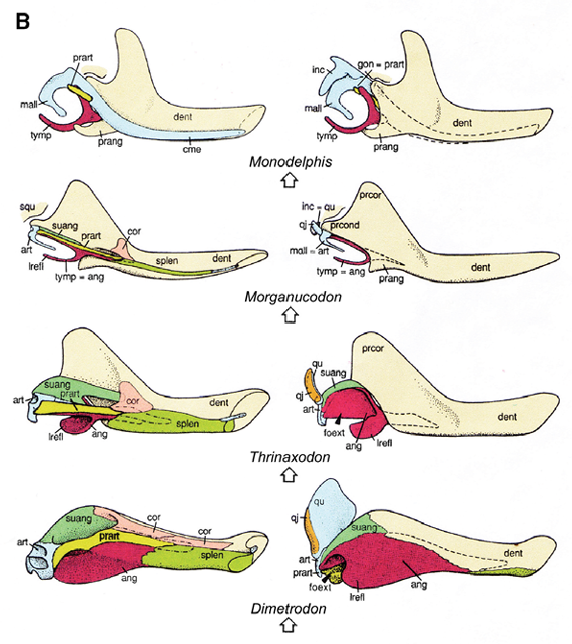
In 1837, anatomist Karl Reichert compared the embryonic development of birds and mammals. This comparison led to his suggestion that the malleus and incus match the articular and quadrate (Gilbert 2014). In a mammal embryo, the future malleus is attached to a rod of cartilage in the lower jaw called Meckel’s cartilage. The intervening part of this cartilage later disappears, freeing the malleus and incus to act as separate bones (Wang et al. 2026). Fossils such as Liaoconodon show adults with their ear bones still linked to their jaws in this way. This evidence suggests the ear bones fully separated more than once (Meng et al. 2011).
This transition gave mammals an important advantage. Once the bones were small, light, and free of the jaw, they were able to vibrate, allowing mammals to pick up on quiet and high-pitched noises (Schultz 2026). This more sensitive hearing may have been especially valuable for early small mammals trying to survive when dinosaurs were at their peak, by allowing them to detect predators and prey more efficiently (Coleman and Boyer 2012). Research has also suggested that the evolution of the middle ear is related to the growth of the neocortex, the part of the mammal brain responsible for handling sensory information (Rowe 1996) . This progression reflects that evolution rarely builds from scratch. Just as the dawn of terrestrial life saw animals gradually reshape fins into limbs (Yano and Tamura 2012), our distant ancestors repurposed a jaw joint into a hearing aid.
References
Anthwal, Neal, Leena Joshi, and Abigail S. Tucker. 2012. “Evolution of the Mammalian Middle Ear and Jaw: Adaptations and Novel Structures.” Journal of Anatomy 222 (1): 147–60. https://doi.org/10.1111/j.1469-7580.2012.01526.x.
Coleman, Mark N., and Doug M. Boyer. 2012. “Inner Ear Evolution in Primates Through the Cenozoic: Implications for the Evolution of Hearing.” The Anatomical Record 295 (4): 615–31. https://doi.org/10.1002/ar.22422.
Gilbert, Scott F. 2014. “Evolutionary Embryology.” Nih.Gov, Sinauer Associates. https://www.ncbi.nlm.nih.gov/books/NBK10049/.
Jenkins, Xavier A, Roger BJ Benson, David P Ford, et al. 2025. “Evolutionary Assembly of Crown Reptile Anatomy Clarified by Late Paleozoic Relatives of Neodiapsida.” Peer Community Journal 5 (August): e89. https://doi.org/10.24072/pcjournal.620.
Maier, Wolfgang, and Irina Ruf. 2015. “Evolution of the Mammalian Middle Ear: A Historical Review.” Journal of Anatomy 228 (2): 270–83. https://doi.org/10.1111/joa.12379.
Mao, Fangyuan, Cunyu Liu, Morgan Hill Chase, Andrew K Smith, and Jin Meng. 2020. “Exploring Ancestral Phenotypes and Evolutionary Development of the Mammalian Middle Ear Based on Early Cretaceous Jehol Mammals.” National Science Review 8 (5): nwaa188. https://doi.org/10.1093/nsr/nwaa188.
Meng, Jin, Yuanqing Wang, and Chuankui Li. 2011. “Transitional Mammalian Middle Ear From a New Cretaceous Jehol Eutriconodont.” Nature 472 (7342): 181–85. https://doi.org/10.1038/nature09921.
Rawson, James R. G., Agustín G. Martinelli, Pamela G. Gill, Marina B. Soares, Cesar L. Schultz, and Emily J. Rayfield. 2024. “Brazilian Fossils Reveal Homoplasy in the Oldest Mammalian Jaw Joint.” Nature, ahead of print, September 25. https://doi.org/10.1038/s41586-024-07971-3.
Rowe, T. 1996. “Coevolution of the Mammalian Middle Ear and Neocortex.” Science (New York, N.Y.) (United States) 273 (5275): 651–54. PubMed. https://doi.org/10.1126/science.273.5275.651.
Schultz, Julia A. 2026. “A Perspective From the Mesozoic: Evolutionary Changes of the Mammalian Skull and Their Influence on Feeding Efficiency and High-Frequency Hearing.” Anatomical Record (Hoboken, N.J. : 2007) (United States) 309 (9): 2315–30. PubMed Central. https://doi.org/10.1002/ar.25652.
UC Museum of Paleontology. 2021. “Jaws to Ears in the Ancestors of Mammals – Understanding Evolution.” April 28. https://evolution.berkeley.edu/what-are-evograms/jaws-to-ears-in-the-ancestors-of-mammals/.
Wang, Haibing, Neal Anthwal, Shuo Wang, and Yuan-Qing Wang. 2026. “Evolutionary Transformations of the Ossified Meckelian Cartilage in Mammaliaforms.” Developmental Biology Advances 17 (1): 11. https://doi.org/10.1186/s13227-026-00265-x.
Wilken, Alec T., Julia A. Schultz, Zhe-Xi Luo, and Callum F. Ross. 2024. “A New Biomechanical Model of the Mammal Jaw Based on Load Path Analysis.” Journal of Experimental Biology 227 (18): jeb247030. https://doi.org/10.1242/jeb.247030.
Yano, Tohru, and Koji Tamura. 2012. “The Making of Differences Between Fins and Limbs.” Journal of Anatomy 222 (1): 100–113. https://doi.org/10.1111/j.1469-7580.2012.01491.x.
Zhang, Yingqi, and Fangyuan Mao. 2025. “Outstanding Discoveries in Paleomammalogy in the Last One and a Half Decade—-Bulletin of the Chinese Academy of Sciences.” Bcas.Cas.Cn, May 6. https://bcas.cas.cn/perspective/202505/t20250506_1042531.html.


Leave a Reply
You must be logged in to post a comment.