You Would not Believe Your Eyes (Ten Million Fireflies)

We’ve all heard the song, they lit up the world as I fell asleep, and so on. Soft bodied beetles of the family Lampyridae, frequently known as fireflies are often cited as a prime example of bioluminescence. But how do they do it? The answer lies in their anatomies, some impressive optical physics, and partially, in urine!

The source of a firefly’s light comes from its light organ. This light organ is composed of three main segments, being the ventral photogenic layer, the dorsal reflector layer, and the cuticle. The photogenic layer is where light is actually produced in the firefly’s light organ, and the cuticle helps to transmit this light to the outside world. The dorsal reflector layer is composed of specialized tissue which amplifies light emitted by the photogenic layer, by reflecting light towards the outside world, hence its name (Chen et al. 2015).

Uric acid is one of the most ubiquitous byproducts of metabolism in the animal kingdom, and it is an important chemical in the process of waste removal in a majority of animals. A firefly’s reflector layer is made up of many spherical granules made of uric acid crystals. These crystals are the mechanism that allows the reflector layer to reflect light that would not have reached the outside world otherwise (Goh et al. 2013).
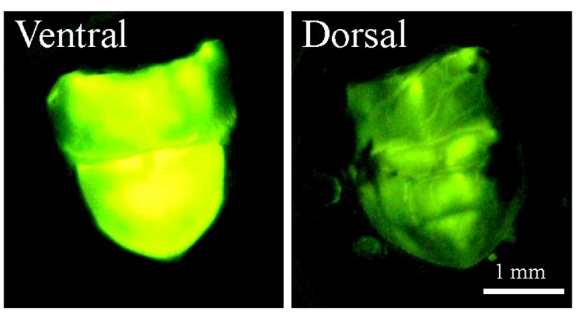
Figure 1. The ventral layer of a firefly’s light organ. Pictured on the left is the ventral photogenic layer. On the right is the dorsal reflector layer. The dorsal layer still emits light, despite not naturally producing any on its own, due to the reflective uric acid crystals (Goh et al. 2013).

These crystals are extremely effective at reflecting light of wavelengths between 400nm and 800nm, with the percentage of light reflected off of them reaching 82% at a wavelength of 550nm. When scientists recreated the uric acid crystals using hollow silica microparticles, the intensity of the light produced by chemiluminescent reactions increased by a factor 55.3 (Chen et al. 2015).

The cuticle of the firefly is also quite important to the optimization of light emission from its light organ. The cuticle is made of longitudinal nanostructures, organized in a highly ordered fashion. These nanostructures help the cuticle to act as a single layer which has a refractive index of 1.24, contributing to the reduction of refractive index mismatch between the firefly body and the air. This allows for a brighter and more efficient light organ (Kim et al. 2012).

Firefly cuticles have been the subject of studies pertaining to light, with LED lenses inspired by the cuticle of the firefly light organ being considered as a candidate for more efficient and powerful displays (Kim et al. 2012).

Fireflies use their light organs for multiple reasons. Notably, the light is used as a defense mechanism, communicating to predators that they are unpalatable if eaten. The light is also used as a mating ritual, with brighter lights and specific light patterns in males signalling to females that they are more fit than their competitors (Scientific American, 2005).

Though they may seem simple at first glance, fireflies have complex and impressive mechanisms that allow them to make the night glow in the way that humanity (and Owl City especially) knows and loves!

References

Chen, Linfeng, Xiaodi Shi, Mingzhu Li, et al. 2015. “Bioinspired Photonic Structures by the Reflector Layer of Firefly Lantern for Highly Efficient Chemiluminescence.” Scientific Reports 5 (1): 12965. https://doi.org/10.1038/srep12965.

Goh, King-Siang, Hwo-Shuenn Sheu, Tzu-En Hua, Mei-Hua Kang, and Chia-Wei Li. 2013. “Uric Acid Spherulites in the Reflector Layer of Firefly Light Organ.” PLoS ONE 8 (2): e56406. https://doi.org/10.1371/journal.pone.0056406.

“How and Why Do Fireflies Light Up?” Scientific American, September 5, 2005. https://www.scientificamerican.com/article/how-and-why-do-fireflies/.

Kim, Jae-Jun, Youngseop Lee, Ha Gon Kim, et al. 2012. “Biologically Inspired LED Lens from Cuticular Nanostructures of Firefly Lantern.” Proceedings of the National Academy of Sciences 109 (46): 18674–78. https://doi.org/10.1073/pnas.1213331109.

Comments

6 Responses to “You Would not Believe Your Eyes (Ten Million Fireflies)”

  1. Daniel Messih Avatar
    Daniel Messih

    Hi iSci! I’ve been wanting to write about this blog post since mating rituals and sexual selection were brought up in one of our LifeSci lectures, since I knew from before that fireflies used their light as part of a mating ritual. I also became pretty interested in the science behind light since we discussed it in our Chemistry atomic structure unit, though this blog post focuses more on the physics of light in the context of fireflies. I hope you all enjoy reading!

  2. Gurleen Hunjan Avatar
    Gurleen Hunjan

    Hi Daniel,

    I enjoyed reading your post!

    My feedback is to include a more detailed conclusion paragraph that comprehensively summarizes all the points you wrote about, and how they tie together, to emphasize the interdisciplinary aspect. I think it would allow the reader to better understand the key takeaways from your blog post!

    Best,

    Gurleen H

  3. Kayo Lake Avatar
    Kayo Lake

    Daniel,

    Thanks for your blog post! Here are a few comments:
    1. I’m not sure we have all heard the song you refer to…perhaps an epigram with the lyrics would help?
    2. The final line of P1 should have ‘in’ to start each clause to maintain parallel structure.
    3. The final line in P3 might be better as “that would not otherwise reach the outside world.” It clears up the tense issue.
    4. In P5 you say the cuticle has ” refractive index of 1.24″. How does this scale operate? What is it comparable to? This might help the reader better understand your point.
    5. I’m not sure about the box around your FIg. 1 text?
    This was a really interesting post. I didn’t know much about fireflies so I really enjoyed reading yoru work. Happy editing!
    Kayo

  4. Ethan Yoon Avatar
    Ethan Yoon

    Hey, Daniel! Great work on your blog post. The song is certainly stuck in my head after reading your post! I just have a couple of comments:

    1. P1, S2: Because they’re two different clauses, consider putting a comma in between “fireflies” and “are”.
    2. P5, S3: It’s awesome that you’re talking about the refractive index! However, especially for those who don’t know or forget what the relevance/meaning of it is in the context of your post, try to put an alternative explanation in layman’s terms next to the more scientific explanation. (i.e. why does this refractive index create a brighter and more efficient light organ?).
    3. Consider combining paragraphs together! Generally, paragraphs should not be single sentences.
    4. Make sure to capitalize “not” in your title to adhere to the Chicago capitalization rules!

    That’s it from me! Once again, great blog post, and I can’t wait to read the final version!

    – Ethan

  5. Albesa Fazliu Avatar
    Albesa Fazliu

    Hi Daniel, Great work on your blog post!

    I have a few small edit suggestions:
    – You introduce a song in the beginning of your blog post which is a clever way to connect with the audience, but I recommend changing the wording slightly. This is a bit meticulous but I think you could add the formal title and artist (“Fireflies” by Owl City), followed by the relating lyrics to fireflies. I think it’s safer to not assume your entire audience knows it, like you would for science!
    – P2, S2: “This light organ is composed of three main segments, being the ventral photogenic layer, the dorsal reflector layer, and the cuticle”. Instead of using the word “being”, use “which are” or add a colon before listing the segments.

    I thought your scientific content was very interesting! These are just some suggestions for readability.

    – Albesa

  6. Audrey Thompson Avatar
    Audrey Thompson

    Hey Daniel!
    Such a cool topic, I really enjoyed reading your blog. I just have a couple of suggestions that may help strengthen your blog post:
    – I think relating this topic to a song is a great way to pull the audience, but I suggest wording it differently so more people understand what exactly you are trying to say.
    – I found some of the jumps between paragraphs to be slightly choppy, maybe adding a bit more flow would make it easier for readers to follow.
    – Lastly adding a larger more conclusive ending paragraph would help bring together your blog as a whole .

    Such an interesting blog post, it was so cool to learn more about fireflies and what makes them glow!

    Thanks, Audrey

Leave a Reply