Throughout an individual’s chemistry education, it is typically taught that we see one, two, or three bonds between atoms, also known as a bond order of one, two, and three respectively. It is instilled in students that elements can not have more than four bonds, but that is not entirely true. Certain properties of transition metals allow for the possibility of increasing bond order to values of four, five, and even six (Merino et al. 2007). Theoretically, bonds between metal atoms with specific characteristics have the potential to reach a bond order of nine. This means there would be nine bonds between two atoms. How would such a high bond order be possible?
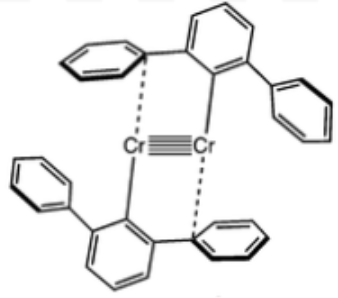
Until the 1960s it was widely believed that the highest possible bond order was three, otherwise known as a triple bond (Merino et al. 2007). Then, in 1964, the first quadruple bond was discovered between two rhenium atoms in the compound [Re2Cl8]2- (Cotton et al. 1964). At that point, chemists dove into the search for higher bond orders. This led to the first quintuple bond discovered in 2005 between two chromium metal atoms (Nguyen et al. 2005). The reduction of a chromium compound with bridging chlorine ligands and large sterically hindering terphenyl ligands forms a compound with a Cr-Cr quintuple bond (Figure 1).

Figure 1. The first quintuple bond found in a Cr(I) complex with terphenyl ligands (Falceto, Theopold, and Alvarez 2015).
The design of these compounds needs to be very precise ensuring the metals exhibit the required characteristics to be able to participate in the quintuple bonding. This starts with the choice in the ligand that binds to the metal center (Nguyen et al. 2005). A ligand’s main purpose is to stabilize a metal center. When they bind to metals, they can reduce the number of valence orbitals available on the metal to participate in metal-metal binding. Therefore, the number of ligands must be minimized in order to maximize the number of valence electrons. The terphenyl ligand on the complex with the first quintuple bond is the only ligand bonded to each chromium atom. As chromium is in group 6, it has six valence d-electrons before bonding to a ligand. After binding to one terphenyl, it now has five remaining valence d-electrons. These five electrons can covalently bond with another chromium atom. If each atom donates five electrons, it can form five bonds.
The other important aspect in forming a quintuple bond is the energies of the molecular orbitals (Falceto, Theopold, and Alvarez 2015). The molecular orbitals of atoms combine together to create bonding orbitals, non-bonding orbitals, and anti-bonding orbitals which increase in energy respectively. Electrons first begin filling the lowest energy orbitals, the bonding orbitals, forming bonds. A quintuple bond needs five bonding orbitals for the valence electrons to reside in. Additionally, the bonding orbitals need to have noticeably lower energy than the antibonding orbitals as seen in figure 2.

Figure 2. The molecular orbital diagram of the terphenyl Cr (I) complex. Each arrow represents an electron and the five filled orbitals in the middle of the diagram represent the five filled bonding orbitals forming the quintuple bonds. The higher energy orbitals are the anti-bonding orbitals. The symbols below the outer metal orbitals indicate the orbital the electron lies in and the symbols below the middle orbitals represent the type of bond formed (Harisomayajula, Nair, and Tsai 2014).
Using the principles highlighted, chemists have discovered another quintuple bond between two molybdenum atoms (Tsai et al. 2009). There are also hypotheses that Mo2 and Cr2 with no ligands form sextuple bonds as evidence has been observed in the gas phase at low temperatures. So, the next time your chemistry teacher talks about bond order, remember that the sky is the limit and chemists are discovering compounds with higher bond orders than before.
References
Cotton, F. A., N. F. Curtis, C. B. Harris, B. F. Johnson, S. J. Lippard, J. T. Mague, W. R. Robinson, and J. S. Wood. 1964. ‘Mononuclear and Polynuclear Chemistry of Rhenium (III): Its Pronounced Homophilicity’. Science (New York, N.Y.) 145 (3638): 1305–7. https://doi.org/10.1126/science.145.3638.1305.
Falceto, Andrés, Klaus H. Theopold, and Santiago Alvarez. 2015. ‘Cr–Cr Quintuple Bonds: Ligand Topology and Interplay Between Metal–Metal and Metal–Ligand Bonding’. Inorganic Chemistry 54 (22): 10966–77. https://doi.org/10.1021/acs.inorgchem.5b02059.
Harisomayajula, N. V. Satyachand, Anokh K. Nair, and Yi-Chou Tsai. 2014. ‘Discovering Complexes Containing a Metal–Metal Quintuple Bond: From Theory to Practice’. Chemical Communications 50 (26): 3391–3412. https://doi.org/10.1039/C3CC48203K.
Merino, Gabriel, Kelling J. Donald, Jason S. D’Acchioli, and Roald Hoffmann. 2007. ‘The Many Ways To Have a Quintuple Bond’. Journal of the American Chemical Society 129 (49): 15295–302. https://doi.org/10.1021/ja075454b.
Nguyen, Tailuan, Andrew D. Sutton, Marcin Brynda, James C. Fettinger, Gary J. Long, and Philip P. Power. 2005. ‘Synthesis of a Stable Compound with Fivefold Bonding Between Two Chromium(I) Centers’. Science 310 (5749): 844–47. https://doi.org/10.1126/science.1116789.
Tsai, Yi-Chou, Hong-Zhang Chen, Chie-Chieh Chang, Jen-Shiang K. Yu, Gene-Hsiang Lee, Yu Wang, and Ting-Shen Kuo. 2009. ‘Journey from Mo−Mo Quadruple Bonds to Quintuple Bonds’. Journal of the American Chemical Society 131 (35): 12534–35. https://doi.org/10.1021/ja905035f.