Providing and caring for children is a vow some parents break, choosing to neglect and abuse them. Sometimes, maltreatment can even lead to death, like in the case of ten-year-old Canadian Aurore Gagnon who was slowly beaten to death by her stepmother, Marie-Anne Houde, and father, Télesphore Gagnon, in 1920 (Brief Case 2023).
Aurore, though beaten by Marie-Anne and Télesphore, only began experiencing the abuse after Marie-Anne moved in with her own two children (Brief Case 2023). The “Cinderella Effect” is a phenomenon in evolutionary psychology that describes the increased likelihood of stepparents inflicting harm upon their spouse’s biological children relative to the biological parents (Block and Kaplan 2022). This effect may explain this sudden onset of cruelty. The survival of the biological parent’s children is directly tied to the parent’s biological fitness, the ability to reproduce offspring, making them less incentivized to abuse their children in favor of continuing their genetic line. In contrast, Marie-Anne lacked common genes with Aurore and would tend to favor her own biological children, and abuse Aurore due to the lack of the evolutionary predisposed desire to want to ensure the Aurore’s survival (Block and Kaplan 2022).
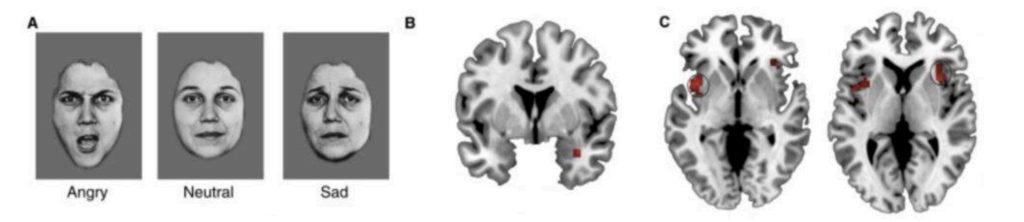
Aurore, who suffered maltreatment, may have faced the common neurological risk of increased reactivity of the anterior insula (AI) and the amygdala in response to angry faces (Figure 1) (McCrory et al. 2011). This makes the child more prone to hypervigilance and heightened stress responses (Fonzo et al. 2016). During a stress response, the amygdala signals the hypothalamus, the part of the brain that communicates with the rest of the body, which then sends signals to the adrenal glands to pump adrenaline into the bloodstream causing symptoms like increased heartbeat, rapid breathing and increased alertness (Harvard Health 2024). When angry faces become a stimulus that is highly salient, hypervigilance and stress responses can persist even in a safe environment leading to anxiety disorder development (McCrory et al. 2011). This is likely what happened when Aurore was asked about the origin of her leg wound by the doctor treating it and she lied and claimed she fell (Brief Case 2023). Due to hypervigilance making her alert to the threat of potential consequences for disclosing her abuse, she lied as a survival strategy.
If Aurore had lived and the abuse had occurred today, cognitive behavioral therapy (CBT) would be recommended as a treatment for children who have experienced trauma. It involves stress-management training, creation of a trauma narrative, alteration of maladaptive appraisals, psycho-education about trauma and trauma reactions (Dittmann and Jensen 2014). Generally, children report that CBT is effective and they can work with the trauma-narratives and learn skills to cope with stress, all of which help them achieve positive changes. Aurore would have likely benefited from this treatment, had she not been murdered.
To conclude, Aurore’s case represents how child abuse is something that can be understood from evolutionary and neuroanatomical perspectives. Unfortunately she did not live to benefit from the psychological treatment for her trauma.
References
Block, Kristina, and Jacob Kaplan. 2022. “Testing the Cinderella Effect: Measuring Victim Injury in Child Abuse Cases.” Journal of Criminal Justice 82 (September):101987. https://doi.org/10.1016/j.jcrimjus.2022.101987.
Brief Case. 2023. “The Horrifying & Tragic Case of Aurore Gagnon.” Posted January 9, 2023, by Brief Case. YouTube, 00:14:52. https://www.youtube.com/watch?v=FBiDoK2_MOU.
Dittmann, Ingeborg, and Tine K. Jensen. 2014. “Giving a Voice to Traumatized Youth—Experiences with Trauma-Focused Cognitive Behavioral Therapy.” Child Abuse & Neglect 38 (7): 1221–30. https://doi.org/10.1016/j.chiabu.2013.11.008.
Fonzo, G. A., H. J. Ramsawh, T. M. Flagan, A. N. Simmons, S. G. Sullivan, C. B. Allard, M. P. Paulus, and M. B. Stein. 2016. “Early Life Stress and the Anxious Brain: Evidence for a Neural Mechanism Linking Childhood Emotional Maltreatment to Anxiety in Adulthood.” Psychological Medicine 46 (5): 1037–54. https://doi.org/10.1017/S0033291715002603.
Harvard Health. 2024. “Understanding the Stress Response.” Harvard Health. Last Modified April 3, 2024. https://www.health.harvard.edu/staying-healthy/understanding-the-stress-response.
McCrory, Eamon J., Stéphane A. De Brito, Catherine L. Sebastian, Andrea Mechelli, Geoffrey Bird, Phillip A. Kelly, and Essi Viding. 2011. “Heightened Neural Reactivity to Threat in Child Victims of Family Violence.” Current Biology 21 (23): R947–48. https://doi.org/10.1016/j.cub.2011.10.015.