What is the biggest, brightest thing in the universe? Is it a star? A nebula? Surely, it’s not a black hole – it cannot be bright! That is technically correct, but the darkest things in the universe ironically also make for the brightest things in existence.
Quasars are cores present in active galaxies that existed long ago, the oldest of which we have found goes back in time 13.03 billion years (Stolte 2021)! An active galaxy’s supermassive black hole is constantly consuming large amounts of matter, all of which eventually circles in and creates a glowing ring of luminous matter around it, known as an accretion disk (Cooper 2018). Electrons and/or protons in this disk closest to the black hole get ejected out into space in jet streams of light from the poles. These emissions, known as jets, are theorized to form due to the magnetic field affecting the charged particles’ path (NASA 2020; Stolte 2021; Figure 1).
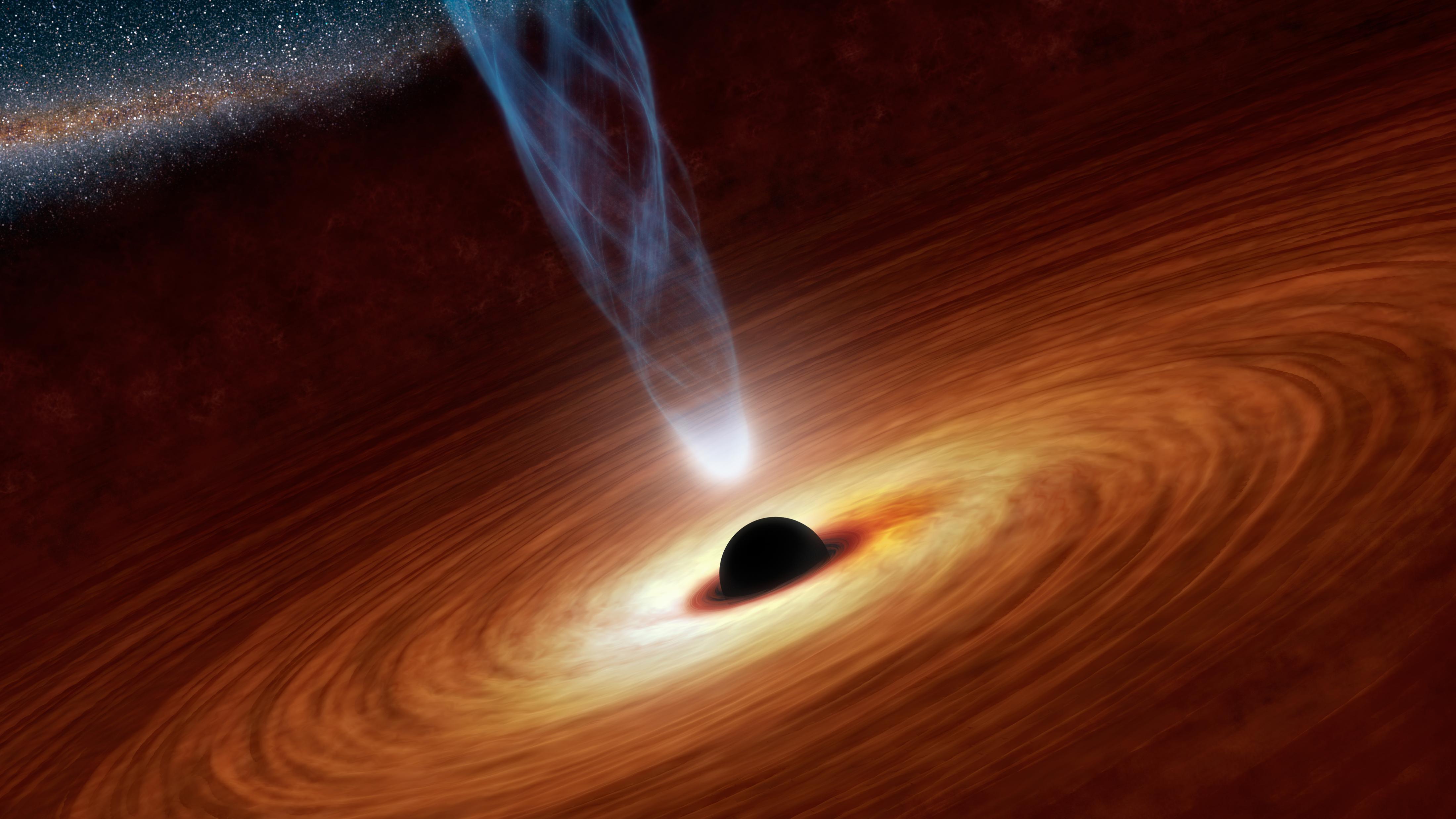
These beastly phenomena fall into the category of active galaxy nuclei (AGN), which is a term used to account for the centres of galaxies that would be considered active. While all quasars are AGN, the opposite is not true. There are several types of AGN, the characterization of which are dependent on their orientation, activity level and brightness, as is described in figure 2 (Silberg n.d; Padovani 2017). Blazars, for example, are sub-sections of quasars that have one of their jets pointed towards the earth, making them appear brighter than ever. Seyfert galaxies are another type of AGN, except these are relatively dimmer than quasars, and the matter that is surrounding these nuclei evidently have lesser amounts of activity, making them release a lower amount of energy. They can also be set apart by their proximity to the Earth, since quasars are usually extremely far (Webb Space Telescope 2021).

The electromagnetic spectrum is an invaluable tool for scientists to study AGN, and this resource is usually taken advantage of through spectrometry and radio astronomy (APS, n.d.). Many large galaxies produce synchrotron radiation, which are radio waves produced by electrons or positrons travelling relativistically the speed of light (NIST 2010). These charged particles emit light in such low energies that it is, at times, only clearly noticeable when looking through radio detecting antennae. Jets emitted from quasars often emit radio waves, making them highly detectable and distinguishable from any noise from the depths of the universe (Webb Space Telescope 2021). Quasars are brighter than most stars in the night sky, and visible through the naked eye. The reason they took a while to find, in fact, was just because they were hiding in plain sight! (APS, n.d.).
Quasars are now found in a very large scale, and the resources we have make us equipped to study them with a higher degree of understanding. It is ironically beautiful that a perfect blackbody can produce more light from its surroundings than the most luminous star, and a benchmark for what scientific research can achieve, and a window to our future understanding of how the universe works.
References
APS. n.d. “This Month in Physics History.” Accessed November 1, 2024. https://www.aps.org/archives/publications/apsnews/202102/history.cfm.
Cooper, Keith. 2018. “Quasars: Brightest Objects in the Universe.” Space.Com. February 24, 2018. https://www.space.com/17262-quasar-definition.html.
NASA. 2013. “Black Holes: Monsters in Space (Artist’s Concept).” NASA Jet Propulsion Laboratory (JPL). February 27, 2013. https://www.jpl.nasa.gov/images/pia16695-black-holes-monsters-in-space-artists-concept/.
NASA. 2020. “The Recipe for Powerful Quasar Jets – NASA.” October 14, 2020. https://www.nasa.gov/image-article/recipe-powerful-quasar-jets/.
NIST. 2010. “What Is Synchrotron Radiation?” NIST, March. https://www.nist.gov/pml/sensor-science/what-synchrotron-radiation.
Padovani, P, D. M Alexander, R. J Assef, B De Marco, P Giommi, R. C Hickox, G. T Richards, et al. 2017. “Active Galactic Nuclei: What’s in a Name?” The Astronomy and Astrophysics Review 25, no. 1. https://doi.org/10.1007/s00159-017-0102-9.
Silberg, Robert A. n.d. “Jet Propulsion Laboratory Herschel Mission Science – Galaxies.” Accessed November 1, 2024. https://herschel.jpl.nasa.gov/galaxies.shtml.
Stolte, Daniel. 2021. “Most Distant Quasar Discovered Sheds Light on How Black Holes Grow | University of Arizona News.” January 12, 2021. https://news.arizona.edu/news/most-distant-quasar-discovered-sheds-light-how-black-holes-grow.
Webb Space Telescope. 2021. “What Are Active Galactic Nuclei?” Webb. March 17, 2021. https://webbtelescope.org/contents/articles/what-are-active-galactic-nuclei.
Comments
11 Responses to “Name Something Brighter than a Black Hole!”
Hey Isci!
As you all know, we are in the midst of an RP. In my research of luminosity, I wondered what the most luminous object could be, and found something incredibly interesting! Hope you all enjoy the post.
Good luck on RP’s, cheers!
– Vihaan
Hi Vihaan,
This was a great blog post that took a complex topic and made it easier to understand, and I now know more about AGN than I did before!
Just some things I came across while reading through:
– You could reword the fifth sentence of the third paragraph to “Blazars are a sub-section of the quasars category….” to have a smoother transition.
– In the last sentence of the third paragraph, you could say “…is that they are closer to the earth” to give that relative distance.
– Make sure to refer to Figure 1 in your text, as it is also really helpful in supplementing your writing.
Happy editing!
Dhara
Hey Dhara!
Thank you for your feedback, it helped a lot in my process of editing. I didn’t exactly incorporate some of your ideas into the blog, but restructured them a bit and took the suggestions into account while making edits to the third paragraph.
Cheers!
-Vihaan
Hi Vihaan,
This was a great blog post! The topic you chose was unique. Here are some suggestions you may want to consider:
– P2, S2: Rephrase the sentence to simplify the information being presented, for example, Active galaxies have supermassive black holes at their centers, drawing in vast amounts of matter that form a glowing ring known as an accretion disk.
– P2, S4: To improve flow and make the sentence more formal consider rephrasing the sentence to something along the lines of “These emissions, referred to as jets are theorized to form from the intense magnetic fields and the voluminous material being drawn into the black hole (NASA 2020).”
– Sources: Currently, many of the sources are from blogs or news articles. Please try to include more peer-reviewed sources, especially for scientific explanations, such as information about different types of AGNs. A potential source you could use for the AGN section is https://doi.org/10.1007/s00159-017-0102-9.
Overall, your post is very well-structured and informative. I can’t wait to read the final version.
Best,
Om
Hey Om,
Your suggestions were awesome, especially the source one, I was sure to include that. I noticed that you made some suggestions in terms of the grammar and structure of my sentences, and while not incorporating them within word-for-word, I was able to keep the suggestions in mind while making edits to the document.
Cheers!
-Vihaan
Hi Vihaan,
Amazing blog post! It was very interesting to learn about how black holes emit radiation that can be visible! Here are some of my thoughts:
In your first paragraph, consider specifying “out there”. Although it provides a broad picture of your work, it is a bit vague and thus can be confusing. Consider replacing it with “the universe” instead.
In your second paragraph, I noticed that you write “ends up” a lot. It is an unnecessary phrase in most of your sentences. I think it would improve clarity if you remove it from your sentences, as you can easily remove it and keep the meaning of the sentence.
In your third paragraph, the sentence “Seyfert galaxies have another type of AGN, yet these are especially dimly lit, and the matter that is surrounding these nuclei have lesser evidence of activity than a quasar” is a bit confusing. I would remove the use of “especially” and “dimly” right beside each other, as it reduces the clarity of the sentence.
Great work! I cannot wait to read your final piece!
Hey Sruti,
Your suggestions were extremely helpful. I made the alterations to my blog with a little adjustment to the wording.
Thank you for reading, cheers!
-Vihaan
Hi Vihaan,
I thoroughly enjoyed to blog post. The concept is such an interesting one, and I’m glad you detailed it so I could learn. I do have a couple of comments though.
Firstly, in the first sentence of your concluding paragraph, you use the term now twice in quick succession. It ends up reading a little clunky, and I wonder if it would sound better if one of them was changed.
Another point I found is in your final sentence. You use a personal pronoun in the sentence, which is improper in this scenario. I would suggest changing it to something along the lines of “It is ironically beautiful that a perfect blackbody can produce more light from its surroundings than the most luminous star”
Overall though, your blog post looks great, and I can’t wait to read the final product.
Sincerely,
Zachary
Hey Zachary,
I am glad you enjoyed the post! Your suggestions were very helpful. I have edited my blog accordingly.
Cheers!
-Vihaan
Hi Vihaan,
Great post – it was so interesting! I have a few suggestions for you during your editing process:
– In the first sentence of your second paragraph, make sure the (Stolte 2021) citation is before the exclamation point (ie. in the same sentence)
– Watch for unnecessary commas in your final sentence. As well, I think some minor rewording could improve its flow while delivering the same message. Instead, it could read, “I find it ironically beautiful that a perfect blackbody can produce more light from its surroundings than the most luminous star, serving as a benchmark for scientific research and a window into our future understanding of the universe.”
– Make sure to reference your figure in your writing
Other than that, this was a great post. Also, I really enjoyed your introduction. I hope you find my comments useful!
Keira
Hey Keira!
I appreciate your suggestions, and have edited the post accordingly.
Glad you enjoyed the post!
-Vihaan