On September 7th of 1978, Georgi Markov, a Bulgarian journalist, was allegedly pricked by an umbrella on Waterloo Bridge in London (Nehring 2017). A tiny metal pellet that released ricin, a deadly protein poison, was found in his leg following his death. The murder weapon nor the killer were ever identified. This case can be explored through the mechanism of action of ricin, clinical presentation of poisoning, and the forensic detection of ricin.
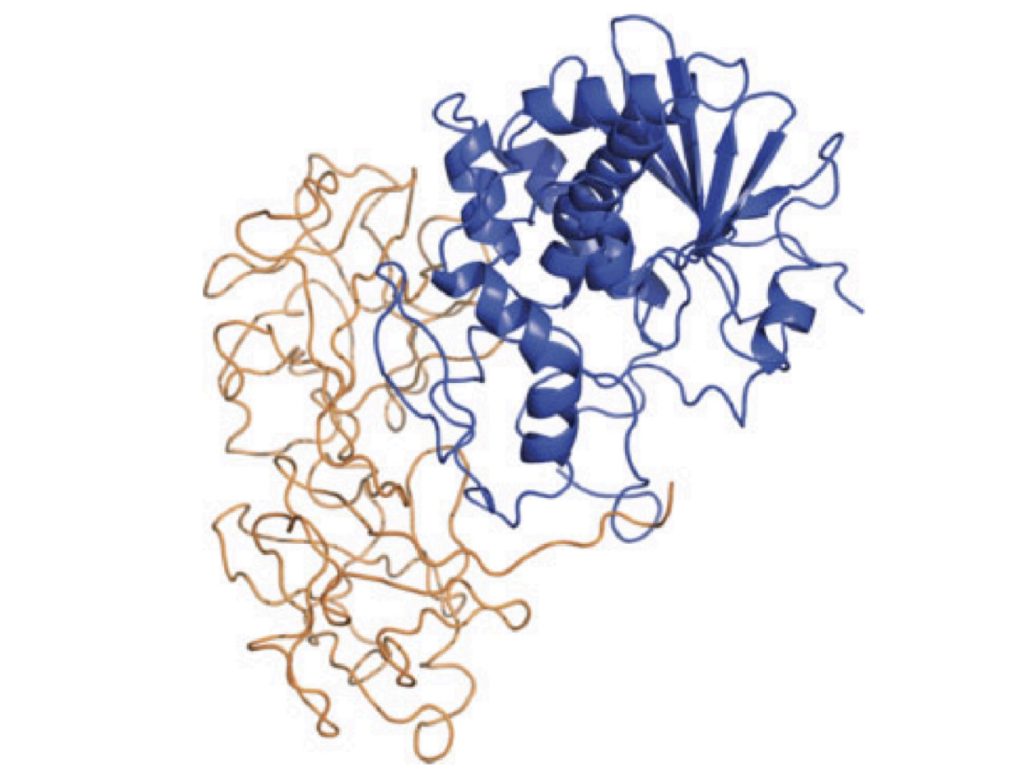
Ricin is a globular, glycosylated heterodimer, meaning it is round in shape with carbohydrate groups attached, and it is composed of two non-identical subunits (Audi et al. 2005). Further, as a type-2 ribosome-inactivating protein, it contains two different chains that work together to inactivate ribosomes. Specifically, it consists of an A chain and B chain (Figure 1). To enter the cell’s cytoplasm, the B chain binds to cell surface glycoproteins and glycolipids, particularly, the galactose (Audi et al. 2005).
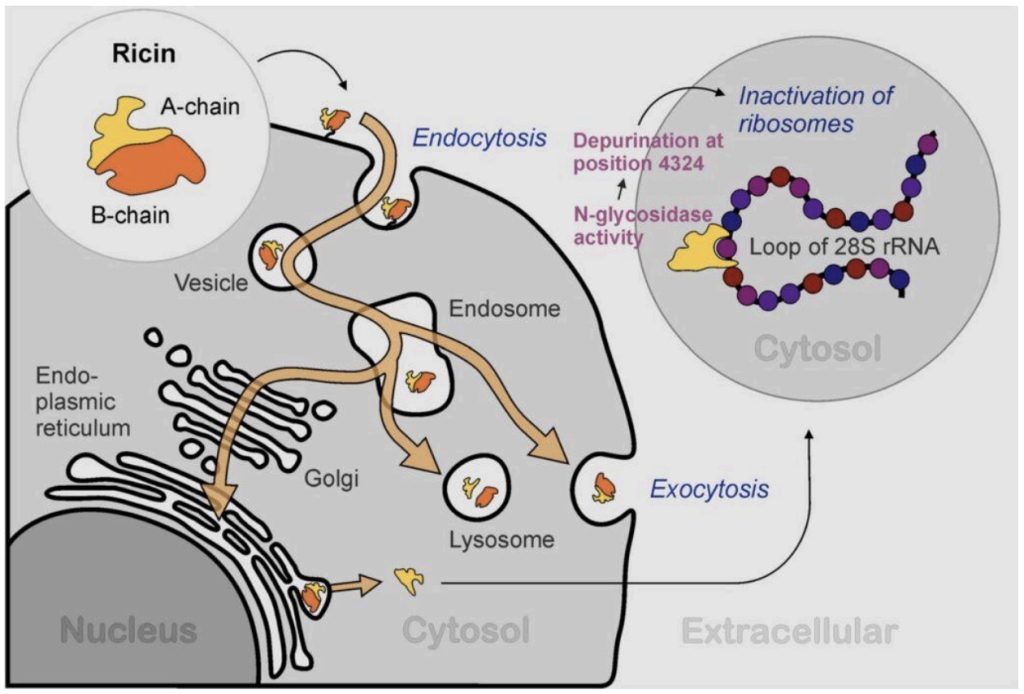
Once in the cytosol, the A chain inhibits protein synthesis through inactivation of ribosomes (Audi et al. 2005). Through removing an adenine residue from the 28S ribosomal RNA loop in the 60S subunit, chain elongation of polypeptides is prevented (Figure 2). In particular, two tyrosine rings in the catalytic cleft of the A chain sandwich the adenine ring between them and then hydrolyzes it, breaking the glycosidic bond (Musshoff and Madea 2009). This leads to cell death.
Clinically, Markov was reported to have felt weakness following the incident (Crompton and Gall 1980). By the next day he was vomiting and had a high fever, which was followed by difficulty speaking that afternoon. Once admitted to the hospital, by September 9th his blood pressure had dropped significantly and his white blood cell count had risen. The autopsy revealed that Markov had visible organ damage and failure, hemorrhages, and the major contributor to his death, heart block where the typical coordination between the atria and ventricles had ceased (Crompton and Gall 1980).
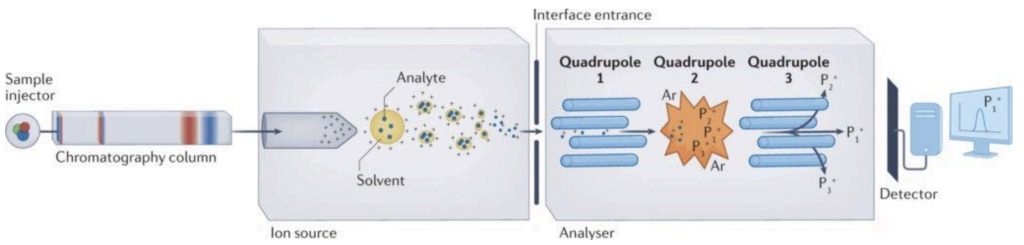
Ricin can be used as a biocrime weapon, and like this case, finds itself in forensic investigations. Though a multitude of forensic methods may be employed for investigating ricin poisoning, Liquid Chromatography–Tandem Mass Spectrometry, as seen in Figure 3, is preferred for differentiating between ricin and other proteins (Fredriksson et al. 2018).
Once ricin is identified, how it was processed can be examined. This is done through forensic markers which lend insight into the perpetrators motives or origin of the poison, as in, if the ricin is intentionally purified (Fredriksson et al. 2018). Ricinoleic acid’s presence indicates that there was minimal purification of ricin, since ricinoleic acid makes up castor oil from the naturally occurring castor beans. Conversely, less ricinoleic acid means more purification. Carbohydrates can also serve as biomarkers given the role they play in the structure of castor beans (Fredriksson et al. 2018). So, if specific carbohydrate concentrations change, different levels of purification can be inferred.
Despite Markov’s killer remaining a mystery, this case can still provide knowledge of the naturally occurring ricin protein and be used to see how forensics can help in cases of biocrime.
References
Audi, Jennifer, Martin Belson, Manish Patel, Joshua Schier, and John Osterloh. 2005. “Ricin Poisoning: A Comprehensive Review.” JAMA 294 (18): 2342. https://doi.org/10.1001/jama.294.18.2342.
Crompton, Rufus, and David Gall. 1980. “Georgi Markov — Death in a Pellet.” Medico-Legal Journal 48 (2): 51–62. https://doi.org/10.1177/002581728004800203.
Franke, Heike, Reinhold Scholl, and Achim Aigner. 2019. “Ricin and Ricinus Communis in Pharmacology and Toxicology-from Ancient Use and ‘Papyrus Ebers’ to Modern Perspectives and ‘Poisonous Plant of the Year 2018.’” Naunyn-Schmiedeberg’s Archives of Pharmacology 392 (10): 1181–1208. https://doi.org/10.1007/s00210-019-01691-6.
Fredriksson, Sten-Åke, David S. Wunschel, Susanne Wiklund Lindström, Calle Nilsson, Karen Wahl, and Crister Åstot. 2018. “A Ricin Forensic Profiling Approach Based on a Complex Set of Biomarkers.” Talanta 186 (August):628–35. https://doi.org/10.1016/j.talanta.2018.03.070.
Musshoff, Frank, and Burkhard Madea. 2009. “Ricin Poisoning and Forensic Toxicology.” Drug Testing and Analysis 1 (4): 184–91. https://doi.org/10.1002/dta.27.
Nehring, Christopher. 2017. “Umbrella or Pen? The Murder of Georgi Markov. New Facts and Old Questions.” Journal of Intelligence History 16 (1): 47–58. https://doi.org/10.1080/16161262.2016.1258248.
Thomas, Stefani N., Deborah French, Paul J. Jannetto, Brian A. Rappold, and William A. Clarke. 2022. “Liquid Chromatography–Tandem Mass Spectrometry for Clinical Diagnostics.” Nature Reviews Methods Primers 2 (1): 96. https://doi.org/10.1038/s43586-022-00175-x.