Bacteria in the gut microbiome are roughly equal in number to human cells, with estimates around 1:1 (Sender et al., 2016). This raises an intriguing question: are we humans with a lot of bacteria, or bacteria having a human experience?
Twenty-five years ago, few people talked about ‘autoimmune disease’ or ‘gut health.’ However, today, these are household terms, thanks to research linking gut bacterial imbalances to many chronic inflammatory diseases (Wang et al., 2024). With 70–80% of the immune system located in the gut, the gut bacteria play a central role in maintaining immune balance and gut barrier integrity (Sender et al., 2016).
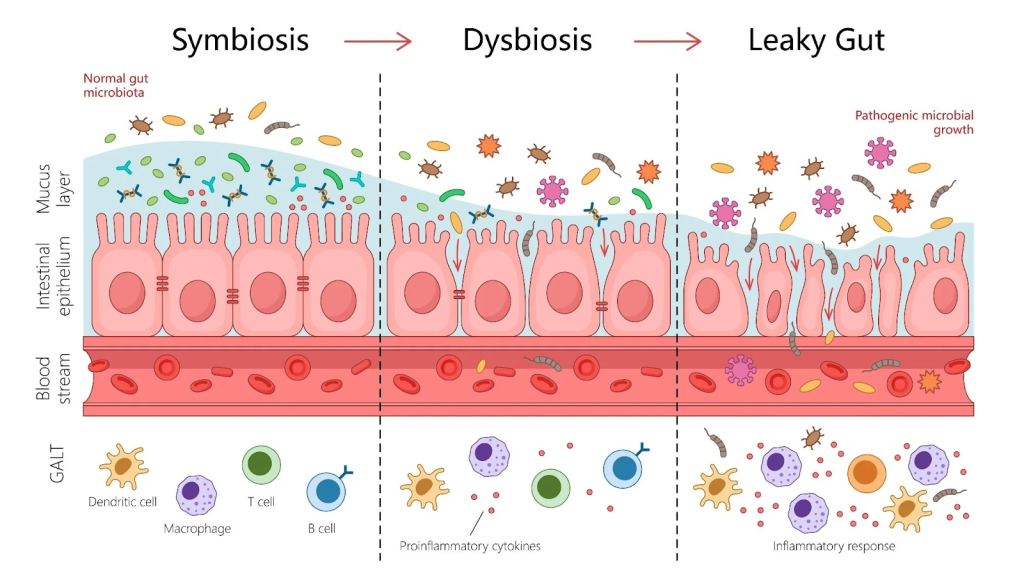
Specifically, leaky gut has been identified as a key contributor to autoimmune diseases. Leaky gut refers to the intestinal permeability that allows for unwanted macromolecules and bacteria to enter the bloodstream (Fasano 2020). Leaky gut occurs when a strain is put on the digestive system from genetic vulnerability, stress, processed foods, or an infection. These irritants disrupt the gut microbiome, reducing beneficial bacteria while allowing the overgrowth of pathogenic bacteria that produce toxins and irritate the gut (Figure 1). As a result, the gut’s intestinal lining becomes inflamed and its mucus layer thins, leading to the loosening of the gut’s tight junctions. Now, pathogenic bacteria are influencing and controlling the body’s state of homeostasis, rather than the beneficial bacteria. Once the gut’s protective mucus layer is compromised, larger molecules, including undigested food particles, toxins, or microbes, slip into the bloodstream. The immune system then recognizes the macromolecules as antigens and produces antibodies against them. Afterwards, when the body ingests the same molecules, it will see those components as a threat, as it has already developed antibodies against them, and that will make the body susceptible to autoimmune disease (Fasano 2020).
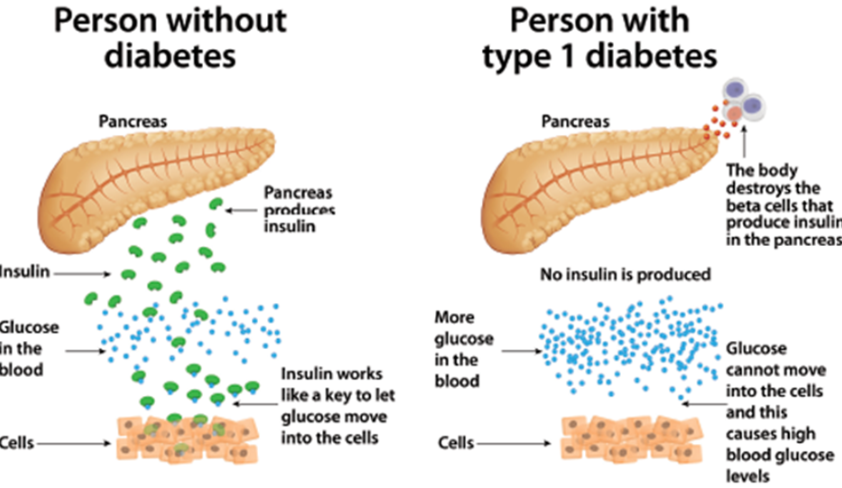
Molecular mimicry is another issue that might lead to autoimmune disorders due to a compromised gut barrier (Rojas et al. 2018). This happens when the molecular structures of some antigens and the body’s own proteins are identical. For example, if a bacterial protein or macromolecule resembles a pancreatic protein, antibodies designed to fight the foreign particle may also attack pancreatic cells. Over time, this unintentional attack may cause tissue damage and worsen autoimmune diseases like type 1 diabetes (Yoon and Jun 2005; Figure 2). In the same way, the gluten fragments that cross the intestinal barrier in celiac disease resemble the proteins of the intestinal lining, causing the immune system to attack the gut. Another instance is Hashimoto’s thyroiditis, when antibodies mistakenly target the thyroid and interfere with its function because specific microbial antigens mimic thyroid proteins.
Additionally, an overabundance of harmful gut bacteria can alter the chemical signals transmitted to the brain through the vagus nerve (Han et al. 2022). The vagus nerve controls immunological and gastrointestinal responses in addition to transmitting to the brain; hence, its interference can increase inflammation, disturb neurotransmitter balance, and affect cognitive and affective functioning. Neurotransmitters like serotonin, dopamine, and GABA are impacted by bacterial imbalances, which can lead to long-term neurodegenerative diseases as well as anxiety, sadness, emotional instability, and cognitive loss (Mörkl et al. 2023).
Far from being silent passengers, gut bacteria help orchestrate human physiology, immunity, and even emotions by influencing nutrient supply, immune responses, and neurotransmitter balance. Understanding the relationship between bacteria, gut health, and well-being allows the body and mind to thrive from the inside out.
References
Fasano, Alessio. 2020. “All Disease Begins in the (Leaky) Gut: Role of Zonulin-Mediated Gut Permeability in the Pathogenesis of Some Chronic Inflammatory Diseases.” F1000Research 9 (January): F1000 Faculty Rev-69. https://doi.org/10.12688/f1000research.20510.1.
Han, Yimin, Boya Wang, Han Gao, et al. 2022. “Vagus Nerve and Underlying Impact on the Gut Microbiota-Brain Axis in Behavior and Neurodegenerative Diseases.” Journal of Inflammation Research 15 (November): 6213–30. https://doi.org/10.2147/JIR.S384949.
Mörkl, Sabrina, Mary I Butler, and Jolana Wagner-Skacel. 2023. “Gut-Brain-Crosstalk- the Vagus Nerve and the Microbiota-Gut-Brain Axis in Depression. A Narrative Review.” Journal of Affective Disorders Reports 13 (July): 100607. https://doi.org/10.1016/j.jadr.2023.100607.
Rojas, Manuel, Paula Restrepo-Jiménez, Diana M. Monsalve, et al. 2018. “Molecular Mimicry and Autoimmunity.” Journal of Autoimmunity 95 (December): 100–123. https://doi.org/10.1016/j.jaut.2018.10.012.
Sender, Ron, Shai Fuchs, and Ron Milo. 2016. “Are We Really Vastly Outnumbered? Revisiting the Ratio of Bacterial to Host Cells in Humans.” Cell 164 (3): 337–40. https://doi.org/10.1016/j.cell.2016.01.013.
Wang, Hongli, Yueshu Cai, Wenqi Wu, Miaomiao Zhang, Yong Dai, and Qingwen Wang. 2024. “Exploring the Role of Gut Microbiome in Autoimmune Diseases: A Comprehensive Review.” Autoimmunity Reviews 23 (12): 103654. https://doi.org/10.1016/j.autrev.2024.103654.
Yoon, Ji-Won, and Hee-Sook Jun. 2005. “Autoimmune Destruction of Pancreatic Beta Cells.” American Journal of Therapeutics 12 (6): 580–91. https://doi.org/10.1097/01.mjt.0000178767.67857.63.
Image Credits
IWC. 2023. “Type 1 vs. Type 2 – What Is the Difference.” IWC, March 15. https://www.iwc.org.au/blog/type-1-vs-type-2-what-is-the-difference?token=jF3tJkso3x2ZqTsTzctCaHVua6VlPAcG.
Souza, Hugo Francisco de. 2025. “How a Leaky Gut Could Be Putting Your Heart at Risk.” News-Medical, July 28. https://www.news-medical.net/news/20250728/How-a-leaky-gut-could-be-putting-your-heart-at-risk.aspx.