One of the leading causes of death worldwide is strokes, with more than 795,000 people experiencing a stroke each year in the United States (Centers for Disease Control and Prevention 2025). It is pertinent that the mechanism of predicting stroke is optimal, and that requires constant innovation and modification to current prediction clinical practices. In this post, we will consider the role of turbulent blood flow, as an addition to the current practices involved in predicting stroke.
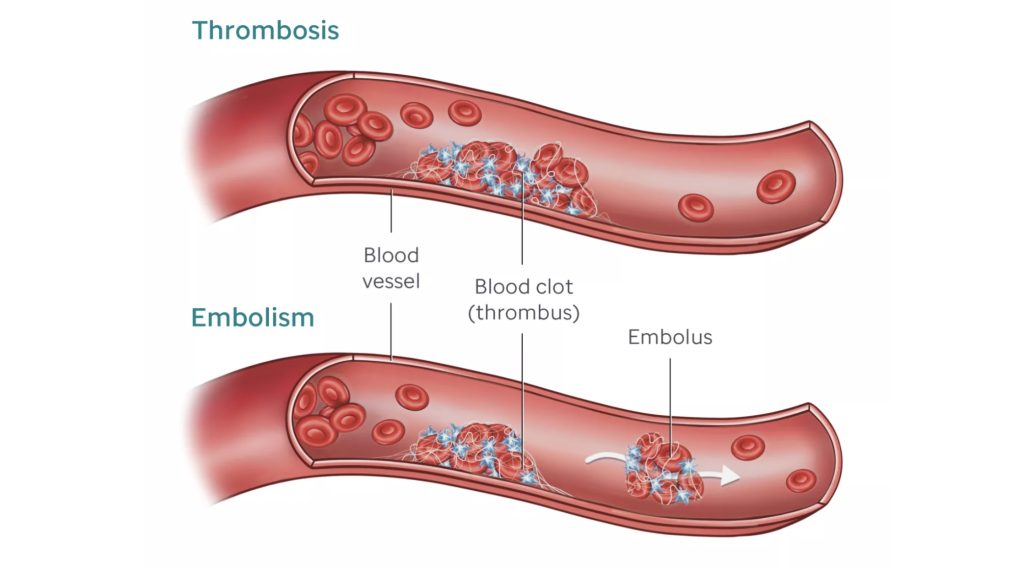
About 87% of strokes are ischemic, characterized by the impeded flow of blood to the brain from a thrombotic (obstruction in the vessel from a blood clot) or embolic event (debris from another part of the body travels to a cerebral vessel), as seen in Figure 1 (Lui et al. 2025; Centers for Disease Control and Prevention 2025). For cerebral thrombosis, the most common risk factor plaque is built up in the inner lining of the arteries, causing them to thicken or harden (Lui et al. 2025). In embolic events, the clot is formed in another part of the body and then travels to the brain.
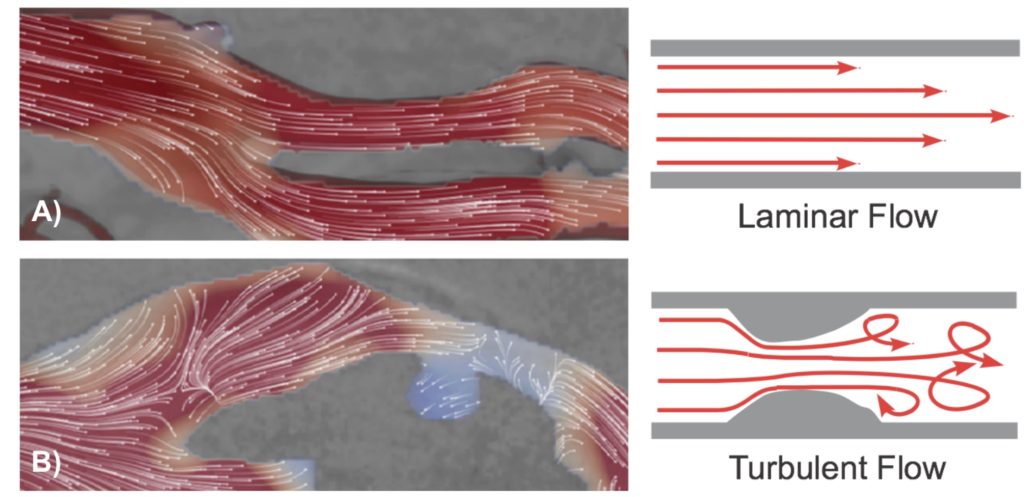
Blood-flow dynamics may serve as an important contributor to predicting stroke, given its role in stroke mechanism. As seen in Figure 2, blood flow transitions from laminar to turbulent as arteries narrow, and this can lead to a stroke (Quinlan and Dooley 2007). When an artery narrows, resistance increases and consequently so does shear stress (Okeahialam and Sirisena 2023). This is due to the blood being forced to move faster through the narrowed space, and thus shear stress can damage the vessel wall or destabilize plaques. The increased velocity can overtake the stability that comes from blood viscosity and the smooth laminar layers of flow get disrupted into chaotic or turbulent flow. Plaques are a way of disturbing laminar flow through narrowing, promoting clot formation and ischemia (Okeahialam and Sirisena 2023).
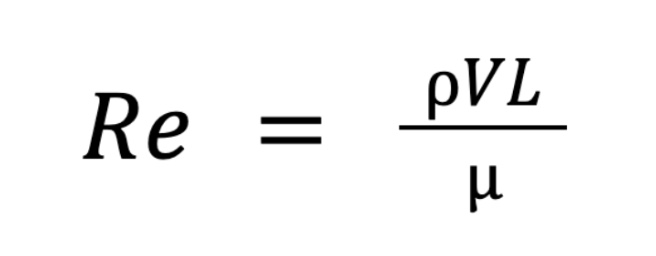
A good measure of whether flow is laminar or turbulent is the Reynolds number given by Equation 1 (Quinlan and Dooley 2007). Turbulent flow, indicated by a high Reynolds number, puts flow-induced stress on blood elements, and therefore Reynolds stress is often used to predict hemolysis (destruction of red blood cells) and thrombosis (formation of a blood clot). Turbulent flow has been observed in carotid plaques, showing that turbulent flow is related to arterial narrowing, thrombosis, and stroke (Shimonaga et al. 2020).
In modern clinical practice, predicting stroke is not really focused on blood-flow dynamics. Instead, primary focus is on clinical factors and imaging techniques, including multi-modal information such as demographic, clinical, laboratory, and radiological data (Rajashekar et al. 2021). These can include variables like age, blood pressure, glucose levels, and atrial fibrillation. When combined with imaging features, there is improvement in prediction models. Further, the neurological severity score given by the National Institutes of Health Stroke Scale, in addition to patient risk factors can also improve prediction (Yassin et al. 2024). Nevertheless, it is not entirely clear-cut and some patients with low scores on this scale may still experience strokes.
Therefore, current practice is far from inadequate, but there are limitations. Given the role turbulent flow plays in ischemic strokes, greater consideration of blood-flow dynamics may enhance the existing predictive models and potentially reduce stroke-related deaths.
References
Centers for Disease Control and Prevention. 2025. “Stroke Facts.” U.S. Centers for Disease Control and Prevention, July 10. https://www.cdc.gov/stroke/data-research/facts-stats/index.html.
Klabunde, Richard E. 2023. “Turbulent Flow.” Cardiovascular Physiology Concepts. https://cvphysiology.com/hemodynamics/h007.
Lui, Forshing, Mahammed Z. Khan Suheb, and Laryssa Patti. 2025. “Ischemic Stroke.” In StatPearls. StatPearls Publishing. http://www.ncbi.nlm.nih.gov/books/NBK499997/.
Okeahialam, Basil N., and Anil I. Sirisena. 2023. “The Physics of Stroke.” Journal of Stroke Medicine 6 (1): 7–10. https://doi.org/10.1177/25166085231174796.
Quinlan, Nathan J., and Patrick N. Dooley. 2007. “Models of Flow-Induced Loading on Blood Cells in Laminar and Turbulent Flow, with Application to Cardiovascular Device Flow.” Annals of Biomedical Engineering 35 (8): 1347–56. https://doi.org/10.1007/s10439-007-9308-8.
Rajashekar, Deepthi, Michael D. Hill, Andrew M. Demchuk, Mayank Goyal, Jens Fiehler, and Nils D. Forkert. 2021. “Prediction of Clinical Outcomes in Acute Ischaemic Stroke Patients: A Comparative Study.” Frontiers in Neurology 12 (May): 663899. https://doi.org/10.3389/fneur.2021.663899.
Shimonaga, Koji, Toshinori Matsushige, Shigeyuki Sakamoto, et al. 2020. “Blood Flow Pattern Analysis for Carotid Plaque Evaluation.” Journal of Stroke and Cerebrovascular Diseases 29 (2): 104539. https://doi.org/10.1016/j.jstrokecerebrovasdis.2019.104539.
St. Jude Children’s Research Hospital. 2024. “Blood Clots.” St. Jude Children’s Research Hospital. https://together.stjude.org/en-us/treatment-tests-procedures/symptoms-side-effects/blood-clot-facts-and-treatment.html.
Yassin, Mazen M., Jiaxi Lu, Asim Zaman, et al. 2024. “Advancing Ischemic Stroke Diagnosis and Clinical Outcome Prediction Using Improved Ensemble Techniques in DSC-PWI Radiomics.” Scientific Reports 14 (1): 27580. https://doi.org/10.1038/s41598-024-78353-y.