Referring to the brain, the center of our nervous system, as one singular, consolidated organ is no longer the full truth. The long-standing model developed decades ago by developmental biologists treated the brain as the product of a common neural ectoderm. Ectoderm refers to the outermost germ layer formed during early animal embryo development that major structures derive from, including the nervous system (Britannica Editors 1998). This initially broad progenitor evolved and progressively developed into the three parts of the brain: forebrain, midbrain, and hindbrain. However, a recent Stanford led study challenges the simplicity of this model. Stanford scientists now report that two distinct neural ectoderms progenitors emerge parallel to one another during gastrulation, a stage in the beginning of embryonic development (Jokhai R.T. et al. 2026). One progenitor evolves to form the anterior brain and another that evolves to form the posterior brain (Jokhai R.T. et al. 2026). The difference in evolutionary history of the two parts of the brain naturally leads to discussion surrounding the validity of the brain being one organ.
In order to derive this conclusion about the human brain, researchers combined mouse lineage tracing with the differentiation of human pluripotent stem cells (hPSCs), cells capable of creating the ectoderm (Romito A. et al. 2015). In mouse embryos, they identified an anterior neural ectoderm (aNE) associated with a gene called Otx2, and a posterior neural ectoderm (pNE) associated with the gene Gbx2 (Jokhai R.T. et al. 2026). The former is linked to the creation of the forebrain/midbrain while the latter is linked with to the hindbrain development. These gene populations were separated in the mouse’s early development, well before the anatomy of the mature brain was evident. This differentiation is mimicked in hPSCs, effectively proving the existence of more than one common neural progenitors.
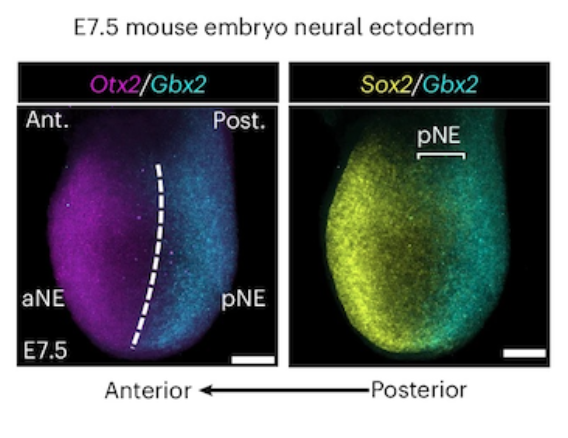
This work does not mean that the brain is literally composed of two independent organs. Rather, it supports a “composite organ” model in which major brain regions arise from distinct embryological sources, and that distinction matters. The result of this study contains answers to a major question that existed in science surrounding the separation of the brain: when does the forebrain/midbrain separate from the hindbrain during embryonic development? (Jokhai R.T. et al. 2026). These researchers have suggested that the neural pluripotent stem cells have already been committed to form the different regions of the brain. Even when challenged, aNE cannot transdifferentiate into hindbrain and pNE cannot transdifferentiate into forebrain/midbrain (Jokhai R.T. et al. 2026).
These findings effectively illustrate how new science is made. The classical model of the brain was not overturned by a single observation. It was tested against an alternative model and methodically upended using scientific processes such as lineage tracing and hPSC-based assays. This serves as a useful reminder that scientific progress often comes from re-examining assumptions with higher resolution tools. Even these examinations remain incomplete, as the researchers propose evolutionary conservation from all the way from chordates, ~550-600 million years ago, to mammals today (Jokhai R.T. et al. 2026), but that claim will require broader comparative evidence. Even with this caveat, the study offers a clear example of model revision in action. Better tools did not replace biological reasoning, they sharpened it.
References
Britannica Editors. “ectoderm.” Encyclopedia Britannica, July 20, 1998. https://www.britannica.com/science/ectoderm.
Jokhai R, Dundes C, Ahsan H, et al. “Two Parallel Neural Ectoderm Progenitors Contribute to the Developing Brain.” Nature Neuroscience, September 18, 2026. https://doi.org/10.1038/s41593-026-02433-7
Romito A, Cobellis G. “Pluripotent Stem Cells: Current Understanding and Future Directions.” Stem Cells Int. December 20, 2015. https://doi.org/10.1155/2016/9451492.

Leave a Reply
You must be logged in to post a comment.