When considering wine production, we often picture grapevines, the fermentation process, and the overall chemistry that is behind it. However, a factor that is often overlooked is the direct/indirect impact of the surrounding vineyard ecosystems on wine production. In particular, many wine producers can be seen investing in beekeeping at their vineyards (Newport 2024). This begs the question: since grapevines are self-pollinating, what role do bees play, and how might changes in bee populations affect wine production?
Bees are important in vineyards because they are critical pollinators, and they play a huge role in pollinating cover crops. These are crops that grow between grapevines and are vital for the quality and maintenance of the grapes, as well as reducing pest damage. These cover crops support microorganisms in the soil that help grapevines absorb nutrients and maintain a healthy growing environment. Ensuring these crops are well pollinated and flourishing is crucial for wine production. So, although grapevines can self-pollinate, bees indirectly contribute to the overall health of the vineyard by influencing the surrounding ecosystem, which influences wine quality (Newport 2024; Wislocki 2020). Therefore, changes in bee populations can impact vineyards and wine production.
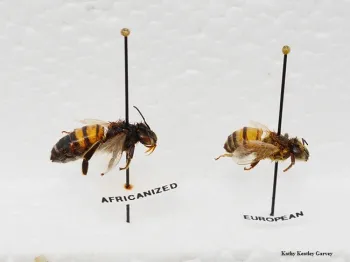
Africanized honey bees provide an interesting example of changes in behaviour and how it impacts pollination. Africanized bees are a hybrid between European and African bee subspecies that were created in an effort to increase honey production in tropical regions. Scientists wanted to cross the Apis mellifera, a calm and peaceful but less productive European honey bee, with the aggressive but more productive African subspecies, Apis mellifera scutellata (National Park Service 2023). This was first attempted in Brazil in the 1950s. Shortly after the experiment began, several colonies of these “Africanized” bees escaped. They spread throughout the Americas and the southern United States, gaining a reputation for being more defensive than many European honey bees, but almost physically indistinguishable (see Figure 1)(Garvey 2025; National Park Service 2023; Visscher 2020). These bees are nicknamed “killer bees” due to their extremely aggressive behaviour when defending their colony, whereby a large number of bees attack any perceived danger, pursuing them over greater distances and for longer periods than European honey bees (National Park Service 2023).
In terms of wine production, Africanized honey bees are not known to directly change grape flavour or quality. However, changes in bee populations can influence pollination and biodiversity in surrounding vineyard ecosystems. For example, these bees may differ in pollination efforts, abscond more frequently, and struggle to survive the winters. Unlike European bees, Africanized bees may outcompete native pollinators for resources due to behavioural issues, disrupting the balance of vineyard ecosystems. These traits would also make the entire wine-making process more challenging for vineyard workers (Hunt 2007).
Therefore, it is important to consider the potential impacts of Africanized bees on wine production due to their aggressive behaviour and contribution to surrounding ecosystems. It is through understanding this that vineyards can make informed decisions about pest management and worker safety. Although bees may not directly determine the taste of wine, they still play a role in its production and should therefore be considered.
References
Garvey, Kathy Keatley. 2025. “UC Davis Doctoral Student Analyzes Population Genetics of Africanized Honey Bees | UC Agriculture and Natural Resources.” UC Agriculture and Natural Resources, March 31. https://ucanr.edu/blog/bug-squad/article/uc-davis-doctoral-student-analyzes-population-genetics-africanized-honey.
Hunt, G. J. 2007. “Flight and Fight: A Comparative View of the Neurophysiology and Genetics of Honey Bee Defensive Behavior.” Journal of Insect Physiology 53 (5): 399–410. https://doi.org/10.1016/j.jinsphys.2007.01.010.
National Park Service. 2023. “Africanized Honey Bees – Saguaro National Park (U.S. National Park Service).” Www.Nps.Gov, December 23. https://www.nps.gov/sagu/learn/nature/africanized-honey-bees.htm.
Newport, Molly. 2024. “For the Love of Bees | Ellis Wines.” Elliswines.Co.Uk, October 15. https://www.elliswines.co.uk/node/3833.
Visscher, Kirk. 2020. “Africanized Honey Bee.” Center for Invasive Species Research, January 24. https://cisr.ucr.edu/invasive-species/africanized-honey-bee.
Wislocki, Amy. 2020. “Why Are Bees Important in the Vineyard?” Decanter, May 20. https://www.decanter.com/learn/why-are-bees-important-in-the-vineyard-438381/.
Comments
9 Responses to “Killer Beez and Booze?”
Hi Hafsa!
I really enjoyed reading your post, I had no idea bees and wine production were connected topics. Here’s a few tweaks I think could improve your blog.
In P2 when discussing the importance of cover crops to the grapevines, maybe consider adding in a detail about how the plants reduce pest damage to the vines.
I would also suggest adding in a figure to enhance your point. A visual representation of the effect of bee presence on vineyard ecosystems would be really beneficial.
Lastly, in P5, it’s not quite clear what the Africanized bee’s differences from European bees have on vineyard’s as the way it is currently stated is very circumstantial. I think adding a sentence comparing them to standard ecosystem interactions would help the paragraph become clearer.
I hope that helps!
Eshal
Hi Eshal,
Thank you so much for your comment! I have incorperated your changes!
Hafsa!
Hey Hafsa,
Excellent blog. I just had a few points of feedback:
+ Make sure to add your comment as well, explaining your idea/reasoning behind this blog (isci connection)
+ If possible, try to add a figure to enhance the visual aspect:)
+ Try to avoid rhetoric if possible: “So, what does this mean for wine production?” –> “In terms of wine production…”
Amazing blog and happy editing,
– Amy
Hi Amy!
Thank you for your comment! I have incorporated your suggestions.
Hafsa
Hi Hafsa!
This was such a fun read, I never would have connected beekeeping to wine, and I loved how you brought in the history of the Africanized bee experiment in Brazil. Here are some suggestions for improvements:
– P1S3: Consider adding a citation for “many wine producers can be seen incorporating beekeeping at their vineyards” (e.g., Newport 2024).
– P4S3: Since the African bee is also Apis mellifera (A. m. scutellata), it might be clearer to say “European subspecies of Apis mellifera” for the calmer bee. Also make sure the species names are italicized!
– P5S4-S5: “abandon the nest excessively” could be “abscond more frequently,” and “It would also make…” doesn’t have a clear subject; maybe “These traits would also make…”. Also double-check that Hunt (2007) supports the overwintering claim, since that paper focuses on defensive behaviour.
– Bigger picture: since we’re in Ontario, it could be cool to add a sentence on whether Africanized bees could ever reach Canadian vineyards (e.g., Niagara) given our colder winters!
I learned a lot about how much goes into a vineyard beyond the grapes. Can’t wait to see the final copy!
– Kurtis
Hi Kurtis!
Thank you for all of your really great suggestions! I have incorporated them into my final product!
Hafsa
Hi Hafsa!
I really liked this topic I found it very interesting! I also think you had a very smooth writing style but I feel like you could expand a bit more on your conclusion to include how vineyard owners could manage the potential challenges associated with these bees.
In P4S1 I noticed that you said “it impacts” rather than “they impact” to agree with the plural noun “changes.”
In P2 I noticed you repeated “huge” twice, I think it would be a good idea to replace at least one of those instances with “important” or “essential” to avoid repetition and keep an academic tone.
Overall I really enjoyed reading your post it was very insightful!
Cassia
Hi Cassia,
Thank you for your comment! I incorporated everything you said into my final.
Hafsa
Hi iSci! For my blog post this semester, I wanted to look at Africanized bees after Chad mentioned them during his pest workshop lecture. I found the concept of “killer bees” to be incredibly fascinating! To tie this to WineSci, I wanted to look at the impact of such pest behaviour on wine, as well as the role that bees play in wine production.
I wanted to lay out my blog post in a way that starts with a bigger picture of the role of bees in wine production, then a little about Africanized bees in general, and finally, Africanized bees’ potential role in wine production. I hope you liked it, and please feel free to comment with any suggestions that you think could help me!
Hafsa