Throughout history, eye-witnesses have reported seeing “darts of light”, “rockets”, and “flames” above thunderstorms (Boeck et al. 1998). Although this may seem fantastical, they were likely a kind of lightning-related phenomena called Transient Luminous Events (TLEs).
In order to understand TLEs themselves, we must first differentiate between positive and negative lightning. Negative lightning is negative charge that is transferred from cloud to ground and is most common. Comparatively, positive lightning originates in the upper parts of a thunderstorm, and make up less than 5% of strikes. Despite their rarity, positive strikes have the potential to be up to 10 times greater in peak charge and electrical potential, as they must burn through more air before reaching the ground (National Oceanic and Atmospheric Administration 2023).
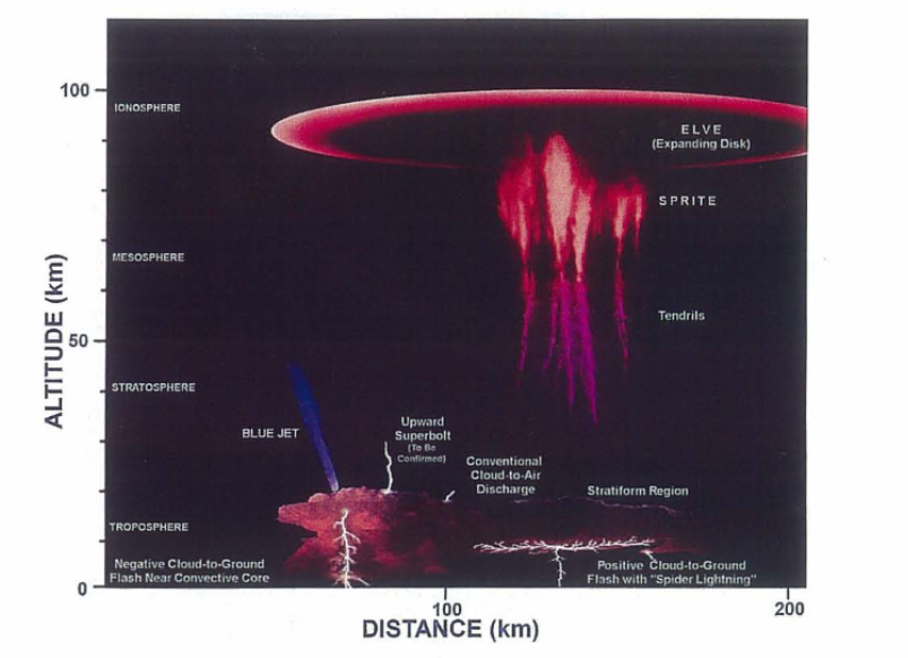
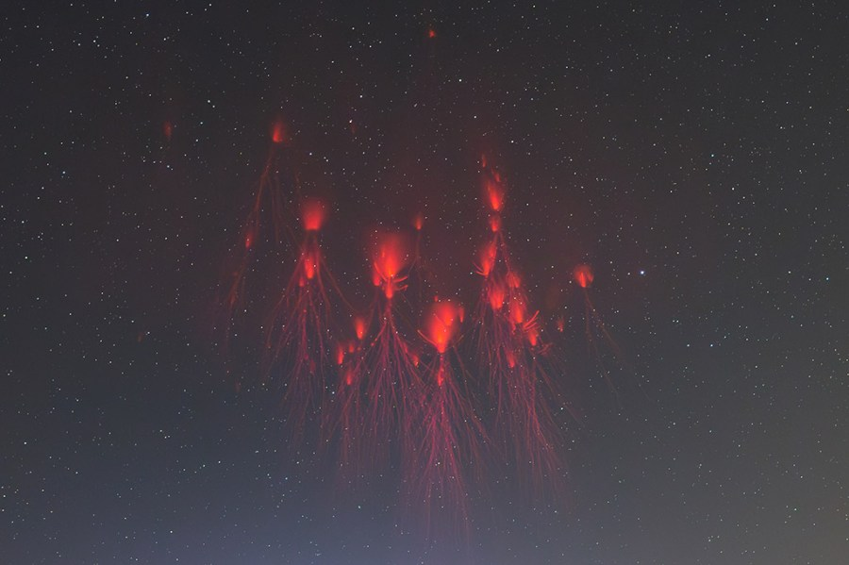
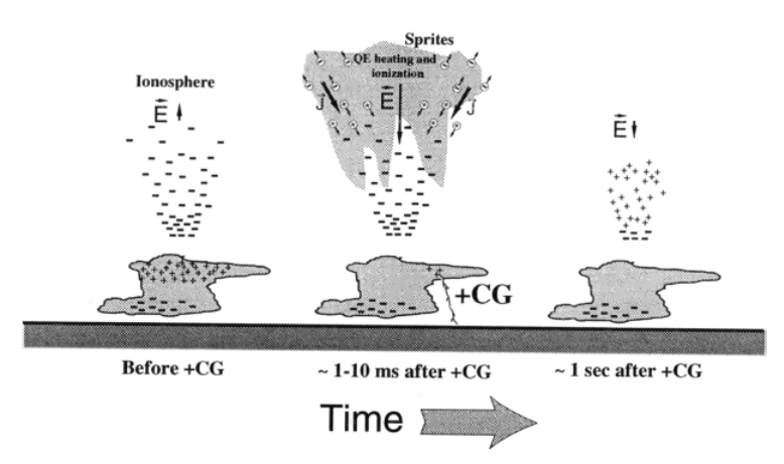
Moving on, there are many types of TLEs, as seen in Figure 1, but the most discussed are sprites, blue jets, and the Emission of Light and Very Low Frequency Perturbations From Electro-magnetic Pulse Sources (ELVES). Sprites appear above thunderstorms, sometimes in clusters, with their tops appearing red and shifting to blue at lower altitudes, as seen in Figure 2. Spanning 50 to 90 km in altitude and lasting only several milliseconds, sprites are associated with +CG, usually appearing a few milliseconds after a strike. A temporary electric field is created from the remaining charges, heating up electrons to create sprites, as seen in Figure 3 (Pasko et al. 1997). However, it is important to note that sprites are not produced by all thunderstorms, even ones with many +CG strikes (Lyons et al. 2003). Sprites were first videotaped accidentally in 1989 and later confirmed using video cameras on several NASA Space Shuttle missions (Boeck et al. 1998).
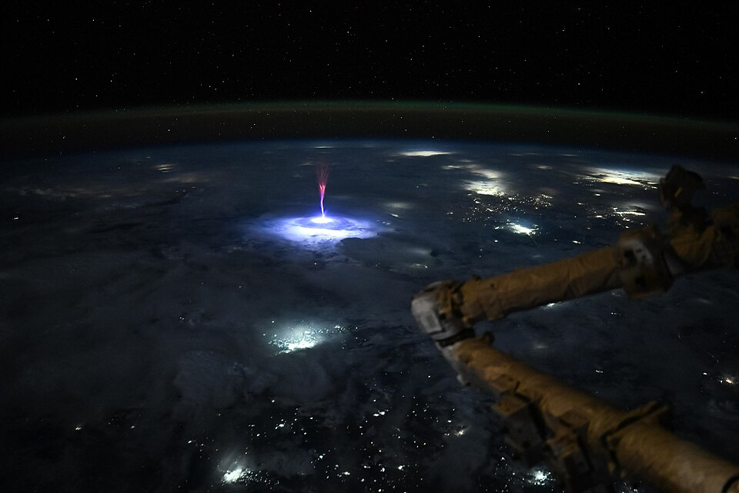
A second type of TLE, blue jets, propagate upwards from active thunderstorms at more than 100,000 m/s and can reach heights of up to 40 km or more. They last 100-200 milliseconds and unlike sprites aren’t associated with a specific CG (Lyons et al. 2003). The existence of blue jets was confirmed during the summer of 1994 when two aircrafts captured the jets on camera during an active thunderstorm (Boeck et al. 1998). There are 2 other types of jets: blue starters are jets that make it only a few kilometers from the top a thundercloud, while gigantic jets begin as discharge between the mid and upper levels of a cloud, continuing to propagate upwards, reaching around 70 km in height, as seen in Figure 4 (Siingh et al. 2012).
Finally, ELVES are an outwardly expanding donut-shaped region between 80 to 100 km in altitude that appears above thunderstorms (Boeck et al. 1998; Lyons et al. 2003). They are the result of a powerful lightning discharge current, positive or negative, that creates an electromagnetic pulse which heats up the atmosphere (Siingh et al. 2012). ELVES are so brief at less than 0.5 milliseconds that they are not visible to the human eye and are difficult to capture even with a camera (Lyons et al. 2003).
Overall, TLEs are fascinating split-second events that remind us just how beautiful, dangerous, and electrifying nature can be. So, the next time you find yourself thinking about a fairytale, try looking above a thunderstorm for sprites, blue jets, or ELVES.
References
Ayers, Nichole. 2025. Photograph. X. https://x.com/Astro_Vapor/status/1940810789830451563.
Boeck, William L., Otha H. Vaughan Jr., R.J. Blakeslee, Bernard Vonnegut, and Marx Brook. 1998. “The role of the space shuttle videotapes in the discovery of sprites, jets and elves.” Journal of Atmospheric and Solar-Terrestrial Physics 60 (7-9): 669-677. https://doi.org/10.1016/S1364-6826(98)00025-X.
Lyons, Walter A., Russell A. Armstrong, E. A. Bering III, and Earle R. Williams. 2000. Photograph. Eos, Transactions American Geophysical Union 81 (33): 373-377. https://doi.org/10.1029/00EO00278.
Lyons, Walter A., Thomas E. Nelson, Russell A. Armstrong, Victor P. Pasko, and Mark A. Stanley. 2003. “Upward Electrical Discharges From Thunderstorm Tops.” Bulletin of the American Meteorological Society 84 (4): 445-454. https://doi.org/10.1175/BAMS-84-4-445.
National Oceanic and Atmospheric Administration. Last modified 2023. “The Positive and Negative Side of Lightning.” https://www.noaa.gov/jetstream/lightning/positive-and-negative-side-of-lightning.
Pasko, V. P., U. S. Inan, T. F. Bell, and Y. N. Taranenko. 1997. “Sprites produced by quasi-electrostatic heating and ionization in the lower ionosphere.” Journal of Geophysical Research 102 (3): 4529-4561. https://doi.org/10.1029/96JA03528.
Siingh, Devendraa, R. P. Singh, Ashkok K. Singh, Sanjay Kumar, M. N. Kulkarni, and Abhay K. Singh. 2012. “Discharges in the Stratosphere and Mesosphere.” Space Science Reviews 169: 73-121. https://doi.org/10.1007/s11214-012-9906-0.
Wang, Xin. 2024. “Sprites Dancing in the Dark Night.” Photograph. Amateur Photographer. https://amateurphotographer.com/latest/photo-news/red-sprite-lightning-wins-top-weather-photography-competition/.
Comments
9 Responses to “Sprites, Blue Jets, and ELVES: Are We Talking Thunderstorms or Fairytales?”
Hey iSci!
I came about this topic after learning about the magnetic pole reversals in the Earth Science lectures, which led me to research more about Earth’s magnetic field and thunderstorms, where I kept seeing the word “sprite” pop up.
Hope you enjoy reading and I look forward to any comments!
Cheron
Hello Cheron,
This was a very interesting read! I found it fascinating to learn more about thunderstorms (one of my favourite weather phenomena). I just have a few suggestions for your final draft:
1. I think that instead of utilizing a rhetorical question, you could state instead: “…Although this sounds made up, what was likely seen was Transient Luminous Events (TLEs)…”. You could also remove the ending, which states, “despite their fantastical names, are as real as you and me”, as you risk running over the word count and sacrificing conciseness.
2. Make sure to centre your figure captions.
3. I would suggest adding a comma in between “themselves” and “we”, within your first sentence of paragraph two.
Overall, this was a very interesting blog post! I look forward to reading the finished version.
Happy editing,
Grifin Suk 🙂
Hello Griffin,
Thanks for replying to my post, I have edited it according to your suggestions!
Hi Cheron!
I find this blog post really cool and the title is great. The post is very descriptive and the figures that you included are helpful and interesting. Here a couple of minor grammar edits that you can make:
P2S1: “Before getting into TLEs themselves we first must discuss positive and negative lightning” There should be a comma after “themselves” because the dependent clause comes first.
P5: I think that adding more of an explanation about how “Electro-magnetic Pulse Sources (ELVES)” connects to what we learned in Earth science about magnetic field/magnetic field reversals could help make it easier to understand. (ex. More about what causes them to appear above thunderstorms?)
Overall, this was a fascinating read and a cool concept!
Best,
Puneet
Hi Puneet,
Thanks for your comments on my blog post! I have changed the grammar in P2S1, and for your comment regarding the ELVES, I think my comment explaining where I came up with the topic may have been a bit misleading, but Earth’s magnetic field/field reversals aren’t directly related to the creation of thunderstorms or ELVES (please correct me if this is not what you meant). Instead, ELVES are created by an electromagnetic pulse from a lightning strike, and this is what heats up the atmosphere to create the phenomenon.
To clarify my comment as to where this topic came from, while researching about Earth’s magnetic field, I found that some thunderstorms can actually launch beams of electrons and positrons into space, and these are influenced by Earth’s magnetic field (this was originally going to be my topic). However, as I kept researching, sprites and jets kept popping up, which peaked my curiosity and eventually became my final topic.
Hopefully this clarified some things, but please let me know if I have interpreted your comment incorrectly. Thanks again for your comment!
Hi Cheron,
I really like your blog post, and I’ll be sure to look at thunderstorms when “thinking about a fairytale.” Here are my suggestions:
– To make sure you won’t go over the word limit, there are some sentences that could be more concise. For example, in Figure 1, instead of saying “the altitudes at which they happen at,” you could simply say, “Figure 1: A depiction of various TLE events and their altitudes.”
– In P4S3: You could also say, “The existence of blue jets was confirmed during the summer of 1994 when two aircrafts captured the jets on camera during an active thunderstorm,” for a more concise sentence.
Great work, Cheron, and I look forward to reading your final draft.
Sophia
Hi Sophia,
Thanks for your suggestions, I have implemented them!
Hey Cheron!
Overall, this was a fascinating, informative post! I just have a few minor suggestions.
P1: In your opening paragraph, I might suggest getting rid of the rhetorical question(s), and instead saying something like “Although this may seem fantastical, they were likely a kind of lightning-related phenomena called Transient Luminous Events (TLEs).” Up to you!
P2S1: I would suggest, “In order to understand TLEs themselves, we must first differentiate between positive and negative lightning.” It sounds a bit more professional.
P2S3: This sentence is a bit long, I might suggest splitting it up like this, “Comparatively, positive lightning originate in the upper parts of a thunderstorm, and make up less than 5% of strikes. Despite their rarity, positive strikes have the potential to be up to 10 times greater in peak charge and electrical potential, as they must burn through more air before reaching the ground.”
P5S1: This is the first time you use the full name of “ELVES”, despite having used this acronym many times in the text prior. I would suggest doing the inverse, using the full name and having the acronym in parentheses, and continuing to use the acronym from then on.
Once again, this was a very interesting post! I look forward to reading the final draft.
– Ruby
Hey Ruby,
Thank you for your comments, I have changed my post to reflect your suggestions!