Naoero is a small island country in the middle of the Southern Pacific ocean, spanning only twenty-one square kilometers, atop a raised coral atoll. Most notably, the country of only 6,000 people leads a legacy of once being one of the countries with the highest GDP in the world, all as a result of a singular export; bird poop (Storr 2020). The island served as a resting place for around 25 species of birds, which over millenia, caused their excrement to then mineralize into a very potent fertilizer, called guano (Buden 2008; Freestone 2025).
Guano is a naturally-occuring compound, resulting from the decay of feces over time, resulting in it having a high concentration of minerals, such as phosphates (Pi), and secondary sulfites (Audra et al. 2021; Browning et al. 2023). Guano plays an important role as a fertilizer for plants, due to the high concentration of Pi. Pi is an essential nutrient for various metabolic compounds, and insufficient Pi within the soil can affect fruit production, quality traits during vegetative growth and root development, leading to reduced crop yield (Khan et al. 2023). Once Nauru declared independence in 1967, the country was able to increase the price on the coveted substance. As a result, this small island nation became almost completely extracted from the guano which once made it so rich, leaving behind only pillars (Figure 1; Figure 2) (Gale 2019).
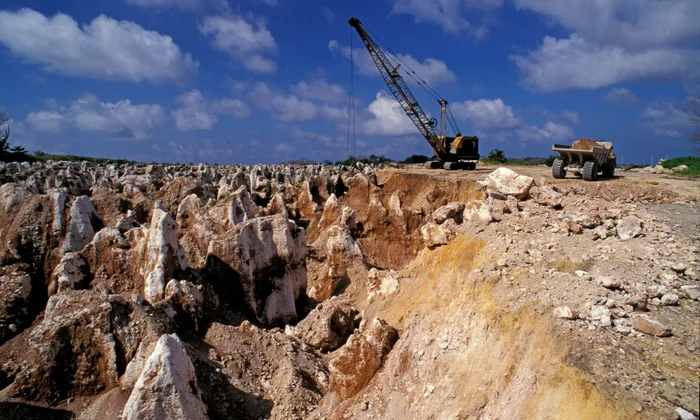
Figure 1: The mined-out guano/phosphate lands of Nauru (A) immediately prior to independence on July 1st, 1967, and (B) in 1998, by which time most of the phosphate reserves had been depleted. The legend at the bottom right-hand corner of Figure (A), shows just how small the island is, with one bar representing 1000 meters (Gale 2019).
Figure 2: A former mining site in Nauru, now exhausted, only with limestone pinnacles still present (Davies and Doherty 2018).
Although Nauru is only a small island in the Pacific Ocean, the end result displays the lengths that humans will go to in order to secure a profit regarding natural resources. When looking at various other situations that are analogous to this one, such as the environmental degradation of the Aral Sea, or the reliance of petroleum from various oil states, a common theme emerges (Want et al. 2020). Having resources means the country may often focus on immediate economic prosperity, rather than long-term sustainability. In Nauru’s case, the extraction of its phosphate deposits resulted in the country facing economic hardship after it ran out, with the barren, limestone pinnacles, serving as tombstones marking a once prosperous past.
References
Audra, Philippe, Vasile Heresanu, Lionel Barriquand, et al. “Bat Guano Minerals and Mineralization Processes in Chameau Cave, Eastern Morocco.” International Journal of Speleology 50, no. 1 (2021): 91–109. https://doi.org/10.5038/1827-806X.50.1.2374.
Browning, Thomas J., Ali A. Al-Hashem, Eric P. Achterberg, et al. “The Role of Seabird Guano in Maintaining North Atlantic Summertime Productivity.” Science of The Total Environment 897 (November 2023): 165309. https://doi.org/10.1016/j.scitotenv.2023.165309.
Buden, Donald W. “The Birds of Nauru.” Notornis 55, no. 1 (2008): 8. https://doi.org/10.63172/767667oadncj.
Davies, Anne, and Ben Doherty. Corruption, Incompetence and a Musical: Nauru’s Cursed History. September 3, 2018. https://www.theguardian.com/world/2018/sep/04/corruption-incompetence-and-a-musical-naurus-riches-to-rags-tale.
Freestone, Elizabeth. “Guano Dollar and Musical Theatre Hubris: A Cautionary Tale.” Green Letters 29, no. 3 (2025): 281–93. https://doi.org/10.1080/14688417.2025.2564345.
Gale, S. J. “Lies and Misdemeanours: Nauru, Phosphate and Global Geopolitics.” The Extractive Industries and Society 6, no. 3 (2019): 737–46. https://doi.org/10.1016/j.exis.2019.03.003.
“International Status, Imperial Form: Nauru and the Histories of International Law.” In International Status in the Shadow of Empire, 1st ed., by Cait Storr. Cambridge University Press, 2020. https://doi.org/10.1017/9781108682602.002.
Khan, Fahad, Abu Bakar Siddique, Sergey Shabala, Meixue Zhou, and Chenchen Zhao. “Phosphorus Plays Key Roles in Regulating Plants’ Physiological Responses to Abiotic Stresses.” Plants 12, no. 15 (2023): 2861. https://doi.org/10.3390/plants12152861.
Wang, Xuanxuan, Yaning Chen, Zhi Li, Gonghuan Fang, Fei Wang, and Haijun Liu. “The Impact of Climate Change and Human Activities on the Aral Sea Basin over the Past 50 Years.” Atmospheric Research 245 (November 2020): 105125. https://doi.org/10.1016/j.atmosres.2020.105125.


Leave a Reply
You must be logged in to post a comment.