Among the different psychological responses to climate change, one that is often overlooked is climate denial, since it can be easy to dismiss these individuals given the overwhelming scientific evidence presented to us that suggests otherwise. However, have we ever stopped to consider where and why this psychological response actually stems from? And how can climate denial spread?
To begin, climate denial is a form of science denial, where individuals reject or understate scientific evidence and anthropogenic impacts surrounding climate change (Calvin et al. 2023). There are different forms of climate denial, such as trend denial, impact denial, or attribution denial; however, they all converge on one key factor: denial of scientific evidence (Bohr 2022). There have been many suggested explanations, such as a lack of knowledge, science distrust, media distrust or the mass spread of science misinformation (Kovaka 2021). Often, individuals may believe information provided to them without further research or understanding of the topic.
Where does this science misinformation come from? Well, it turns out that large corporations may be the ones to blame. Various corporations have been called out for hiding information from the public or pushing negative connotations onto society for their own personal gain. These corporations include the fossil fuel industry, trade associations, conservative philanthropists and others that aid the climate denial narrative through research reports, newsletters, podcasts and social media posts (Bohr 2022). A prominent example is ExxonMobil, one of the largest multinational oil, gas, and petrochemical corporations within the fossil fuel industry. ExxonMobil’s private scientific knowledge was compared to the projections it displayed in public messaging, and it was concluded that its internal, peer-reviewed climate projections closely matched other independent academic models depicting global climate warming. However, company leaders made contradictory public claims that climate science and models were too uncertain to rely on, directly contradicting information that they found (Figure 1) (Supran et al. 2023).
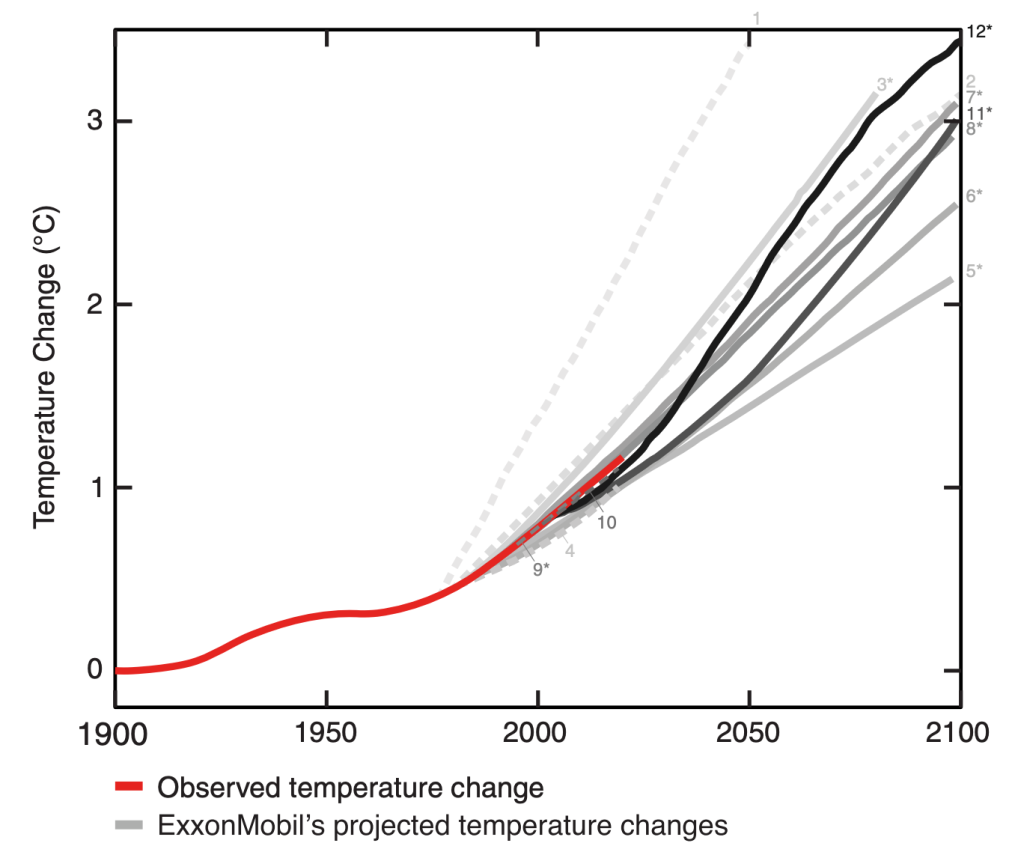
In conclusion, the spread of climate misinformation can play a role in influencing climate denial, which can have consequential impacts on climate action. Given the urgency of climate change, climate denialism can impact climate policy, reduce climate literacy and impact how climate scientists work and communicate with the public (McLean 2023). Understanding where climate misinformation originates and how it can be weaponized by various corporations can help explain where climate denial may be stemming from in relation to the spread of misinformation. Ultimately, confronting this disconnect between climate science and public doubt is essential to support climate action.
References
Bohr, Jeremiah. 2022. “The Structure and Culture of Climate Change Denial – American Sociological Association.” American Sociological Association, November 28. https://www.asanet.org/footnotes-article/structure-and-culture-climate-change-denial/.
Calvin, Katherine, Dipak Dasgupta, Gerhard Krinner, et al. 2023. IPCC, 2023: Climate Change 2023: Synthesis Report. Contribution of Working Groups I, II and III to the Sixth Assessment Report of the Intergovernmental Panel on Climate Change [Core Writing Team, H. Lee and J. Romero (Eds.)]. IPCC, Geneva, Switzerland. First. Edited by Paola Arias, Mercedes Bustamante, Ismail Elgizouli, et al. With Hoesung Lee. Intergovernmental Panel on Climate Change (IPCC). https://doi.org/10.59327/IPCC/AR6-9789291691647.
Kovaka, Karen. 2021. “Climate Change Denial and Beliefs about Science.” Synthese 198 (3): 2355–74. https://doi.org/10.1007/s11229-019-02210-z.
McLean, Angela. 2023. “What Impact Do Climate Change Misinformation and Disinformation Have? HTML.” GOV.UK, June. https://www.gov.uk/government/publications/climate-change-misinformation-impacts/what-impact-do-climate-change-misinformation-and-disinformation-have-html.
Supran, G., S. Rahmstorf, and N. Oreskes. 2023. “Assessing ExxonMobil’s Global Warming Projections.” Science 379 (6628). https://doi.org/10.1126/science.abk0063.


Leave a Reply
You must be logged in to post a comment.