The spruce budworm (Choristoneura fumiferana) is the most widespread and damaging native defoliator of coniferous trees in North America (Nealis, 2016). This endemic Lepidopteran poses a significant ecological and economic threat to the boreal forest. The last major outbreak in eastern Canada during the 1970s defoliated 52 million hectares (Kettela 1983). Outbreaks occur approximately every 35 years and often persist for more than a decade (Nealis, 2016). Defoliation can reduce tree growth by 90% and cause mortality rates of up to 85% in its preferred host, balsam fir (Abies balsamea), although spruce budworm also feeds on white spruce (Picea glauca) and other economically important species (MacLean et al. 2019).
Reducing the impact of spruce budworm outbreaks is therefore an important economic and ecological undertaking. Although disturbances such as forest fires and spruce budworm outbreaks play critical roles in shaping forest productivity and ecosystem dynamics, their intensity can sometimes justify human intervention (Johns et al. 2019). Approaches to managing spruce budworm can be categorized into reactive plant protection and proactive population control.
Historically, reactive plant protection relied on powerful, broad-spectrum insecticides such as DDT (dichlorodiphenyltrichloroethane) applied through aerial spraying (Webb, 1952). Although these efforts caused high larval mortality, they failed to stop expanding outbreaks (Johns et al. 2019). Following the banning of DDT, management shifted toward more targeted insecticides such as Bacillus thuringiensis kurstaki (Btk), which is a soil bacterium that produces a proteinaceous crystal specifically toxic to Lepidoptera (Van Frankenhuyzen 1990). Rather than treating entire regions with broad-spectrum insecticides, these strategies focused on using Btk on high-value spruce-fir stands experiencing sustained moderate defoliation and high budworm densities (Fuentealba et al. 2019).
A recent outbreak in Quebec and New Brunswick provided an opportunity to test proactive population control. Between 2014 and 2017, spruce budworm spread from Quebec into New Brunswick. An uncontrolled outbreak was predicted to cause $25–30 billion in economic losses (Liu et al. 2022). New Brunswick responded with targeted interventions based on the concept of double-equilibrium dynamics: adding mortality in strategically important areas could prevent populations from reaching the higher equilibrium associated with full-scale outbreaks (Johns et al. 2019). This approach relies on intensive monitoring and sampling to track populations and allow rapid, targeted spraying (MacLean et al., 2019). The results of the proactive management strongly suggest the strategy worked with only 2500 ha of defoliation detected in New Brunswick compared to 2,728,000 ha defoliated in neighbouring Quebec.
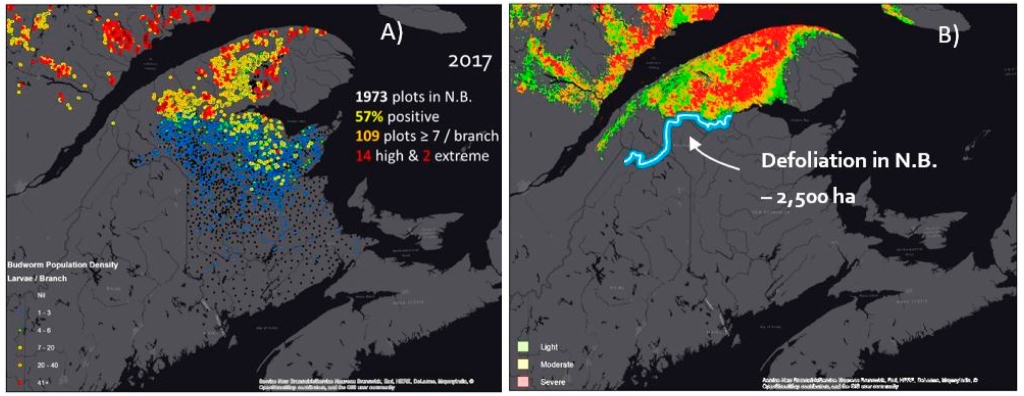
Figure 1: Two maps which show the result of four years of proactive population control spraying of Btk in New Brunswick. Map A shows spruce budworm larval density in 2017, and map B shows defoliation severity. The blue line in map B shows the border between Quebec and New Brunswick and highlights the efficacy of population control. In 2017, New Brunswick had 2,500 ha of defoliation, while the neighbouring portion of Quebec (which did not use population control) had 2,728,000 ha of defoliation (MacLean et al. 2019).
Climate change further complicates management. Population models in Ontario predict that warming temperatures will allow outbreaks to emerge farther north in the boreal forest, where roads, airports, and other management infrastructure are limited (Candau and Fleming 2011). A major outbreak could also release an estimated 2.21 million tonnes of CO₂ from dead and dying trees, equivalent to emissions from approximately 466,000 passenger vehicles (MacLean et al., 2019).
Spruce budworm management lies at the intersection of biology, ecology, economics, and public policy. Current evidence suggests that data-driven, proactive population control may provide an effective means of balancing natural ecosystem processes with the protection of economically important forest resources.
References:
Candau, Jean-Noël, and Richard A. Fleming. 2011. “Forecasting the Response of Spruce Budworm Defoliation to Climate Change in Ontario.” Canadian Journal of Forest Research 41 (10): 1948–60. https://doi.org/10.1139/x11-134.
Fuentealba, Alvaro, Alain Dupont, Christian Hébert, Richard Berthiaume, Roberto Quezada-García, and Éric Bauce. 2019. “Comparing the Efficacy of Various Aerial Spraying Scenarios Using Bacillus Thuringiensis to Protect Trees from Spruce Budworm Defoliation.” Forest Ecology and Management 432 (January): 1013–21. https://doi.org/10.1016/j.foreco.2018.10.034.
Johns, Robert C., Joseph J. Bowden, Drew R. Carleton, et al. 2019. “A Conceptual Framework for the Spruce Budworm Early Intervention Strategy: Can Outbreaks Be Stopped?” Forests 10 (10): 910. https://doi.org/10.3390/f10100910.
Kettela, E. G. 1983. A Cartographic History of Spruce Budworm Defoliation from 1967 to 1981 in Eastern North America. Information Report, Rapport d’information, DPC-X-14. Canadian Forestry Service, Environment Canada.
Liu, Zelin, Changhui Peng, David A. MacLean, Louis De Grandpré, Jean-Noël Candau, and Daniel Kneeshaw. 2022. “Evaluating and Quantifying the Effect of Various Spruce Budworm Intervention Strategies on Forest Carbon Dynamics in Atlantic Canada.” Forest Ecosystems 9: 100052. https://doi.org/10.1016/j.fecs.2022.100052.
MacLean, David A., Peter Amirault, Luke Amos-Binks, et al. 2019. “Positive Results of an Early Intervention Strategy to Suppress a Spruce Budworm Outbreak after Five Years of Trials.” Forests 10 (5): 448. https://doi.org/10.3390/f10050448.
Nealis, V. G. 2016. “Comparative Ecology of Conifer-Feeding Spruce Budworms (Lepidoptera: Tortricidae).” The Canadian Entomologist 148 (S1): S33–57. https://doi.org/10.4039/tce.2015.15.
Van Frankenhuyzen, K. 1990. “Development and Current Status of Bacillus Thuringiensis for Control of Defoliating Forest Insects.” The Forestry Chronicle 66 (5): 498–507. https://doi.org/10.5558/tfc66498-5.
Webb, F. E. 1955. “BIOLOGICAL ASSESSMENT OF AERIAL FOREST SPRAYING AGAINST THE SPRUCE BUDWORM IN NEW BRUNSWICK: 1. TIMING OF OPERATIONS 1952-54.” The Forestry Chronicle 31 (4): 342–52. https://doi.org/10.5558/tfc31342-4.

Leave a Reply
You must be logged in to post a comment.